
Heron Maiden
鷺娘
- Date:
- early 20th century (1900–1930)
- Medium:
- Color woodblock print; ōban
- Source:
- Art Institute of Chicago
Description
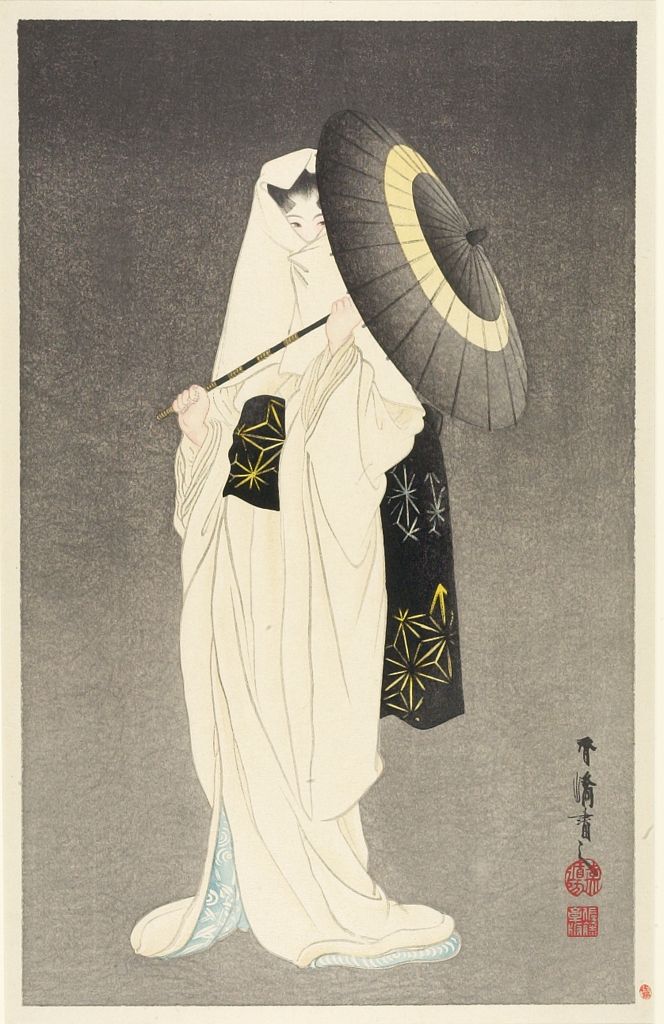
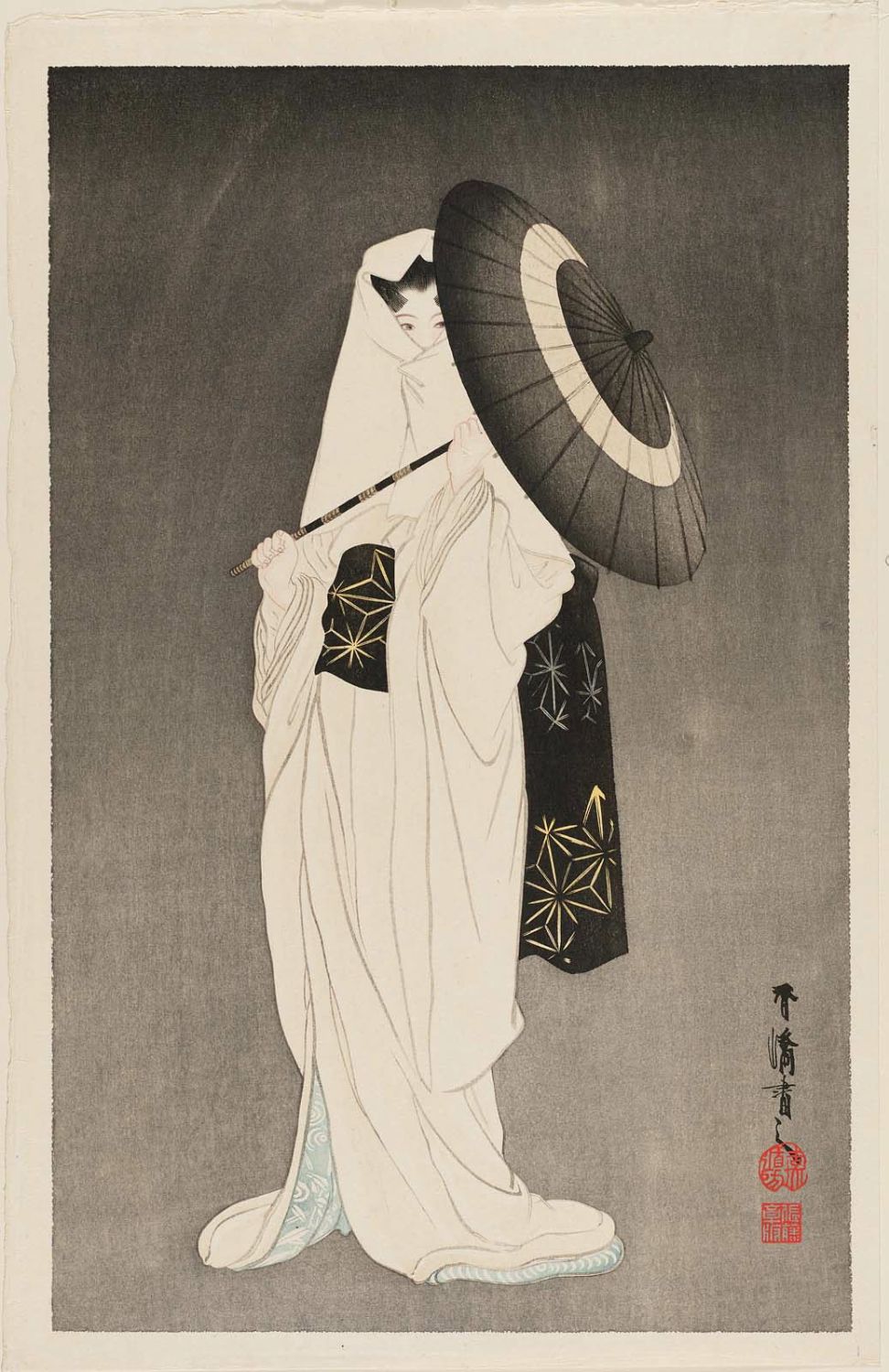
Heron Maiden (Sagi musume, 鷺娘) is a color woodblock print in the ōban format by Taniguchi Kōkyō, held by the Art Institute of Chicago (1957.587) and dating from the early twentieth century. The subject is one of the most famous dance pieces of the kabuki repertoire: the Sagi musume, first staged in 1762, in which a young woman appears in white robes against a snowy ground and reveals herself, through a series of costume changes, to be the spirit of a white heron whose feelings transform her into a human form before her unrequited love drives her back into bird-form torment. Kōkyō's composition takes the iconic moment of the dance — the heron-maiden in pure white kimono and bare head, the long sweep of her hair, her body turned slightly off the picture axis — and isolates the figure against a near-empty ground, in the Kyoto Shijō habit of generous negative space he had absorbed from his teachers Suzuki Hyakunen and Kōno Bairei. The print displays the technical refinement that the late-Meiji and Taishō Kyoto block-printing trade had developed: subtle bokashi gradations across the snow-white robe, fine line work on the hair and facial features, and the kind of restrained gauffrage (blind embossing) that distinguishes high-end editions of these prints. The Sagi musume subject was a favorite of Kōkyō's, and impressions of his various compositions on this theme survive in the Art Institute of Chicago, the Museum of Fine Arts in Boston, the Harvard Art Museums, and other major collections, making it the work for which he is today best known to collectors of Japanese prints.
More Prints by Taniguchi Kōkyō
More Birds & Flowers Prints
Frequently Asked Questions
Heron Maiden (鷺娘) was created by Taniguchi Kōkyō (谷口香嶠) in early 20th century (1900–1930).
Heron Maiden depicts birds & flowers.