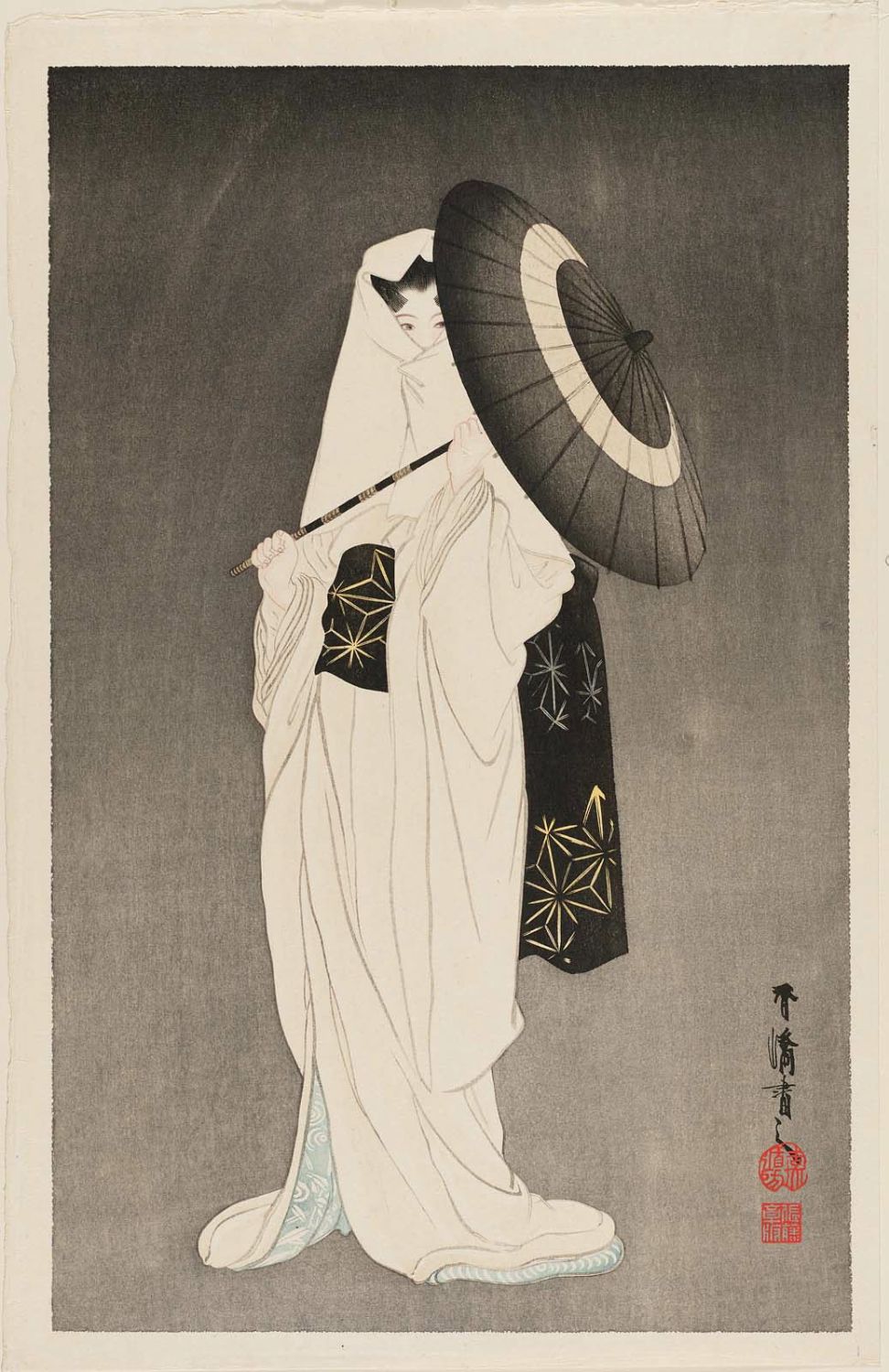
Heron Girl (Sagi musume)
鷺娘
- Date:
- Taishō era, 20th century
- Medium:
- Color woodblock print
Description
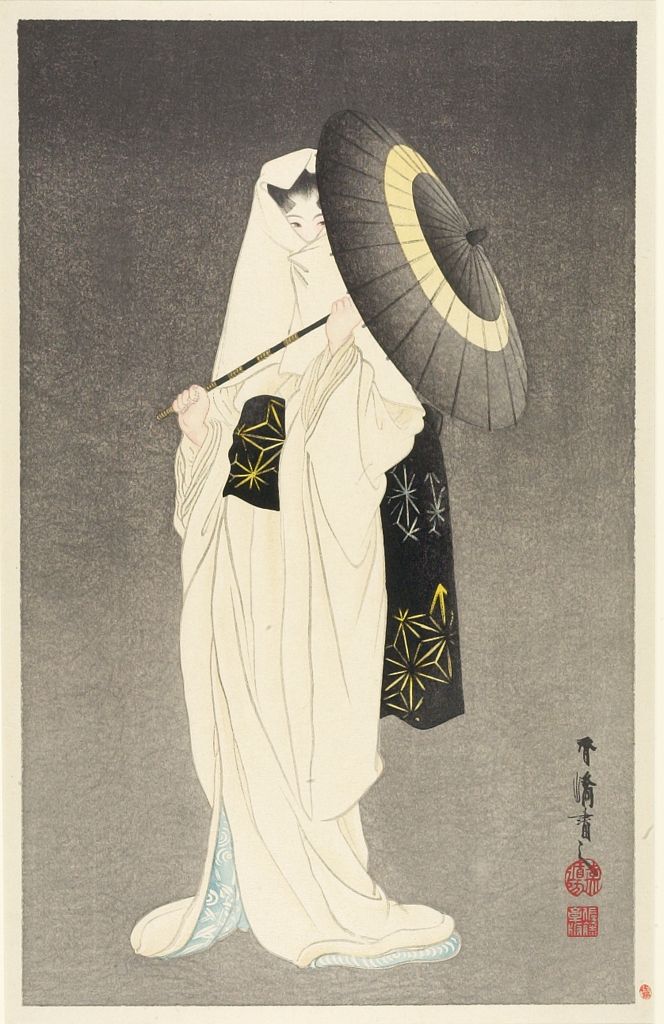
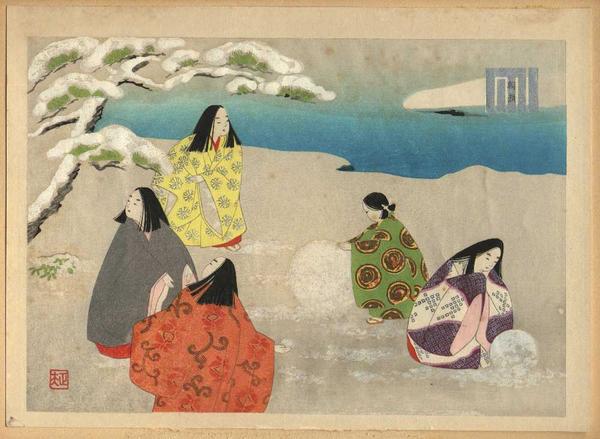
Heron Girl (Sagi musume, 鷺娘) is a color woodblock print by Taniguchi Kōkyō held by the Museum of Fine Arts in Boston (object 252249) and catalogued as Taishō-era, twentieth-century. The print continues the artist's preferred late-career subject: the heron-spirit of the eighteenth-century kabuki dance Sagi musume (first staged 1762), in which a young woman in white robes against a snowy ground reveals herself through a series of costume changes to be the spirit of a white heron tormented by unrequited love. Kōkyō isolates the figure against an indeterminate ground, with the kimono rendered in graduated white-on-white bokashi and the hair, eyes, and lips picked out in fine line, in the Kyoto Shijō habit of placing closely observed figures in generous negative space that he had absorbed from his teachers Suzuki Hyakunen and Kōno Bairei. The MFA's holdings of Meiji and Taishō Japanese prints — among the most comprehensive in the United States — include this Sagi musume alongside his other late prints, and the print supports comparison with the Heron Maiden of the Art Institute of Chicago and the Spirit of the Heron impressions held by the Harvard Art Museums to give a sense of how Kōkyō treated the subject across multiple compositions and editions. The print is preserved in the museum's deep ukiyo-e and Meiji-Taishō print holdings, which include some 37,000 Japanese prints catalogued for open-access viewing.
More Prints by Taniguchi Kōkyō

More Birds & Flowers Prints
Frequently Asked Questions
Heron Girl (Sagi musume) (鷺娘) was created by Taniguchi Kōkyō (谷口香嶠) in Taishō era, 20th century.
Heron Girl (Sagi musume) depicts birds & flowers and children.