
Biography
Hashimoto Kansetsu (1883–1945) was one of the most distinguished nihonga painters of the Taishō and early Shōwa periods, a leading figure of the Kyoto school whose work bridged the classical East Asian painting tradition and the modernizing impulses of early twentieth-century Japan. A pupil of Takeuchi Seihō, the great modernizer of the Maruyama-Shijō tradition, Kansetsu absorbed his teacher's commitment to disciplined sketching from life (shasei) and then pushed it in his own direction: toward Chinese-style literati subjects, toward animal painting of unusual psychological depth, and toward an austere, classically grounded vision of figure painting drawn from the Tang and Song masters he studied throughout his life. Working from his celebrated Kyoto studio-villa, Hakusasonsō, near Ginkaku-ji at the foot of Mount Daimonji, he became one of the most internationally minded of Kyoto's painters and one of the most committed exponents of the kanga (Chinese painting) current that gathered force in nihonga circles during the 1910s and 1920s.
Kansetsu was born in Kobe in 1883 into a family steeped in Chinese learning; his father, Hashimoto Kaikan (1852–1935), was a Confucian scholar and painter who gave his son an unusually rigorous classical education. From early childhood Kansetsu was trained in the reading of classical Chinese texts, in calligraphy, and in the basic vocabulary of literati painting (bunjinga). This grounding gave him a literary depth that would distinguish his later work from the more strictly observational practice of his Kyoto Shijō contemporaries: the historical and poetic subjects that recurred throughout his career — Chinese court figures, hermits and scholars, drinking poets, and Sino-Japanese Buddhist iconography — were not exotic borrowings but motifs he had encountered first as a student of the classics.
In 1903, at the age of twenty, Kansetsu entered Takeuchi Seihō's Kyoto painting school, the Chikujōkai, then the most important training ground in the city for a younger generation of nihonga painters. Seihō had recently returned from a year of European travel that reshaped his approach to animal and landscape painting, and from him Kansetsu absorbed the Maruyama-Shijō discipline of close observation, especially in animal painting, together with the conviction that nihonga must remain technically anchored in the brush traditions of East Asia even as it engaged with Western pictorial space and modern subjects.
Kansetsu exhibited at the government Bunten (Ministry of Education Exhibition) from his twenties, showing works such as Lingering Snow Outside Tieling Castle (1908) and the Bai Juyi–inspired Song of the Lute (also translated Ballad of the Lute, 1910), and he continued to exhibit at the Bunten and its successors, the Teiten and Shin-Bunten, through the 1920s and 1930s, joining the Teiten judging committee in 1919 and becoming one of the senior figures of the official exhibition system. In 1913 he made the first of what would eventually be more than sixty trips to China. These journeys were formative: he studied Chinese painting and scenery at first hand and returned with a deepened commitment to Chinese subject matter and the literati tradition. The China trips continued through the 1920s and 1930s and fed directly into the long series of Chinese-themed paintings that became his signature — Tang and Song historical figures, Chinese landscapes, and Buddhist arhats and bodhisattvas. Where Seihō had absorbed Europe and brought it back to Kyoto, Kansetsu absorbed China and brought it back as a vocabulary for nihonga at its most ambitious scale.
In 1921 Kansetsu also traveled to Europe, an experience that broadened his exposure to Western figure painting. The villa-studio he built near Ginkaku-ji at the foot of Mount Daimonji in Kyoto, the Hakusasonsō, was begun in 1916 and combined a working studio and residence with elaborate Japanese gardens, a large collection of Chinese and Japanese antiquities, and a salon that drew Kyoto's painters, writers, and connoisseurs. Hakusasonsō survives today as a memorial museum dedicated to his work.
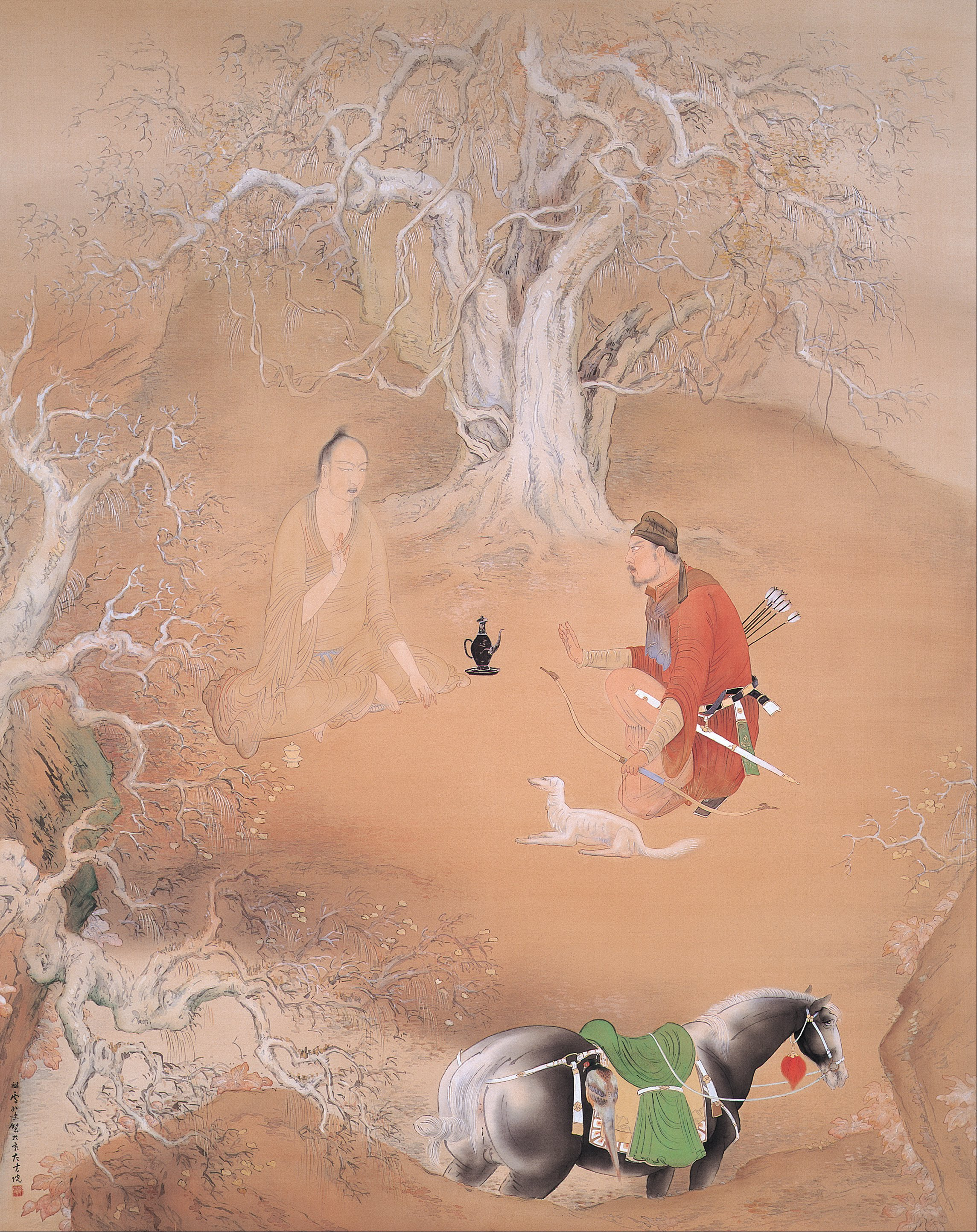
The core of Kansetsu's mature output falls into several overlapping bodies of work. The first is his suite of Chinese historical and literary subjects, exemplified by Song of the Lute (1910), based on Bai Juyi's famous Tang poem, and by the many hermits, scholars, poets, and arhats he drew from the Chinese narrative tradition. These works combine literati subject matter with a nihonga technique of ink and color on silk or paper at large scale, often on hanging scrolls or folding screens, and constitute one of the most sustained nihonga engagements with kanga subject matter in the twentieth century. The second body of work is his animal painting. Inherited from Seihō but pursued with a distinctive psychological seriousness, Kansetsu's animals — monkeys above all, as in Monkeys (1933) and Monkey in Frost (1939), but also deer, dogs, oxen, and birds — became one of the most admired strands of his career. His gibbons and old monkeys, painted from close observation, drew on the long Chan Buddhist tradition of monkey painting (the Song painter Muqi being a touchstone) while incorporating the careful anatomical study of his Maruyama-Shijō training. A third strand comprises landscape and seasonal painting in the broader Kyoto nihonga manner — quiet meditations on Japanese rural life and the seasonal motifs of classical poetry.
Kansetsu held senior positions in the Japanese art establishment in the last decade of his life. In 1934 he was appointed an Imperial Court Artist (Teishitsu Gigeiin), and in 1935 he became a member of the Imperial Art Academy (Teikoku Bijutsuin) upon the reorganization of the Teiten. He died at Hakusasonsō on 26 February 1945, at the age of sixty-one. His work is preserved above all at the Hakusasonsō memorial museum in Kyoto, which holds a large group of his paintings and sketches alongside the collection of Chinese antiquities he assembled, and he is now recognized as one of the most accomplished twentieth-century interpreters of the kanga tradition in the nihonga idiom.
Key Facts
- Active Period
- 1883–1945
- Nationality
- 🇯🇵Japan
- Movement
- Meiji/Taishō Prints
- Works Indexed
- 13
Frequently Asked Questions
Hashimoto Kansetsu (1883–1945) was one of the most distinguished nihonga painters of the Taishō and early Shōwa periods, a leading figure of the Kyoto school whose work bridged the classical East Asian painting tradition and the modernizing impulses of early twentieth-century Japan. A pupil of Takeuchi Seihō, the great modernizer of the Maruyama-Shijō tradition, Kansetsu absorbed his teacher's commitment to disciplined sketching from life (shasei) and then pushed it in his own direction: toward Chinese-style literati subjects, toward animal painting of unusual psychological depth, and toward an austere, classically grounded vision of figure painting drawn from the Tang and Song masters he studied throughout his life. Working from his celebrated Kyoto studio-villa, Hakusasonsō, near Ginkaku-ji at the foot of Mount Daimonji, he became one of the most internationally minded of Kyoto's painters and one of the most committed exponents of the kanga (Chinese painting) current that gathered force in nihonga circles during the 1910s and 1920s.
Hashimoto Kansetsu was active from 1883 to 1945. They were associated with the Meiji/Taishō Prints movement.
Hashimoto Kansetsu's work was shaped by the Meiji/Taishō Prints tradition in Japanese woodblock printmaking. Meiji/Taishō Prints: Meiji and Taishō era prints (1868–1926) bridge the transition from traditional ukiyo-e to the modern shin-hanga and sosaku-hanga movements.
Original prints by Hashimoto Kansetsu can be found in collections including University Art Museum, Tokyo University of the Arts, Kawamura Memorial DIC Museum of Art (via Google Arts & Culture / Wikimedia Commons), Honolulu Museum of Art, Adachi Museum of Art (via Google Arts & Culture / Wikimedia Commons).
Woodblock Prints by Hashimoto Kansetsu (13)
Spring Day
遅日
1913
Hanging scroll; ink and color on silk

Arhat Holding Pagoda
羅漢
1917
Hanging scroll; ink and color on paper

Mulan
木蘭
1918
Pair of six-panel folding screens; ink and color on silk

Sound of the Wind in the Pines (and Seven-Character Line Calligraphy)
松籟図
1918
Diptych of hanging scrolls; ink and light color on paper

Drunken Li Bai
酔李白
Taishō period, c. 1920s
Hanging scroll; ink on paper

Visiting a Hermit
訪隠図
1930
Hanging scroll; ink and color on silk

Gibbons
猿猴図
1933
Hanging scroll; ink and color on silk

Morning after Rain
雨後之朝
1937
Hanging scroll; ink and color on silk

Old Monkey with Cherry in Autumn
老猿桜秋
1938
Hanging scroll; ink and color on silk

Autumn Farm
秋圃
1939
Hanging scroll; ink and color on silk

Monkey
猿
1940
Hanging scroll; ink and color on silk

Dogs from Europe
欧州の犬
1941
Hanging scroll; ink and color on silk

Summer Evening
夏夕
1941
Hanging scroll; ink and color on silk