
Biography
Hatsuyama Shigeru (初山滋, 1897-1973) was one of the most beloved Japanese illustrators of the twentieth century, equally celebrated as a pioneering designer of children's books and magazines and as a serious sōsaku-hanga (creative print) artist. His career stretched across nearly seven decades and bridged two worlds that were often kept distinct in modern Japan — the commercial illustration trade that supplied the booming children's literature market of the late Meiji, Taishō, and Shōwa periods, and the small, self-organized world of independent printmakers who insisted on designing, carving, and printing each work themselves. The unusual coherence of Hatsuyama's career came from his ability to keep both practices in dialogue: his independent prints retained the warmth and clarity of editorial illustration, and his published illustrations were always made by an artist with a printmaker's understanding of color, shape, and the physical surface of paper.
Hatsuyama was born on July 10, 1897 in Asakusa, in the heart of old Edo-period Tokyo. He came of age in a city that was still alive with the visual culture of woodblock prints — kibyōshi yellow-cover books, theatre handbills, calendar prints — and his earliest formal training was firmly in this older tradition. At around the age of eight he briefly studied yamato-e painting under Araki Tanrei, a Kano-school painter active in the Yanaka neighborhood. In 1907 he worked at a workshop in Kanda-Imagawabashi painting decorative kimono patterns, an experience that gave him an early familiarity with flat color, repeat motif, and the relationship between line and ground. In 1911, at fourteen, he entered the studio of Ikawa Sengai, a Japanese-style painter known for his bijinga (images of beautiful women), and remained Sengai's pupil through his formative years.
His turn toward illustration came in the late 1910s, as the Japanese publishing industry began to invest heavily in magazines for children. In 1919 he began providing cover illustrations for the children's magazine Otogi no Sekai (Fairy World), continuing until the magazine ceased publication in October 1923. He went on to become one of the central illustrators of Kodomo no Kuni (Land of Children), the influential children's magazine that appeared throughout the 1920s and 1930s and provided a forum for many of Japan's most important modern illustrators. Hatsuyama's editorial style — flat color, gently caricatured figures, and a deeply sympathetic treatment of childhood — set him apart from contemporaries who worked in a more openly decorative or sentimentalized mode. His Asakusa upbringing left him at ease with both folk and high-cultural sources, and he drew freely from yamato-e, ukiyo-e, and Japanese folk toys, recombining their motifs in inventive ways.
The gradual militarization of Japanese society from the mid-1930s posed a dilemma for many illustrators of children's literature. Hatsuyama, by his own account, objected to the production of propaganda imagery for young readers; rather than retool his idiom for nationalist publications, he stepped back from much of his commercial work and turned his energies increasingly toward independent printmaking. This decision aligned him with the sōsaku-hanga (creative print) movement, whose leaders — most importantly Onchi Kōshirō — insisted that the artist personally design, carve, and print each work, making the woodblock a vehicle for individual expression rather than commercial reproduction. In 1939, when Onchi founded the Ichimokukai (First Thursday Society), Hatsuyama became one of its early members, attending the group's regular meetings in Tokyo to discuss work in progress, exchange impressions, and sustain a community of independent printmakers through the difficult years of the early 1940s. In 1944 he was admitted to the Nihon Hanga Kyōkai (Japan Print Association), the principal national organization of sōsaku-hanga artists. By the time the war ended, Hatsuyama had effectively remade himself as an independent printmaker.
His postwar output, beginning in the late 1940s and continuing into the early 1970s, ranges from gentle kachō-e (bird-and-flower) prints to abstracted children's subjects and images of toys and games. Series of related prints — sometimes lettered, sometimes numbered — recur throughout his catalogue. His technique, while always tightly disciplined, remained loose enough to accommodate strong color, occasional textural play, and an unselfconscious warmth that distinguishes his work from the more austere abstraction of some of his Ichimokukai peers. The result is a body of postwar prints that reads as the work of an artist who never lost his love of children's imagery and never doubted that it could carry serious adult content.
Hatsuyama's prints are now held in major collections internationally, including the Art Institute of Chicago, the Cleveland Museum of Art, the British Museum, and the National Museum of Modern Art in Tokyo. He died in 1973, leaving behind a substantial body of illustrated books, magazine covers, and independent prints. For historians of modern Japanese visual culture, his career is a particularly instructive case study in how an editorial illustrator could move into the world of sōsaku-hanga without abandoning the values that had animated his earlier work; for collectors of mid-twentieth-century Japanese prints, he remains one of the warmest and most distinctive voices in a movement otherwise known for its formal experimentation.
Key Facts
- Active Period
- 1897–1973
- Nationality
- 🇯🇵Japan
- Movement
- Sōsaku-hanga
- Subjects
- Birds & FlowersChildrenRain
- Works Indexed
- 14
Frequently Asked Questions
Hatsuyama Shigeru (初山滋, 1897-1973) was one of the most beloved Japanese illustrators of the twentieth century, equally celebrated as a pioneering designer of children's books and magazines and as a serious sōsaku-hanga (creative print) artist. His career stretched across nearly seven decades and bridged two worlds that were often kept distinct in modern Japan — the commercial illustration trade that supplied the booming children's literature market of the late Meiji, Taishō, and Shōwa periods, and the small, self-organized world of independent printmakers who insisted on designing, carving, and printing each work themselves. The unusual coherence of Hatsuyama's career came from his ability to keep both practices in dialogue: his independent prints retained the warmth and clarity of editorial illustration, and his published illustrations were always made by an artist with a printmaker's understanding of color, shape, and the physical surface of paper.
Hatsuyama Shigeru was active from 1897 to 1973. They were associated with the Sōsaku-hanga movement.
Hatsuyama Shigeru's work was shaped by the Sōsaku-hanga tradition in Japanese woodblock printmaking. Sōsaku-hanga: ## What is sōsaku-hanga? Sōsaku-hanga (創作版画, "creative prints") was a twentieth-century Japanese print movement defined by a single commitment: the artist must design, carve, and print every work alone.
Hatsuyama Shigeru's prints frequently feature birds & flowers, children, rain.
Original prints by Hatsuyama Shigeru can be found in collections including Harvard Art Museums, Art Institute of Chicago, Honolulu Museum of Art.
Woodblock Prints by Hatsuyama Shigeru (14)
Colts
1948
Color woodblock print

Flowers, Birds
1953
Color woodblock print

Three Children
20th century
Color woodblock print, edition 8/14

Nymphs (Birds and Flowers)
20th century
Color woodblock print
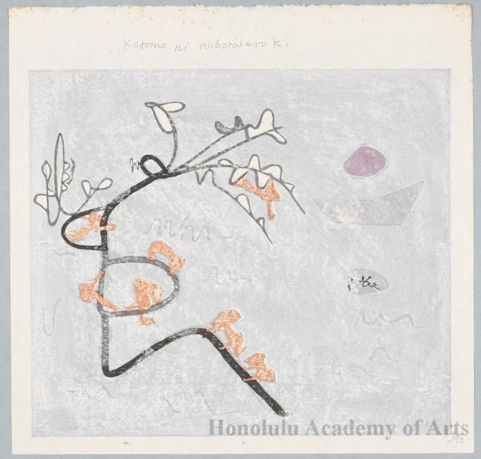
Tree That Children Can Climb (Kodomo ni noborareru ki)
子供に登られる木
c. 1955
Color woodblock print

Tea Party
c. 1950s
Color woodblock print
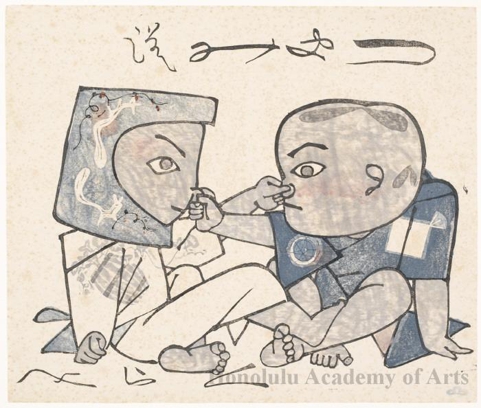
Contest in Pinching Noses
c. 1956
Color woodblock print

Plucking B
1959
Color woodblock print; edition 8/11

Rainbow #90
1959
Color woodcut print

Winter Birds in Floating Sleep (Ukine no fuyu dori)
浮き寝の冬鳥
1962
Color woodblock print; edition 12/13
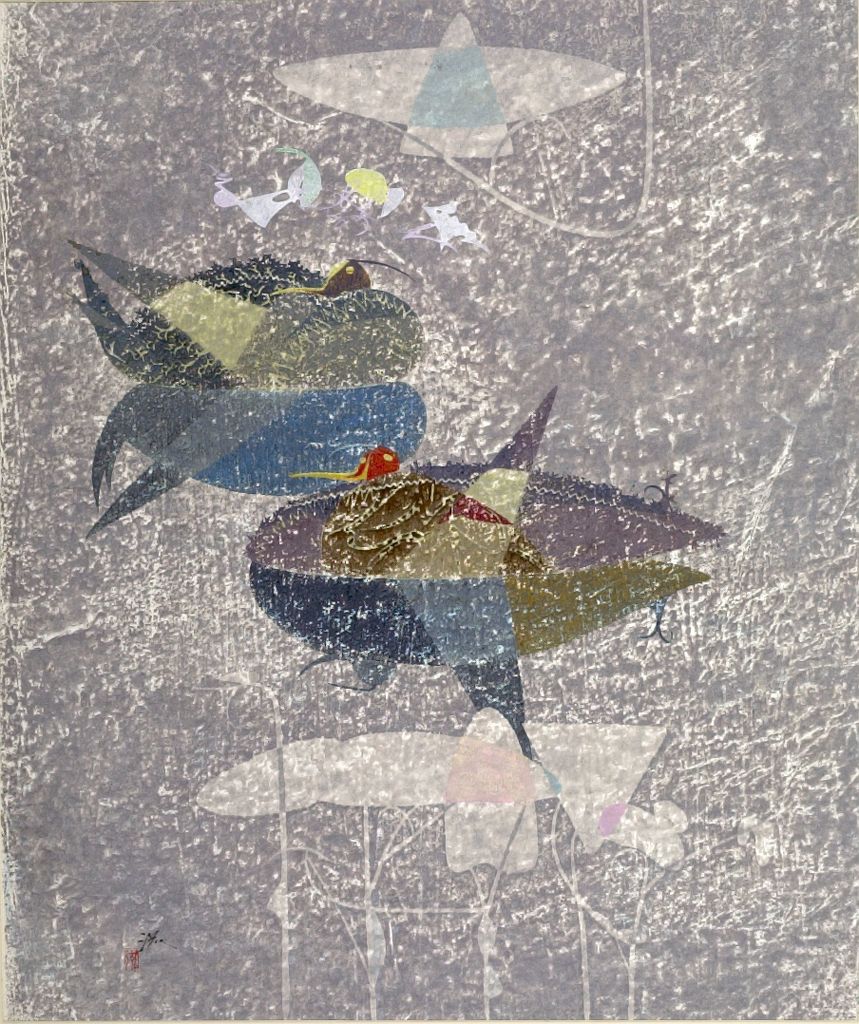
Floating Sleep - Winter Birds
浮き寝の冬鳥
1962
Color woodblock print
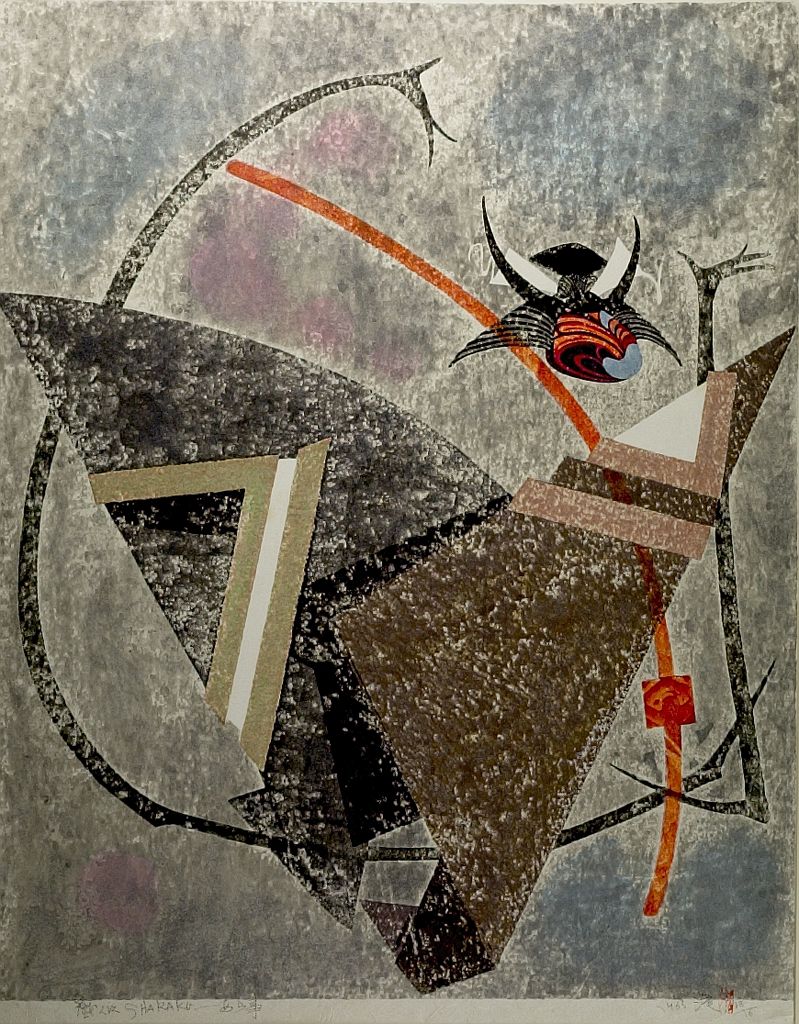
Sharaku
写楽
1963
Color woodblock print
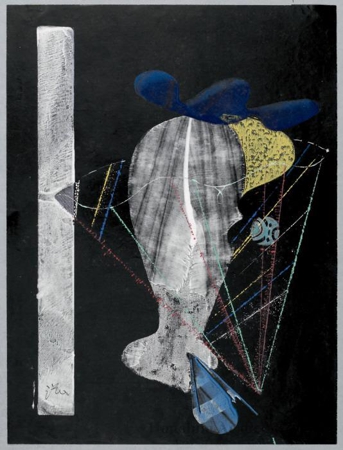
Airplane
c. 1965
Color woodblock print
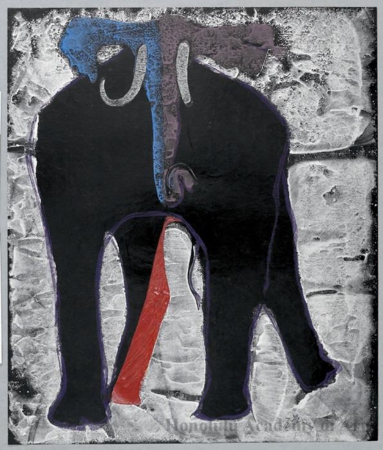
Elephant
c. 1970
Color woodblock print