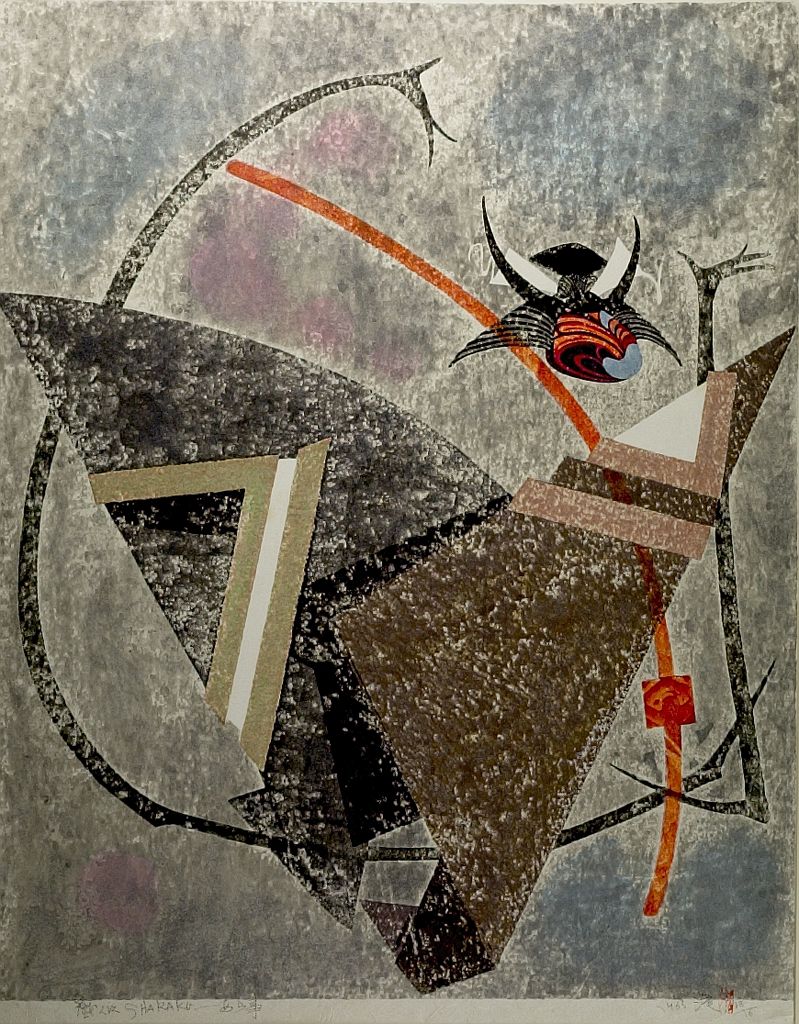
Sharaku
写楽
- Date:
- 1963
- Medium:
- Color woodblock print
- Source:
- Harvard Art Museums
Description
Sharaku, made by Hatsuyama Shigeru in 1963 and held by the Harvard Art Museums (https://ukiyo-e.org/image/harvard/HUAM-CARP00824), is a notable late work in which the artist pays homage to one of the most enigmatic figures in the history of Japanese prints — Tōshūsai Sharaku, the late-eighteenth-century kabuki portraitist who worked for less than a year before disappearing from the record. Rather than copy a specific Sharaku ōkubi-e, Hatsuyama distills the kabuki actor portrait into a simplified mask-like form, with a frontal face built from broad areas of color and contour. The result reads simultaneously as homage and as transformation: the dramatic intensity of Sharaku's original portraits survives, but it is filtered through Hatsuyama's characteristic flattening, his fondness for decorative pattern, and the visual habits he developed across decades of children's-book illustration. By 1963, Hatsuyama had been a leading figure within sōsaku-hanga (creative print) practice for more than two decades; a long-standing member of Onchi Kōshirō's Ichimokukai (First Thursday Society) and of the Nihon Hanga Kyōkai, he continued to design, carve, and print each work himself. The print also reflects the broader mid-twentieth-century interest in the history of Japanese printmaking — a moment when sōsaku-hanga artists were both reasserting their own modernity and consciously reconnecting with the ukiyo-e lineage. For collectors of Hatsuyama Shigeru, Sharaku of 1963 is a particularly clear example of how the artist could engage classical ukiyo-e imagery without surrendering the warmth and simplicity that defined his own idiom.
More Prints by Hatsuyama Shigeru


Featured in Collections
Curated cross-cuts that include this print.
Frequently Asked Questions
Sharaku (写楽) was created by Hatsuyama Shigeru (初山滋) in 1963.