Biography
Hiroshi Yamazaki was a pioneering Japanese photographer whose work stripped photography down to its most elemental relationship: the encounter between light and the photosensitive surface. Born in Nagano Prefecture in 1946, he studied at Nihon University's Department of Art before becoming a freelance photographer in 1969 and beginning to make 16mm films in 1973.
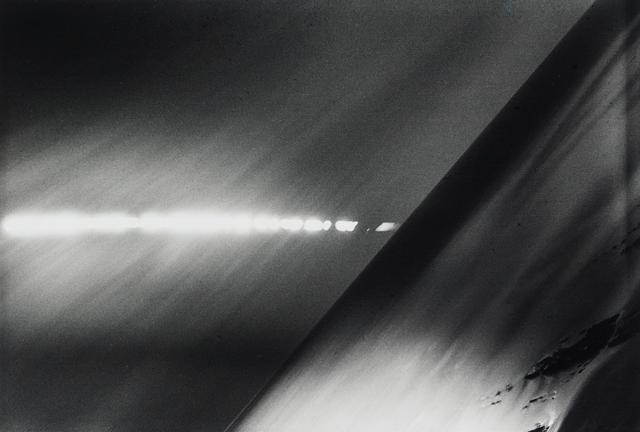
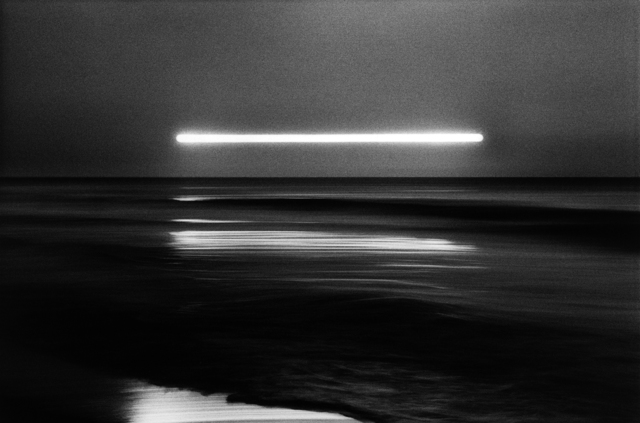
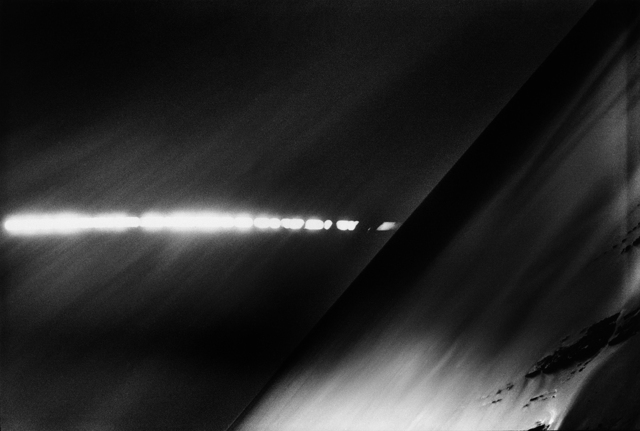
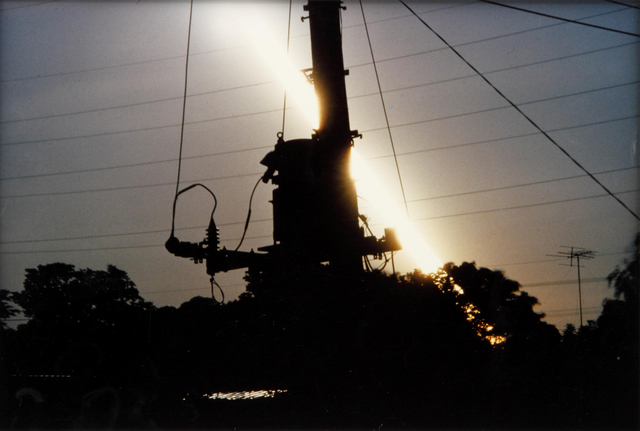
In the early 1970s, Yamazaki began questioning the conventional photographic method of searching for a good subject and capturing it. He experimented instead with photographing without selecting a subject, creating images in which landscape was confined within a window frame or reduced to a featureless seascape. This conceptual approach led to two bodies of work that would define his legacy. His Suiheisen series studied sea horizons with an almost scientific detachment, while his celebrated Heliography series used long exposures to trace the path of the sun near the horizon, producing luminous arcs of light across otherwise still compositions. The Photographic Society of Japan awarded him first prize in 1983 for these time-exposed photographs of the sun over the sea.
Yamazaki pursued the role light plays in photography rather than simply reproducing scenic beauty. Later in his career, he introduced a series on cherry blossoms captured against the sun with a super-telephoto lens, transforming familiar subjects into abstract studies of radiance, and another series of cherry blossoms reproduced as photograms, pushing further toward photography's material essence.
He became a full-time professor at Tohoku University of Art and Design in 1993 and also taught at Musashino Art University and TPO Photo School. He received the Ina Nobuo Award in 2001. His work is held in the collections of the Museum of Modern Art in New York, the Princeton University Art Museum, the International Center of Photography, and the Tokyo Metropolitan Museum of Photography. He died in 2017, leaving behind a body of work that fundamentally expanded the possibilities of the photographic medium.
Key Facts
- Active Period
- 1946–2017
- Nationality
- 🇯🇵Japan
- Movement
- Contemporary Mokuhanga
- Subjects
- LandscapesSeascapes
- Works Indexed
- 5
Frequently Asked Questions
Hiroshi Yamazaki was a pioneering Japanese photographer whose work stripped photography down to its most elemental relationship: the encounter between light and the photosensitive surface. Born in Nagano Prefecture in 1946, he studied at Nihon University's Department of Art before becoming a freelance photographer in 1969 and beginning to make 16mm films in 1973.
Hiroshi Yamazaki was active from 1946 to 2017. They were associated with the Contemporary Mokuhanga movement.
Hiroshi Yamazaki's work was shaped by the Contemporary Mokuhanga tradition in Japanese woodblock printmaking. Contemporary Mokuhanga: Contemporary mokuhanga (literally "wood-block print") encompasses artists working from approximately 1970 to the present who continue or reinvent traditional Japanese woodblock printing techniques.
Hiroshi Yamazaki's prints frequently feature landscapes, seascapes.