Biography
Hishikawa Morofusa (菱川師房, active c. 1685–1715) was an early Edo ukiyo-e painter and printmaker, the son and immediate heir of Hishikawa Moronobu (c. 1618–1694), the founder of the single-sheet woodblock print tradition. Morofusa belonged to the small but consequential generation of artists who carried the Hishikawa-school vocabulary directly out of his father's late seventeenth-century workshop and into the early eighteenth century, a transitional moment when sumizuri-e (single-block black ink prints) remained dominant but the conventions of hand-coloring and serialized book illustration were rapidly expanding. His surviving works, scattered across major collections including the Metropolitan Museum of Art, the Museum of Fine Arts in Boston, and the British Museum, document an artist who maintained his father's compositional templates while adapting them to the changing taste and publishing economy of the Genroku era and the early eighteenth century.
The son of Moronobu and presumed heir to the Hishikawa atelier — the first dedicated ukiyo-e studio — Morofusa was trained from an early age in his father's distinctive linear style, the bold contour drawing and dense kimono patterning that descended from the family's earlier textile-design practice. Moronobu had himself emerged from a family of nuihaku embroiderers in Awa province, and the textile sensibility he brought to single-sheet prints was transmitted intact to his son. Morofusa's draftsmanship displays the same confident, supple line, the same delight in the calligraphic description of brocaded robes, and the same compositional logic of full-bodied figures arranged across the picture plane that distinguished his father's prints and book illustrations.
Morofusa's active career as a print and book illustrator spans roughly three decades, from around 1685 through about 1715. During his father's lifetime he likely collaborated on the Hishikawa workshop's substantial output of ehon (illustrated books) and single-sheet prints, contributing both to designs published under his father's name and to works that began to appear under his own. After Moronobu's death in 1694, Morofusa inherited the formal leadership of the Hishikawa school and continued producing prints and books in the family style. Among the works associated with his hand is a set of prints illustrating the classical One Hundred Poems (Hyakunin Isshu), which he is thought to have completed from drawings his father left behind. His surviving output of single-sheet sumizuri-e prints and illustrated books demonstrates the breadth of practice that defined a senior Hishikawa-school artist of the period.
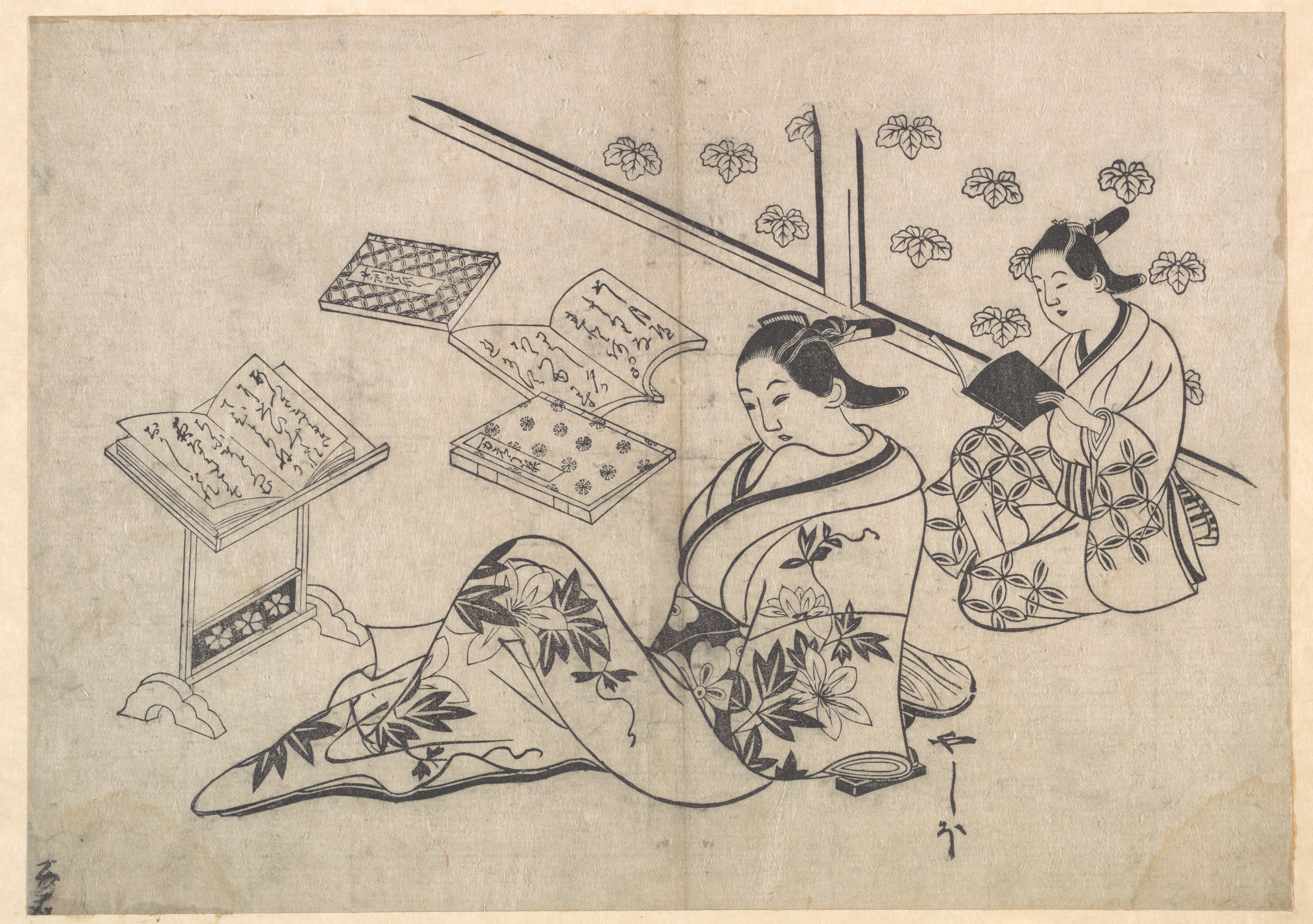
In subject matter, Morofusa stayed firmly within the iconographic vocabulary his father had established. He produced genre scenes of urban leisure and travel, auspicious imagery such as the shichifukujin (seven gods of good fortune), and bijin-ga images of beautiful women, among them a print of a courtesan walking beneath cherry trees now in the Harvard Art Museums. His print work explored this territory in monochrome ink: travel scenes set along the Tōkaidō and other major highways — including On the Yoshida Highway (Yoshida kaidō) in the Museum of Fine Arts, Boston — alongside figural and auspicious subjects. The motif of a beauty pausing to look back over her shoulder, brought to its most famous expression in Moronobu's own painting, had been perfected in the Hishikawa workshop and became one of the foundational compositional templates of ukiyo-e.
The later trajectory of Morofusa's career is notable. According to a long-standing tradition, sometime after the turn of the eighteenth century he gave up the printmaking trade altogether and returned to his family's hereditary textile business — a withdrawal that helped bring the once-dominant Hishikawa school into decline as newer studios such as the Torii rose to prominence. His move from print to textile work illustrates the close kinship between the two crafts in early Edo culture and the ease with which Hishikawa-school artists moved between pattern design and figural composition for the print market.
Morofusa is recognized today as a significant but historically understudied figure in the early Hishikawa-school transmission, an artist whose surviving works in major museum collections — including the Metropolitan Museum of Art, the Museum of Fine Arts in Boston, and the British Museum — help reconstruct the moment when ukiyo-e was being consolidated as a hereditary studio practice and when the conventions of bijin-ga, meisho-e, and auspicious imagery were taking the forms they would maintain across the next century of woodblock printing.
Key Facts
- Nationality
- 🇯🇵Japan
- Movement
- Ukiyo-e
- Works Indexed
- 1
Frequently Asked Questions
Hishikawa Morofusa (菱川師房, active c. 1685–1715) was an early Edo ukiyo-e painter and printmaker, the son and immediate heir of Hishikawa Moronobu (c. 1618–1694), the founder of the single-sheet woodblock print tradition. Morofusa belonged to the small but consequential generation of artists who carried the Hishikawa-school vocabulary directly out of his father's late seventeenth-century workshop and into the early eighteenth century, a transitional moment when sumizuri-e (single-block black ink prints) remained dominant but the conventions of hand-coloring and serialized book illustration were rapidly expanding. His surviving works, scattered across major collections including the Metropolitan Museum of Art, the Museum of Fine Arts in Boston, and the British Museum, document an artist who maintained his father's compositional templates while adapting them to the changing taste and publishing economy of the Genroku era and the early eighteenth century.
Hishikawa Morofusa's work was shaped by the Ukiyo-e tradition in Japanese woodblock printmaking. Ukiyo-e: ## What is ukiyo-e? Ukiyo-e ([浮世絵](/glossary/ukiyo-e)) — literally "pictures of the floating world" — is the Edo-period Japanese print and painting tradition that flourished from roughly 1660 to 1868, depicting the pleasures of urban life in Edo (modern Tokyo): courtesans, kabuki actors, sumo wrestlers, famous landscapes, and seasonal beauties.
Original prints by Hishikawa Morofusa can be found in collections including Metropolitan Museum of Art.