Biography
Hisui Sugiura (杉浦非水, 1876–1965) was a pioneering Japanese graphic designer and artist who played a central role in introducing European Art Nouveau and Secessionist aesthetics into Japanese commercial art and poster design during the Meiji, Taisho, and early Showa eras. Best known for his elegant advertising campaigns for the Mitsukoshi department store, Sugiura helped establish graphic design as a respected art form in Japan and created some of the most visually striking commercial imagery of the early twentieth century.
Born in Matsuyama, Ehime Prefecture, on the island of Shikoku, on May 15, 1876, he later became known by the art-name Hisui; his given name was Tsutomu. He trained first in traditional Japanese-style painting — studying under the Shijō-school painter Matsuura Ganki and later Kawabata Gyokushō — and graduated from the Japanese-style painting department of the Tokyo School of Fine Arts (now Tokyo University of the Arts) in 1901. While there he also studied under the influential Western-style painter Kuroda Seiki, who had trained in France and was instrumental in introducing European oil painting to Japan. This exposure to Western art gave Sugiura a foundation in European artistic principles that he would later apply to his groundbreaking commercial design work.
The turning point in Sugiura's career came at the Mitsukoshi department store, which he joined in 1908 as a part-time designer working on the covers of the store's magazine; in 1910 he became the first head of its newly created design department — a position that gave him unprecedented scope to apply modern design principles to Japanese commercial art. Mitsukoshi, which traced its origins to the Echigoya kimono shop founded in 1673, was reinventing itself as one of Japan's first modern department stores, modeled on European precedents. Sugiura's poster designs for Mitsukoshi became iconic images of Taisho-era modernity, featuring elegant women in both kimono and Western dress surrounded by flowing organic forms, stylized natural motifs, and bold typographic elements that married the sinuous curves of Art Nouveau with Japanese decorative traditions.
Sugiura's design work extended beyond posters to encompass packaging, magazine covers, book design, pamphlets, and a wide range of promotional materials. His visual language drew on multiple sources: the curvilinear elegance of Art Nouveau and the Vienna Secession, the flat decorative patterns of traditional Japanese design, and the naturalistic observation he had learned in his training as a painter. From 1922 to 1924 he traveled and studied in Europe, deepening his direct engagement with contemporary European graphic design. The result was a distinctive hybrid aesthetic that was neither purely Western nor purely Japanese but something genuinely new — a visual expression of the cultural synthesis that defined Taisho-era Japan.
While Sugiura's primary legacy is in graphic design rather than fine-art printmaking, his work intersects with the broader history of Japanese prints in important ways. His poster designs were produced using lithographic and other printing techniques, and they share the visual concerns of contemporary woodblock print artists: the interplay of line and color, the relationship between text and image, and the challenge of creating compelling visual narratives. His influence on subsequent generations of Japanese designers and illustrators has been profound, and his Mitsukoshi posters remain among the most celebrated examples of Japanese graphic design.
Sugiura was also active as an organizer and educator. In 1925 he founded Shichinin-sha, a society devoted to the study of poster and advertising design, and in 1935 he became one of the founders of the Tama Imperial Art School (now Tama Art University), where he was an influential teacher. He received the Japan Art Academy's Imperial Award in 1955 and was awarded the Medal of Honor with Purple Ribbon in 1958. He died on August 18, 1965, at the age of eighty-nine. His posters and designs are preserved in Japanese museum and design collections and remain landmarks in the history of modern Japanese visual culture.
Key Facts
- Active Period
- 1876–1965
- Nationality
- 🇯🇵Japan
- Movement
- Meiji/Taishō Prints
- Subjects
- Birds & FlowersAbstractFigures
- Works Indexed
- 10
Frequently Asked Questions
Hisui Sugiura (杉浦非水, 1876–1965) was a pioneering Japanese graphic designer and artist who played a central role in introducing European Art Nouveau and Secessionist aesthetics into Japanese commercial art and poster design during the Meiji, Taisho, and early Showa eras. Best known for his elegant advertising campaigns for the Mitsukoshi department store, Sugiura helped establish graphic design as a respected art form in Japan and created some of the most visually striking commercial imagery of the early twentieth century.
Hisui Sugiura was active from 1876 to 1965. They were associated with the Meiji/Taishō Prints movement.
Hisui Sugiura's work was shaped by the Meiji/Taishō Prints tradition in Japanese woodblock printmaking. Meiji/Taishō Prints: Meiji and Taishō era prints (1868–1926) bridge the transition from traditional ukiyo-e to the modern shin-hanga and sosaku-hanga movements.
Hisui Sugiura's prints frequently feature birds & flowers, abstract, figures.
Original prints by Hisui Sugiura can be found in collections including Japanese Art Open Database, Art Gallery of Greater Victoria.
Woodblock Prints by Hisui Sugiura (10)
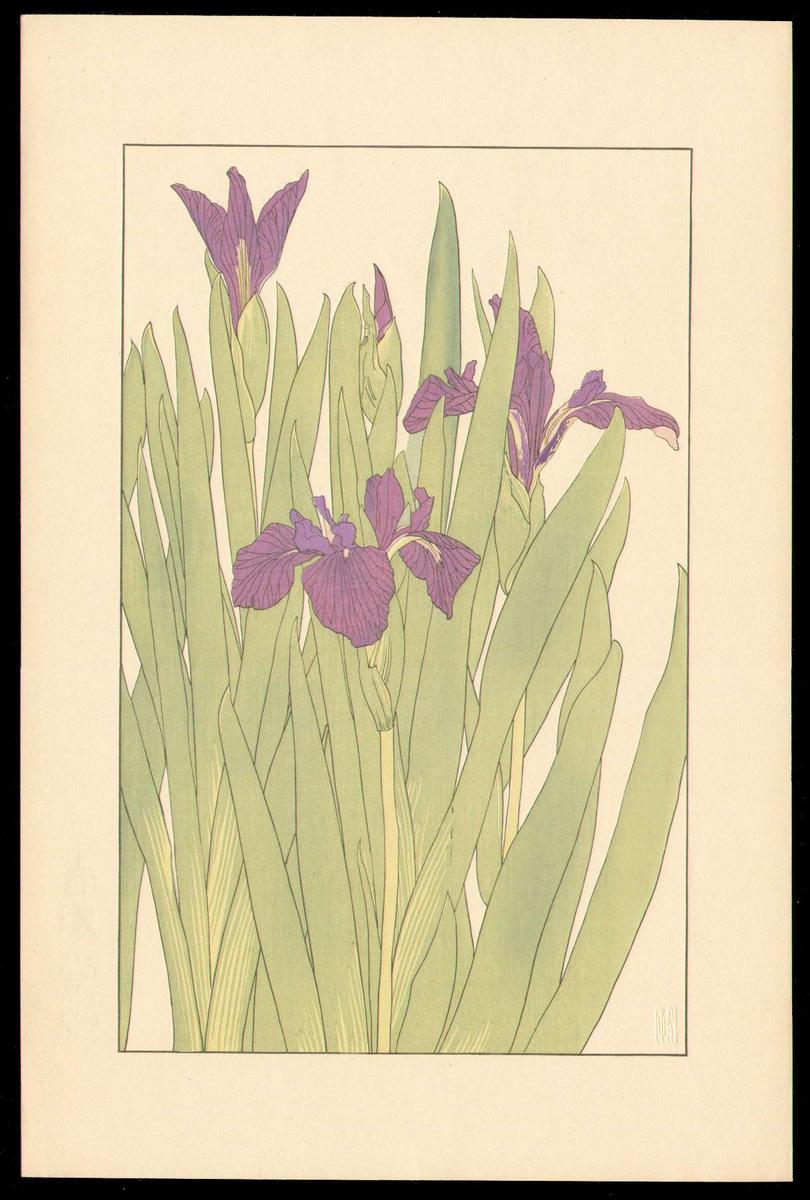
Dutch Iris
Woodblock print
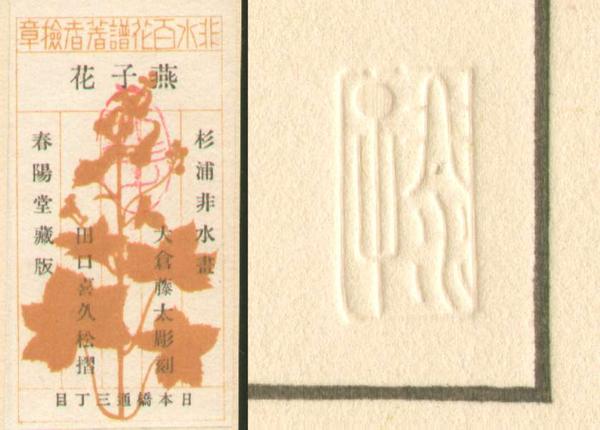
Dutch Iris
Woodblock print
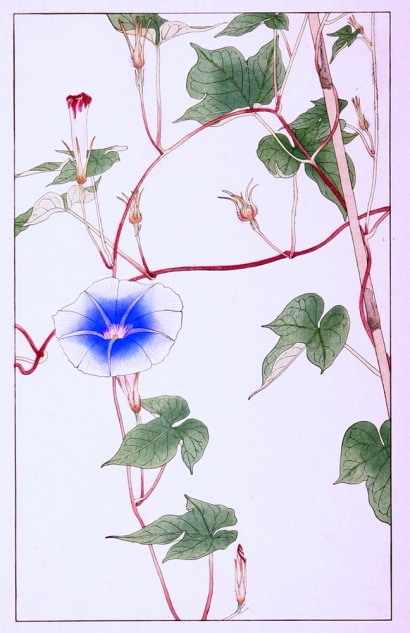
Morning Glory
Woodblock print
Untitled (hisui-sugiura)
Woodblock print
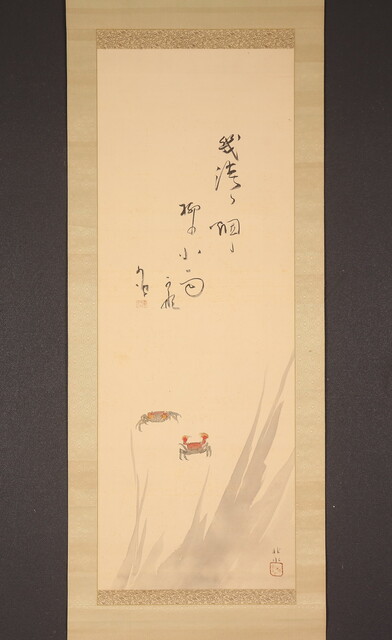
Two Crabs
Silk

Poppy ("Devil")
Mokuhanga (Japanese woodblock)

Raspberry
Mokuhanga (Japanese woodblock)

Sweet peas
Mokuhanga (Japanese woodblock)

Asiatic dayflower
Mokuhanga (Japanese woodblock)

Hisui zuan-shû. a collection of 50 designs
Mokuhanga (Japanese woodblock)