
Asiatic dayflower
- Medium:
- Mokuhanga (Japanese woodblock)
- Image courtesy of
- Saru Gallery
Description
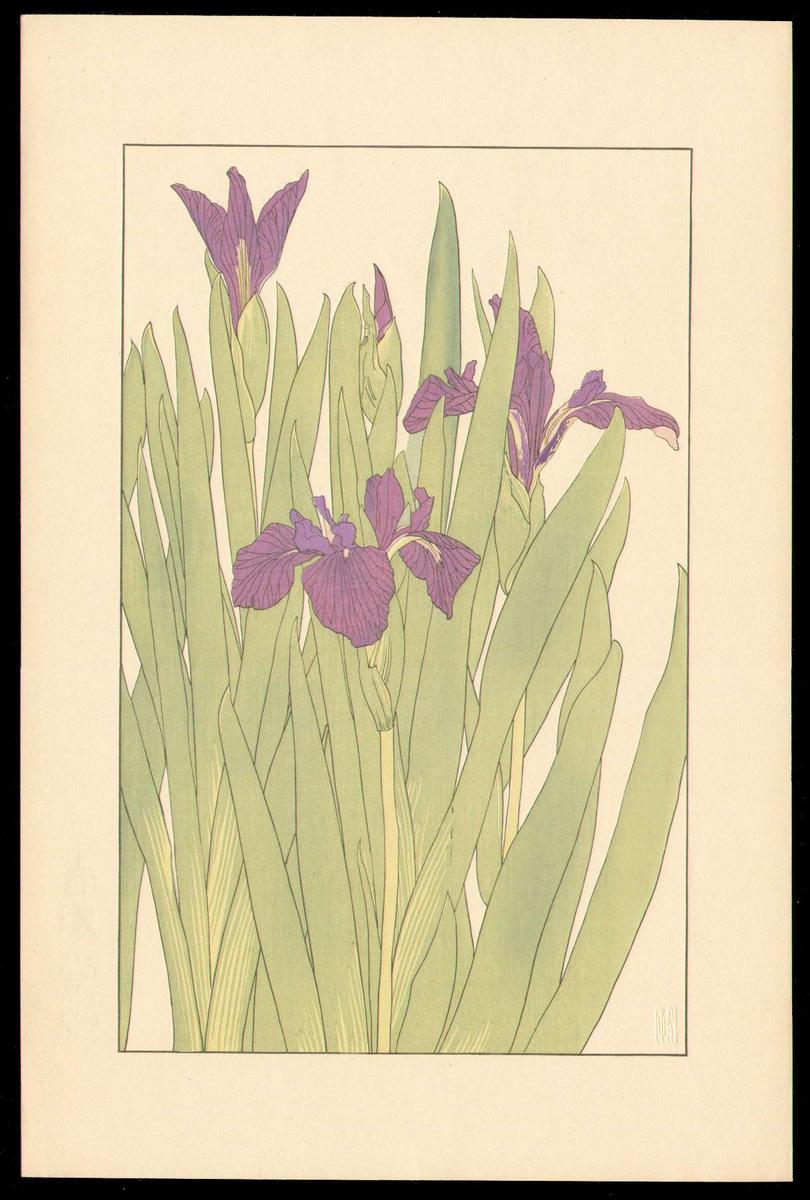
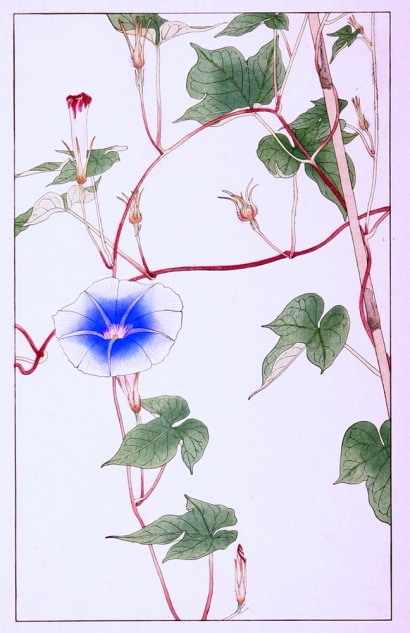
A study of tsuyukusa, the Asiatic dayflower (Commelina communis), a small wild plant whose intense blue petals have been used as a fugitive dye (aobana) in Japanese craft for centuries. Sugiura's design likely abstracts the flower's characteristic two-petal upper bloom and folded spathe into a flat decorative motif, with the thin lance-shaped leaves arranged as supporting linear elements. The mokuhanga medium suits the plant well: the saturated blue can be carried as a single uniform impression, set against the green of the foliage with minimal tonal modulation. By selecting a humble native wildflower rather than the more prestigious chrysanthemum or peony, Sugiura aligns the print with the Taishō-era enthusiasm for everyday botanical subjects and the rinpa tradition's attention to seasonal grasses. Within his zuan output, plates of this type demonstrate how indigenous Japanese flora could be carried into a modern graphic vocabulary suitable for contemporary commercial application — a translation that defined his decades of teaching and his work for clients including Mitsukoshi and the Tokyo subway.
More Prints by Hisui Sugiura
Frequently Asked Questions
Asiatic dayflower was created by Hisui Sugiura (杉浦非水).