
Biography
Ippitsusai Bunchō (一筆斎文調, active c. 1755-1790) was one of the most distinctive designers of Edo yakusha-e (kabuki actor prints) of the Meiwa and An'ei eras (1764-1781), and a central figure in the mid-eighteenth-century reform of actor portraiture that prepared the ground for both the Katsukawa school and, two decades later, the radical okubi-e of Tōshūsai Sharaku. Working in Edo through roughly the 1760s and 1770s, Bunchō produced a tightly focused corpus of hosoban kabuki actor prints, bijin-ga (beautiful-women pictures), and the occasional illustrated book, all marked by an elegant, slightly mannered draughtsmanship that contemporary collectors prized and that modern scholarship recognizes as one of the essential bridges between the earlier Torii actor tradition and the psychological yakusha-e of the late eighteenth century.
The biographical record for Bunchō is unusually thin even by ukiyo-e standards. His surname is recorded as Mori, and he is believed to have begun his career as a painter, training under Ishikawa Yukimoto of the Kanō school before moving into commercial print design; little else about his life is documented. His earliest known printed work dates from the mid-1750s — illustrations of 1755 — his most concentrated activity as an actor-print designer falls between roughly 1765 and 1772, and after about 1772 he largely turned away from actor prints toward pictures of beautiful women. His last recorded work is a picture-calendar (e-goyomi) of 1790, and his death is usually placed around 1791, though little about it is documented.
Bunchō's importance to the history of Edo kabuki actor prints lies in his role as the co-architect, with Katsukawa Shunshō, of the new portrait-based yakusha-e of the Meiwa-Tenmei period. Before the late 1760s, actor prints had been dominated by the Torii school of Kiyomitsu and Kiyohiro, whose stylized hosoban figures functioned more as theatrical heraldry than as portraits of named performers; audiences identified actors not by face but by the family crest (mon) printed on the costume. Bunchō and Shunshō, working in parallel and in dialogue across the same Edo theatrical world, began producing hosoban actor prints in which the face was individualized to the point that contemporary theatergoers could recognize specific performers — Ichikawa Yaozō II, Segawa Kikunojō II, Iwai Hanshirō IV, Matsumoto Kōshirō III, Nakamura Nakazō I, Onoe Tamizō I, Sanogawa Ichimatsu II — without needing the crest to identify them. Bunchō's contribution to this transformation has sometimes been overshadowed in later scholarship by Shunshō's larger and more sustained output, but in the years 1768-1770 the two men were equal partners in the reform.
The pivotal document of that partnership is Ehon Butai Ōgi (絵本舞台扇, "Picture Book of Stage Fans"), published in Edo in 1770 by Kariganeya Ihei in three volumes. Designed jointly by Bunchō and Shunshō, the book presents kabuki actors of the Edo and Osaka stages in the format of a fan painting, each leaf treating one performer with the new individualized facial conventions. Roughly half of the designs are by Bunchō and half by Shunshō, and the book is the single most important printed monument of the new portrait-based yakusha-e. Impressions from the book are held in major museum collections, including the Art Institute of Chicago, the Museum of Fine Arts Boston, the Metropolitan Museum of Art, and the British Museum. Ehon Butai Ōgi fixed the visual conventions — observed, individualized faces, restrained color, and an uncluttered ground — that the Katsukawa school would then carry forward for the next thirty years.
Bunchō's mature style in the single-sheet hosoban is recognizable at a glance. His drawing is finer and more lyrical than Shunshō's, with a thinner, more even outline that lingers on the curve of a sleeve, the fall of a sash, or the swept-back line of an actor's hairline. His faces are slightly elongated and his eyes a touch larger than Shunshō's, giving his actors a faintly melancholy, introspective look that distinguishes them from the more robust Katsukawa likenesses. His palette in the late 1760s and early 1770s draws on the rich nishiki-e (multi-block color print) techniques developed since Suzuki Harunobu's breakthroughs of 1765 — soft mineral pinks, deep indigo (aizome), mustard yellow, and a controlled use of black — and the registration of his color blocks is consistently fine. Within the hosoban diptych and triptych he was equally capable, choreographing two or three actors into staged tableaux that document specific Nakamura-za, Ichimura-za, and Morita-za productions of the late 1760s and early 1770s.
In parallel with his actor prints, Bunchō produced a small but distinguished body of bijin-ga. The most important of these is the series Fuji-bumi ("Folded Love-letters"), datable to about 1769-1770, in which named Yoshiwara courtesans — among them Chibune of the Ebiya house and Somenosuke of the Matsubaya — are shown in hosoban portraits inscribed with their house and rank. The series is one of the earliest examples of named-courtesan portraiture in single-sheet color prints and a clear precedent for the celebrity bijin-ga that Kitao Shigemasa, Torii Kiyonaga, and finally Kitagawa Utamaro would develop over the next twenty years. From about 1769 Bunchō's beauty prints show the clear influence of Suzuki Harunobu, in whose wake he took up the celebrity-beauty genre of famous Edo shop girls and teahouse waitresses.
Bunchō's relationship to the Katsukawa school was both collaborative and competitive. In the years immediately around Ehon Butai Ōgi the two artists were working in the same idiom and for overlapping publishers, and contemporary kabuki audiences appear to have treated them as a pair. From roughly 1772 onward Bunchō largely abandoned actor prints — none from the An'ei era are known — turning instead to pictures of beautiful women, while Shunshō's output expanded and his pupils — Shunkō, Shun'ei, Shunjō, and eventually the young Hokusai under the name Shunrō — consolidated the Katsukawa monopoly on actor prints. Bunchō never founded a school in the same way, and his withdrawal from the actor-print world after An'ei 1 (1772) suggests that he was unable or unwilling to compete with the Katsukawa atelier system. His later designs are sparser and more eccentric in palette, and by the time Sharaku produced the okubi-e of 1794-1795 Bunchō was effectively forgotten by the Edo print public.
In the longer history of Edo yakusha-e, however, Bunchō's significance is unmistakable. Together with Shunshō he is the artist who established the conventions of portrait-based actor prints in the late 1760s — observed face, individualized brows and mouth, full-length figure on an unornamented ground, restrained polychrome palette — that defined the genre for the next half-century. He is one of the essential pre-Sharaku artists, the figure to whom modern scholarship turns when reconstructing the conditions out of which Sharaku's psychologically intense actor portraits of 1794-1795 emerged. His Fuji-bumi courtesan series and his Ehon Butai Ōgi collaboration are foundational documents of mid-Edo print culture. His work is held in major public collections, including the Art Institute of Chicago, the Museum of Fine Arts Boston, the Metropolitan Museum of Art, the British Museum, and the Honolulu Museum of Art. Today Ippitsusai Bunchō is recognized as one of the most refined draughtsmen of the Meiwa-An'ei era and an indispensable figure in the long transformation of Edo kabuki actor prints from theatrical heraldry into portraiture.
Key Facts
- Nationality
- 🇯🇵Japan
- Movement
- Ukiyo-e
- Works Indexed
- 52
Frequently Asked Questions
Ippitsusai Bunchō (一筆斎文調, active c. 1755-1790) was one of the most distinctive designers of Edo yakusha-e (kabuki actor prints) of the Meiwa and An'ei eras (1764-1781), and a central figure in the mid-eighteenth-century reform of actor portraiture that prepared the ground for both the Katsukawa school and, two decades later, the radical okubi-e of Tōshūsai Sharaku. Working in Edo through roughly the 1760s and 1770s, Bunchō produced a tightly focused corpus of hosoban kabuki actor prints, bijin-ga (beautiful-women pictures), and the occasional illustrated book, all marked by an elegant, slightly mannered draughtsmanship that contemporary collectors prized and that modern scholarship recognizes as one of the essential bridges between the earlier Torii actor tradition and the psychological yakusha-e of the late eighteenth century.
Ippitsusai Buncho's work was shaped by the Ukiyo-e tradition in Japanese woodblock printmaking. Ukiyo-e: ## What is ukiyo-e? Ukiyo-e ([浮世絵](/glossary/ukiyo-e)) — literally "pictures of the floating world" — is the Edo-period Japanese print and painting tradition that flourished from roughly 1660 to 1868, depicting the pleasures of urban life in Edo (modern Tokyo): courtesans, kabuki actors, sumo wrestlers, famous landscapes, and seasonal beauties.
Original prints by Ippitsusai Buncho can be found in collections including Art Institute of Chicago, ukiyo-e.org, Cleveland Museum of Art.
Woodblock Prints by Ippitsusai Buncho (52)

The Actor Yamashita Kinsaku II as Moshio, Wife of Ito Sukekiyo, in the Play Izu-goyomi Shibai no Ganjitsu, Performed at the Morita Theater in the Eleventh Month, 1772
c. 1772
Color woodblock print; hosoban

The Actor Segawa Kikunojo II as the Courtesan Maizuru in the Play Furisode Kisaragi Soga (Soga of the Long, Hanging Sleeves in the Second Month), Performed at the Ichimura Theater from the Twentieth Day of the Second Month, 1772
c. 1772
Color woodblock print; hosoban

The Actor Ichikawa Komazo II as Kudo Saemon Suketsune (?) in the Play Haru wa Soga Akebono-zoshi (?), Performed at the Nakamura Theater (?) in the First Month, 1772 (?)
c. 1772
Color woodblock print; hosoban

The Courtesan Mitsunoto of the Hishiya House, from the series "Sanjurokkasen (Thirty-six Flowers)"
c. 1772
Color woodblock print; chuban

Ushiwaka-maru on the Gojo Bridge
reprint of c. 1769 design
Color woodblock print; hosoban

The Shrine Dancers (Miko) Ohatsu and Onami
1769
Color woodblock print; hosoban
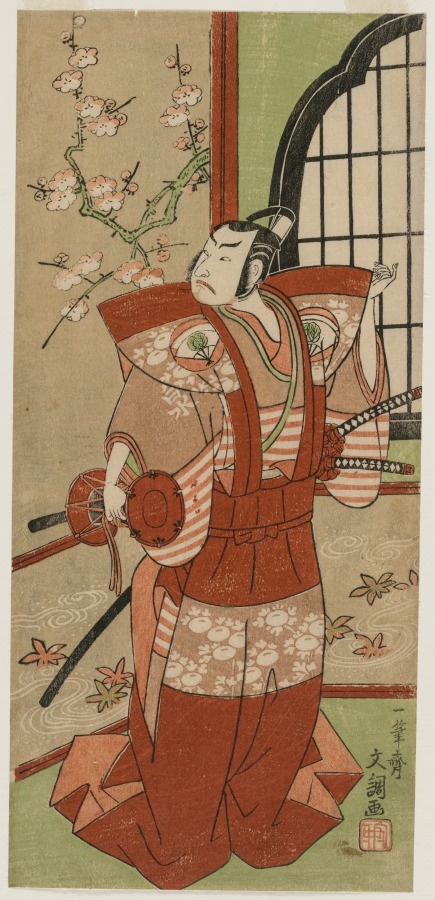
Onoe Kikugorō I as Izumi no Saburō in the Play Snowflakes: Plum Blossoms Kaomise
1769
color woodblock print

The Actor Segawa Kikunojo II as the Heron Maiden in the play "Cotton Wadding of Izu Protecting the Matrimonial Chrysanthemums (Myoto-giku Izu no Kisewata)," performed at the Ichimura Theater from the first day of the eleventh month, 1770
1770
Color woodblock print; hosoban

The Actor Ichikawa Monnosuke II as Tsunewaka-maru in the Play Iro Moyo Aoyagi Soga, Performed at the Nakamura Theater in the Second Month, 1775
c. 1775
Color woodblock print; hosoban

Actor's dressing table, from "A Picture Book of Stage Fans (Ehon butai ogi)"
1770
Color woodblock print; page from illustrated book

The Actor Arashi Hinaji, from "A Picture Book of Stage Fans (Ehon butai ogi)"
1770
Color woodblock print; page from illustrated book
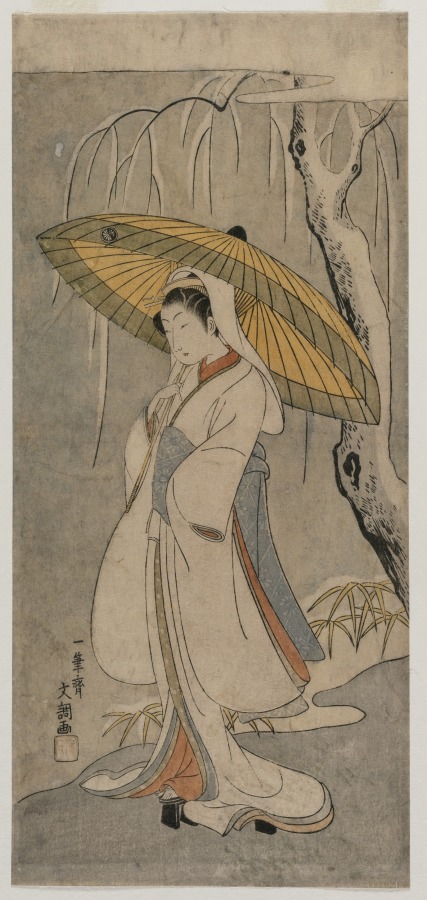
Segawa Kikunojo II as the Heron Maiden (from the series Ichimura Theater)
1770
color woodblock print

The Actor Ichikawa Yaozo II in a pre-performance celebration of the play "Soga Monogatari," performed at the Morita Theater in the second month, 1773
1773
Color woodblock print; left sheet of hosoban triptych

Bijin with Hat

Parading courtesan, Komura and attendant

Nihon meizan zue 日本名山図会 (Illustrations of Famous Mountains in Japan)

Bijin

The Actor Sakata Sajuro I as a Samurai's Manservant (Yakko)

(untitled)

Buncho joruri kagami 文張浄瑠璃鑑 (Mirror of Plays Set Forth as Literature)

Ayase no sekisho / Bokusui Hakkei

Ehon butai ogi 絵本舞台扇 (Picture-book of the Stage in Fan-shapes)

Teashop beauty with a cat in her kimono
