Biography
Isoda Koryusai (1735-1790) was one of the most prolific and inventive ukiyo-e bijin-ga masters of the mid-Edo period, a transitional figure who carried the lyrical idiom of Suzuki Harunobu forward into the more sumptuous, full-bodied print style that would dominate the 1770s and 1780s. Working in Edo through the An'ei (1772-1781) and early Tenmei (1781-1789) eras, Koryusai produced an astonishing range of woodblock prints, paintings, and book illustrations, with modern catalogues attributing some 2,500 designs to his hand. He is celebrated above all as Harunobu's most important successor in bijin-ga (pictures of beautiful women), as the supreme master of the hashira-e (pillar print) format, and as the designer of the landmark courtesan series Hinagata Wakana no Hatsumoyo (Models for Fashion: New Designs as Fresh as Young Leaves), one of the most ambitious and long-running ranking series of Yoshiwara courtesans ever produced in ukiyo-e.
Born in 1735, Koryusai began life as a samurai retainer of the Tsuchiya clan, a low-ranking but established warrior family. After the death of the head of his clan he became a ronin (masterless samurai) and settled near the Ryogoku bridge in Edo, in the Yagenbori district. This samurai-class background is a recurring biographical detail that distinguished him from most of his ukiyo-e contemporaries, who tended to come from chonin (townsman) backgrounds, and it accords with the ease he showed both in the samurai and warrior subjects of his earliest prints and, later, in his witty parodies of classical and Chinese moral tales. He signed those early works with the art name Haruhiro, whose 'Haru' element echoed that of Harunobu, and only later adopted the name Koryusai by which he is best known.
Koryusai's career as a printmaker took off in the late 1760s, in the wake of Suzuki Harunobu, the pioneer of the full-color nishiki-e print. Although it is often assumed that Koryusai studied under Harunobu, no direct evidence documents a teacher-pupil relationship between them; what is certain is that his earliest designs, from circa 1769 to 1770, are so close to Harunobu's in figure type, palette, and compositional idiom that they have at times been confused with Harunobu's own work. Slim-waisted, doll-like beauties in delicate pastel kimono; lovers sheltering beneath a single umbrella in the snow; children at play in fashionable musical pastimes, all of these were subjects drawn directly from Harunobu's repertoire. When Harunobu died in 1770, leaving the bijin-ga field without its leading designer, Koryusai stepped into the vacancy with extraordinary energy. Through the early 1770s he absorbed Harunobu's idiom and then began to push it outward, lengthening proportions, intensifying color, and developing a more grounded sense of weight and physical presence in his female figures.
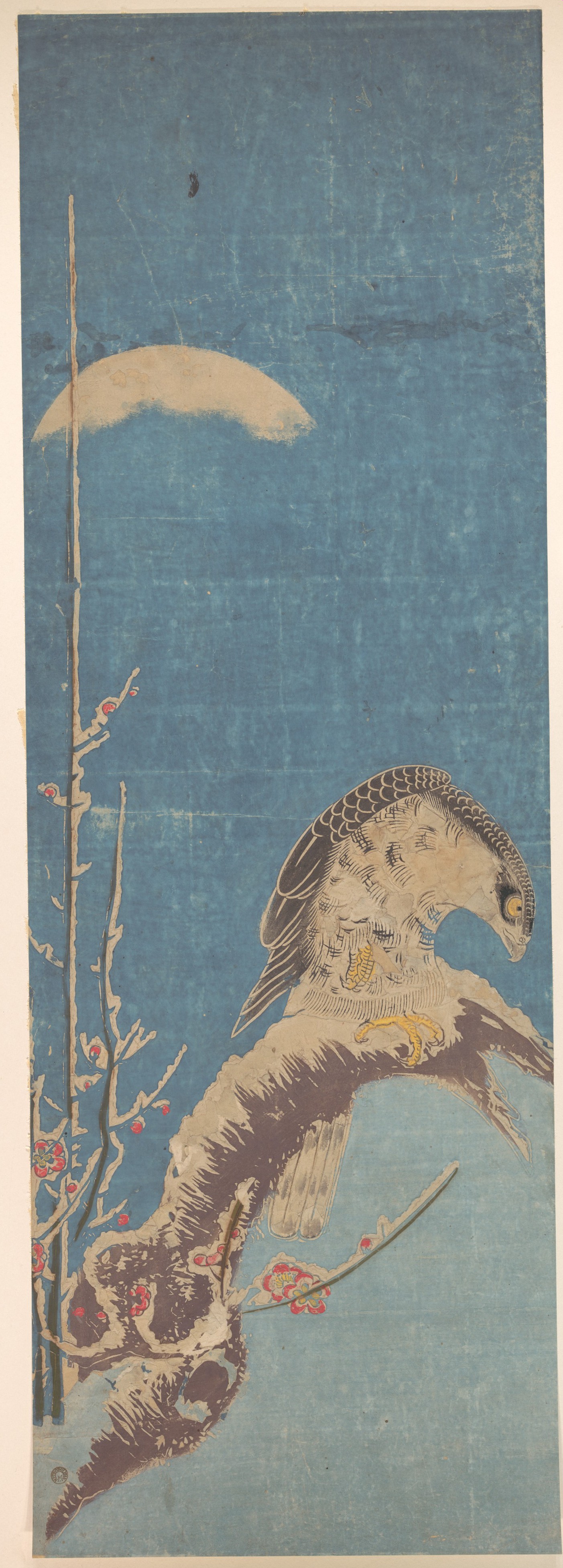
The most distinctive of his formal innovations was his treatment of the hashira-e, or pillar print, a tall, narrow format roughly 28 by 5 inches that was pasted onto the wooden posts of Edo townhouses as cheap, replaceable decor. The format had existed before Koryusai but had been treated essentially as a vertical cropping of an ordinary print. Koryusai reimagined it as a compositional problem of its own, designing figures that wrapped, leaned, and folded into the impossibly narrow column, often with a single tall pine, a hanging robe, or a falling ribbon as a structural spine. His finest pillar prints are model examples of how he turned a constrictive shape into a virtuoso exercise. Modern scholarship credits Koryusai with more hashira-e than any other ukiyo-e artist, at least 350 designs in the format, and his work here remains among the most prized survivals from the An'ei period.
From roughly 1775 onward, Koryusai turned increasingly to the Yoshiwara pleasure quarters for subject matter, and it is in this phase that he produced his single most consequential body of work: Hinagata Wakana no Hatsumoyo, sometimes translated as Models of Fashion: New Designs as Fresh as Young Leaves. Published from about 1776 into the early 1780s and running to roughly 140 large o-ban designs, the series presented each leading courtesan of the Yoshiwara in full standing pose, attended by one or two kamuro (child attendants), and lavishly dressed in the season's newest fabric patterns. The series functioned simultaneously as a portrait gallery of celebrity courtesans, a fashion catalog of textile design, and a ranking guide for connoisseurs. It established a template for the courtesan portrait that Kiyonaga, Utamaro, and Eishi would all build upon in the next two decades, and it consolidated Koryusai's reputation as a designer of bijin-ga at the highest level of fashion-system sophistication.
Koryusai was also a designer of beautifully observed kacho-ga (bird-and-flower prints), including chuban-format studies that survive in particularly fresh impressions in major collections such as the Art Institute of Chicago. He produced topographical series in the Eight Views (hakkei) tradition, fashion parodies of classical Komachi poems and of Chinese moral exemplars, twelve-month and twelve-zodiac series, and a sustained body of shunga. His engagement with the mitate (parody) genre, retelling famous warrior episodes or moral tales in contemporary Edo dress, gave his middle-period prints their characteristic wit.
In the early 1780s, at the height of his commercial success, Koryusai turned away from print design and shifted his energies to painting on silk and paper. In 1782 he received the honorary Buddhist title hokkyo (Bridge of the Law), an unusually distinguished rank for an ukiyo-e artist, and the shift to painting reflected both a desire for higher-status commissions and a generational handover of the bijin-ga print market to Torii Kiyonaga. Koryusai's paintings, which survive in far fewer numbers than his prints, return to the Yoshiwara subjects he had made his own in a more restrained manner. He died in Edo in 1790, leaving behind one of the deepest and most varied print oeuvres of the eighteenth century.
For collectors and students of ukiyo-e today, Isoda Koryusai occupies a pivotal position: the artist who transmitted Harunobu's intimate world of beauties into the more ambitious large-format prints of the late eighteenth century, the supreme master of the pillar print, and the designer whose Hinagata Wakana series helped define the courtesan portrait for a generation. His chuban-format Edo prints, with their delicate color registers and slim Harunobu-derived figures, remain among the most rewarding entry points into mid-Edo bijin-ga.
Key Facts
- Active Period
- 1735–1790
- Nationality
- 🇯🇵Japan
- Movement
- Ukiyo-e
- Works Indexed
- 150
Frequently Asked Questions
Isoda Koryusai (1735-1790) was one of the most prolific and inventive ukiyo-e bijin-ga masters of the mid-Edo period, a transitional figure who carried the lyrical idiom of Suzuki Harunobu forward into the more sumptuous, full-bodied print style that would dominate the 1770s and 1780s. Working in Edo through the An'ei (1772-1781) and early Tenmei (1781-1789) eras, Koryusai produced an astonishing range of woodblock prints, paintings, and book illustrations, with modern catalogues attributing some 2,500 designs to his hand. He is celebrated above all as Harunobu's most important successor in bijin-ga (pictures of beautiful women), as the supreme master of the hashira-e (pillar print) format, and as the designer of the landmark courtesan series Hinagata Wakana no Hatsumoyo (Models for Fashion: New Designs as Fresh as Young Leaves), one of the most ambitious and long-running ranking series of Yoshiwara courtesans ever produced in ukiyo-e.
Isoda Koryūsai was active from 1735 to 1790. They were associated with the Ukiyo-e movement.
Isoda Koryūsai's work was shaped by the Ukiyo-e tradition in Japanese woodblock printmaking. Ukiyo-e: ## What is ukiyo-e? Ukiyo-e ([浮世絵](/glossary/ukiyo-e)) — literally "pictures of the floating world" — is the Edo-period Japanese print and painting tradition that flourished from roughly 1660 to 1868, depicting the pleasures of urban life in Edo (modern Tokyo): courtesans, kabuki actors, sumo wrestlers, famous landscapes, and seasonal beauties.
Isoda Koryūsai's prints frequently feature winter, children, moonlight, birds & flowers, rain, mount fuji.
Original prints by Isoda Koryūsai can be found in collections including Art Institute of Chicago, Victoria and Albert Museum, Metropolitan Museum of Art.
Woodblock Prints by Isoda Koryūsai (150)

Lovers
1770
Woodblock print; ink and color on paper

Crane, Bamboo and Iris
c. 1775
Color woodblock print; chuban

Cocks Fighting near Bamboo Grove
c. 1770s
Color woodblock print; chuban

Young Woman Hanging a Mosquito Net
c. 1775
Color woodblock print; tanzaku

Courtesan Looks Down at Youth Dressed as Mendicant Monk
c. early 1770s
Color woodblock print; hashira-e

Hawk on Plum Branch Looking Down at Fleeing Bird
c. 1775
Color woodblock print; hashira-e

Falcon at Sunrise
c. 1775
Color woodblock print; hashira-e

Cock Flying Over Pot of Adonis
c. 1770s
Color woodblock print; chuban

Nui and Chiyo from Daimon Fujiya performing the hobby-horse dance, from the series "Comic Performances by the Entertainers of the Pleasure Quarters at the Niwaka Festival (Seiro geiko niwaka kyogen zukushi)"
c. 1776/81
Color woodblock print; chuban

The Courtesan Mitsuhana of the Ohishiya (Ohishiya uchi Mitsuhana), from the series "Evergreen Brocades of the Pleasure Quarters (Seiro tokiwa nishiki)"
c. 1776/81
Color woodblock print; koban

Poem by Bun'ya no Yasuhide, from the series "Modern Versions of the Six Immortal Poets (Imayo fuzoku rokkasen)"
c. 1776/81
Color woodblock print; chuban

Haruka and Haruji of the Kadotamaya as Soga no Goro and Asaina Saburo in the armor-pulling scene, from the series "Comic Performances by the Entertainers of the Pleasure Quarters at the Niwaka Festival (Seiro geiko niwaka kyogen zukushi)"
c. 1776/81
Color woodblock print; chuban

The Courtesan Sugawara of the Tsuruya and Her Attendant
c. 1776/81
Color woodblock print; hashira-e

Seven Sages of the Bamboo Grove - No. 2 (Chikurin shichiken sono ni), from the series "Popular Versions of Sages (Fuzoku kenjin ryaku)"
c. 1776/81
Color woodblock print; chuban

Young Couple Dressed as Mendicant Monks (Genpachi and Komurasaki?)
c. 1777
Color woodblock print; hashira-e

Parakeet on the Branch of a Cherry Tree
1772-1789

Shioginu of the Tsutaya, from the series "Models for Fashion: New Designs as Fresh as Young Leaves (Hinagata wakana no hatsu moyo)"
c. 1777/78
Color woodblock print; oban

Lady Tomoe and the warrior Uchida Ieyoshi
1772 - 1781

The Courtesan Hanaogi of the Ogiya and her attendant, from the series "Fans of the East (Azuma ogi)"
c. 1777/78
Color woodblock print; bai aiban

Two Courtesans Watching an Attendant Play with a Rat
c. 1777
Color woodblock print; aiban

Manzan of the Chojiya, from the series "Models for Fashion: New Designs as Fresh as Young Leaves (Hinagata wakana no hatsu moyo)"
c. 1778/80
Color woodblock print; oban

Sugawara of the Tsuruya dreaming of Daikoku
c. 1778
Color woodblock print; chuban

Hamaya of the Asahimaruya, from the series "Models for Fashion: New Designs as Fresh as Young Leaves (Hinagata wakana no hatsu moyo)"
c. 1778/80
Color woodblock print; oban
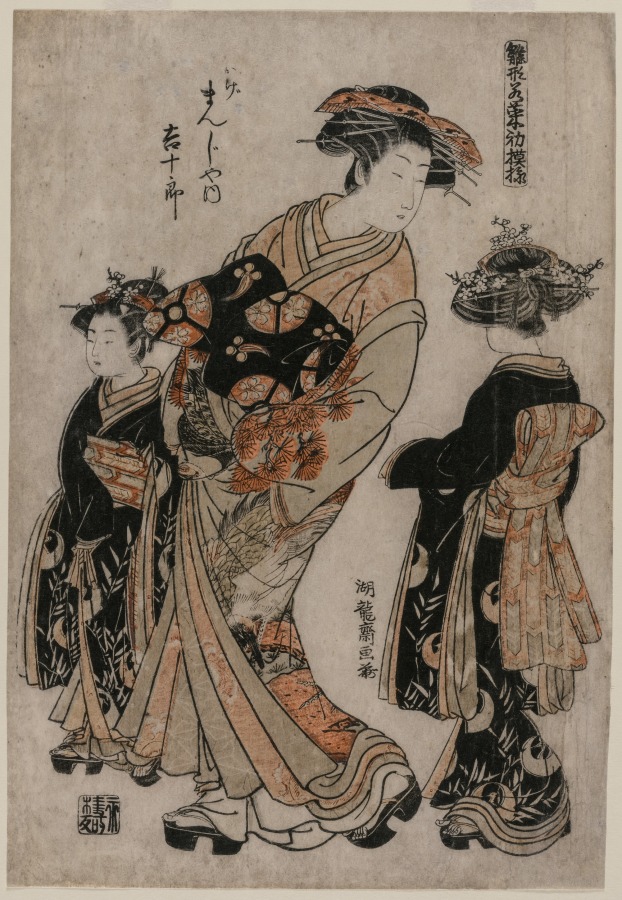
The Courtesan Kichijuro of Kage Manjiya with Two Kamuro (from the series Models for Fashions: New Designs as Fresh as Young Leaves)
late 1770s
color woodblock print