
Nui and Chiyo from Daimon Fujiya performing the hobby-horse dance, from the series "Comic Performances by the Entertainers of the Pleasure Quarters at the Niwaka Festival (Seiro geiko niwaka kyogen zukushi)"
- Date:
- c. 1776/81
- Medium:
- Color woodblock print; chuban
- Source:
- Art Institute of Chicago
Description
This 1771 nishiki-e by Isoda Koryusai, from the series Comic Performances by the Entertainers of the Pleasure Quarters at the Niwaka Festival (Seiro geiko niwaka kyogen zukushi), is preserved in the Art Institute of Chicago. The print captures Nui and Chiyo of the Daimon Fujiya house performing the harukoma, or hobby-horse dance, one of the comic turns staged each autumn during the Niwaka festival in the Yoshiwara. For a few days every year the licensed quarter suspended its usual hierarchy and let courtesans, kamuro, and geisha perform short kabuki-derived skits, parades, and dances in the main street; collectors prized prints of these performances as souvenirs of a fleeting, festival-only spectacle. Koryusai documents the two performers with the careful attention to house affiliation and costume that defines Edo bijin-ga at its most documentary. He records the precise patterns of their kimono, the curve of the toy horse Nui rides, and the subtle differences in posture that distinguish the two women. The series sits a few years before Hinagata Wakana no Hatsumoyo, the great fashion atlas Koryusai would launch in the mid-1770s with publisher Nishimuraya Yohachi, and shares its census-like ambition: rather than isolating a single ideal beauty, Koryusai treats the Yoshiwara as a whole community whose internal events deserve their own pictorial chronicle. His training in the Kano school is visible in the disciplined contour line and the way he models drapery as architecture for the body. The Art Institute identifies the impression as a chuban-format nishiki-e of 1771 and locates it within Koryusai's most productive years between Harunobu's death in 1770 and Kiyonaga's rise at the end of the decade.
More Prints by Isoda Koryūsai


More Mount Fuji Prints
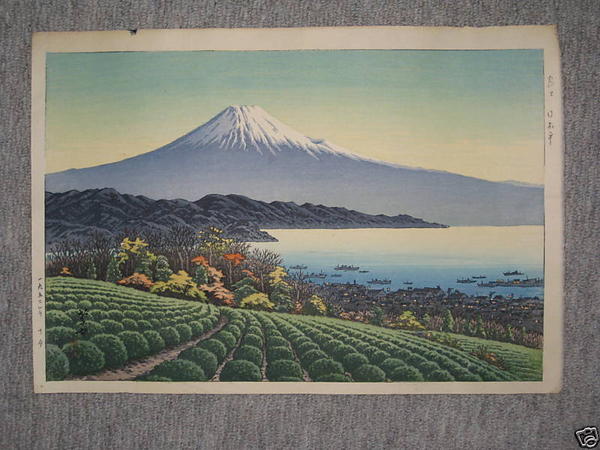
Fuji from tea farm
Woodblock print

Akasaka, Fujikawa, Okazaki, Chiryu, and Narumi, from the series "Famous Places on the Fifty-three Stations of the Tokaido, Five Stations (Tokaido gojusan eki goshuku meisho)"
c. 1830/35
Color woodblock print; oban
![Mount Fuji on a Moonlit Night, Kawai Bridge (Tsukiyo no Fuji [Kawaibashi]), from the series "Selection of Views of the Tokaido (Tokaido fukei senshu)" by Kawase Hasui](https://www.artic.edu/iiif/2/d0960668-1e73-339a-b182-fb995a54bff0/full/843,/0/default.jpg)
Mount Fuji on a Moonlit Night, Kawai Bridge (Tsukiyo no Fuji [Kawaibashi]), from the series "Selection of Views of the Tokaido (Tokaido fukei senshu)"
1947
Color woodblock print; oban

Mt. Fuji in Rain (Ame no Fuji)
n.d.
Color woodblock print
Featured in Collections
Curated cross-cuts that include this print.
Frequently Asked Questions
Nui and Chiyo from Daimon Fujiya performing the hobby-horse dance, from the series "Comic Performances by the Entertainers of the Pleasure Quarters at the Niwaka Festival (Seiro geiko niwaka kyogen zukushi)" was created by Isoda Koryūsai (礒田湖龍斎) in c. 1776/81.
Nui and Chiyo from Daimon Fujiya performing the hobby-horse dance, from the series "Comic Performances by the Entertainers of the Pleasure Quarters at the Niwaka Festival (Seiro geiko niwaka kyogen zukushi)" depicts mount fuji.