Biography
Kaigetsudō Doshin (懐月堂度辰, active c. 1711-1736) was one of the principal pupils of Kaigetsudō Ando and among the designers of the short-lived but enormously influential Kaigetsudō school, which dominated the production of large-format standing bijin paintings and prints in early-eighteenth-century Edo. Trained in his master's Asakusa studio during the Shōtoku and Kyōhō eras, Doshin extended the Kaigetsudō formula for monumental courtesan portraiture into the years following Ando's banishment in 1714, when the workshop's surviving members continued to produce hanging-scroll paintings and the rare oversized woodblock prints that constitute the school's most celebrated legacy.
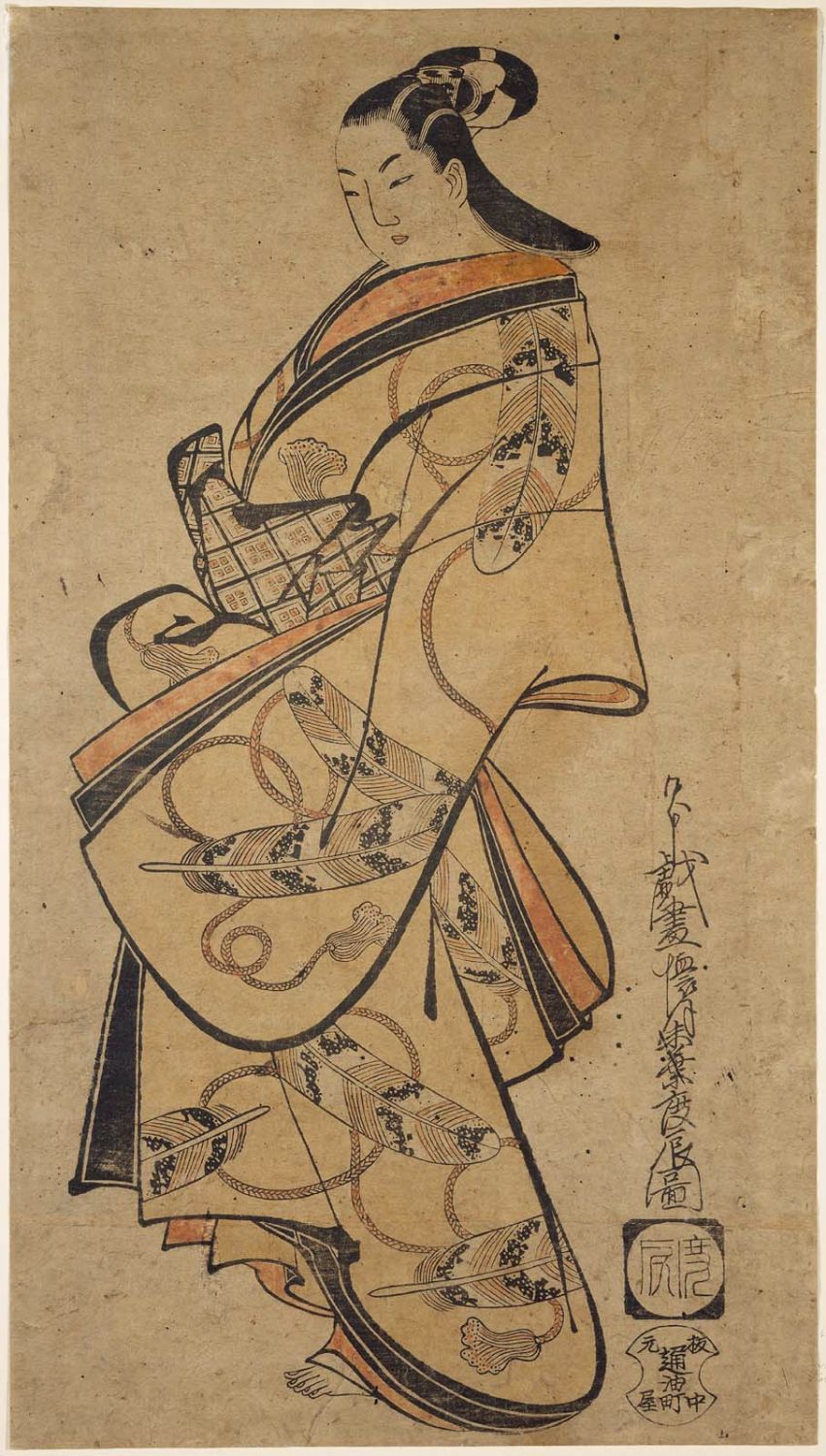
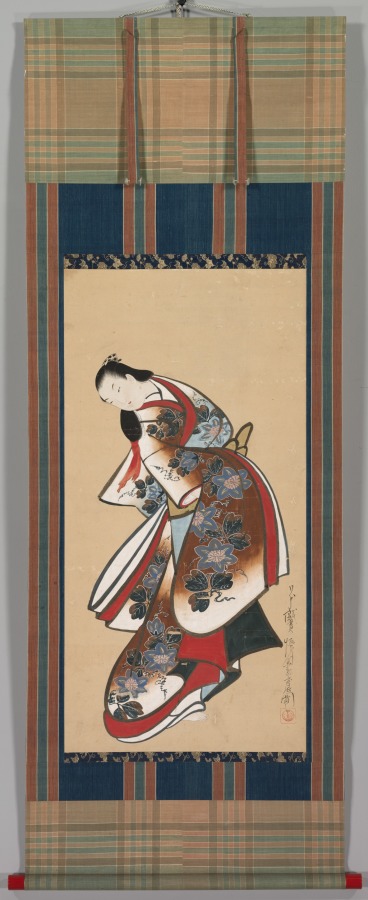
The Kaigetsudō school was founded by Kaigetsudō Ando (c. 1671-1743), who established a small but tightly disciplined workshop in the Asakusa district of Edo during the first decade of the eighteenth century. Ando and his pupils specialized almost exclusively in a single subject: full-length standing portraits of the highest-ranking courtesans (tayū and oiran) of the Yoshiwara pleasure quarter, rendered with bold ink contours, monumental scale, and lavishly patterned kimono. Unlike the Torii school, which served the kabuki theater, or the Hishikawa lineage, which produced narrative scrolls and book illustrations, the Kaigetsudō workshop functioned as a kind of branded portrait studio for an idealized vision of the Yoshiwara beauty, working to a sharply defined visual formula that subordinated individual sitter likeness to a powerful generic type. The school's signature pose — a tall, slightly twisting standing figure turned partially away from the viewer, the head inclined and the body wrapped in a sumptuously patterned outer robe falling open to reveal an underrobe of contrasting color and design — became one of the most recognizable images in all of ukiyo-e.
Doshin entered Ando's studio as a pupil and adopted the Kaigetsudō name along with the personal name Doshin (度辰), one of several pupil names that incorporated an element of the master's own name. The other principal Kaigetsudō pupils — Anchi (安知), Dohan (度繁), and Doshū (度種) — together with Doshin formed the workshop's productive core. Each followed the same compositional formula, and modern attribution among the Kaigetsudō names can be difficult, with several surviving paintings reassigned between hands as scholarship has developed. Doshin's hand is generally distinguished by a somewhat softer, more amiable manner — fuller forms and gentler facial expressions — set within the school's shared vocabulary.
The Kaigetsudō workshop's history was disrupted in 1714 by the Ejima-Ikushima scandal, in which Lady Ejima, a senior lady-in-waiting at the shogun's Edo Castle, was found to have visited the kabuki actor Ikushima Shingorō during an official outing. The scandal implicated dozens of court officials, women of the shogun's household, and members of the entertainment world; the kabuki theater itself was severely restricted, and Kaigetsudō Ando was caught up in the sweeping investigation that followed and banished from Edo to the island of Ōshima. Ando's exile effectively dissolved the workshop's organized production, but the surviving pupils, including Doshin, appear to have continued painting Kaigetsudō-style portraits for at least another decade or two. The dating of Doshin's career to c. 1711-1736 in standard museum catalogues reflects this post-1714 continuation, with the bulk of his identifiable work probably produced in the years surrounding Ando's departure.
Doshin's surviving output is dominated by hanging-scroll paintings in ink and color on paper, with the standing-figure composition repeated across many examples in characteristic Kaigetsudō variations of kimono pattern, accessory, and pose; he also treated less typical subjects, such as a courtesan seated and writing a letter. He was additionally responsible for one of the small group of large-format Kaigetsudō woodblock prints (mostly sumizuri-e or hand-colored monochromes) that survive in only a handful of impressions today, produced in such small quantities that the school's prints are among the rarest in the ukiyo-e canon. His Courtesan for the Ninth Month, a near-full-sheet vertical print in the Metropolitan Museum of Art, is one of the most important Kaigetsudō prints to survive.
Works attributed to Doshin are held by the Metropolitan Museum of Art — which owns more than one composition by him, including his celebrated print — as well as the Honolulu Museum of Art and the Art Institute of Chicago. The school as a whole occupies a distinctive position in the history of ukiyo-e: a brief, intense workshop that produced almost no commercial print volume but established a monumental visual vocabulary for the standing bijin that would echo in later ukiyo-e images of beautiful women well into the nineteenth century.
Key Facts
- Nationality
- 🇯🇵Japan
- Movement
- Ukiyo-e
- Works Indexed
- 1
Frequently Asked Questions
Kaigetsudō Doshin (懐月堂度辰, active c. 1711-1736) was one of the principal pupils of Kaigetsudō Ando and among the designers of the short-lived but enormously influential Kaigetsudō school, which dominated the production of large-format standing bijin paintings and prints in early-eighteenth-century Edo. Trained in his master's Asakusa studio during the Shōtoku and Kyōhō eras, Doshin extended the Kaigetsudō formula for monumental courtesan portraiture into the years following Ando's banishment in 1714, when the workshop's surviving members continued to produce hanging-scroll paintings and the rare oversized woodblock prints that constitute the school's most celebrated legacy.
Kaigetsudō Doshin's work was shaped by the Ukiyo-e tradition in Japanese woodblock printmaking. Ukiyo-e: ## What is ukiyo-e? Ukiyo-e ([浮世絵](/glossary/ukiyo-e)) — literally "pictures of the floating world" — is the Edo-period Japanese print and painting tradition that flourished from roughly 1660 to 1868, depicting the pleasures of urban life in Edo (modern Tokyo): courtesans, kabuki actors, sumo wrestlers, famous landscapes, and seasonal beauties.
Original prints by Kaigetsudō Doshin can be found in collections including Museum of Fine Arts, Boston.