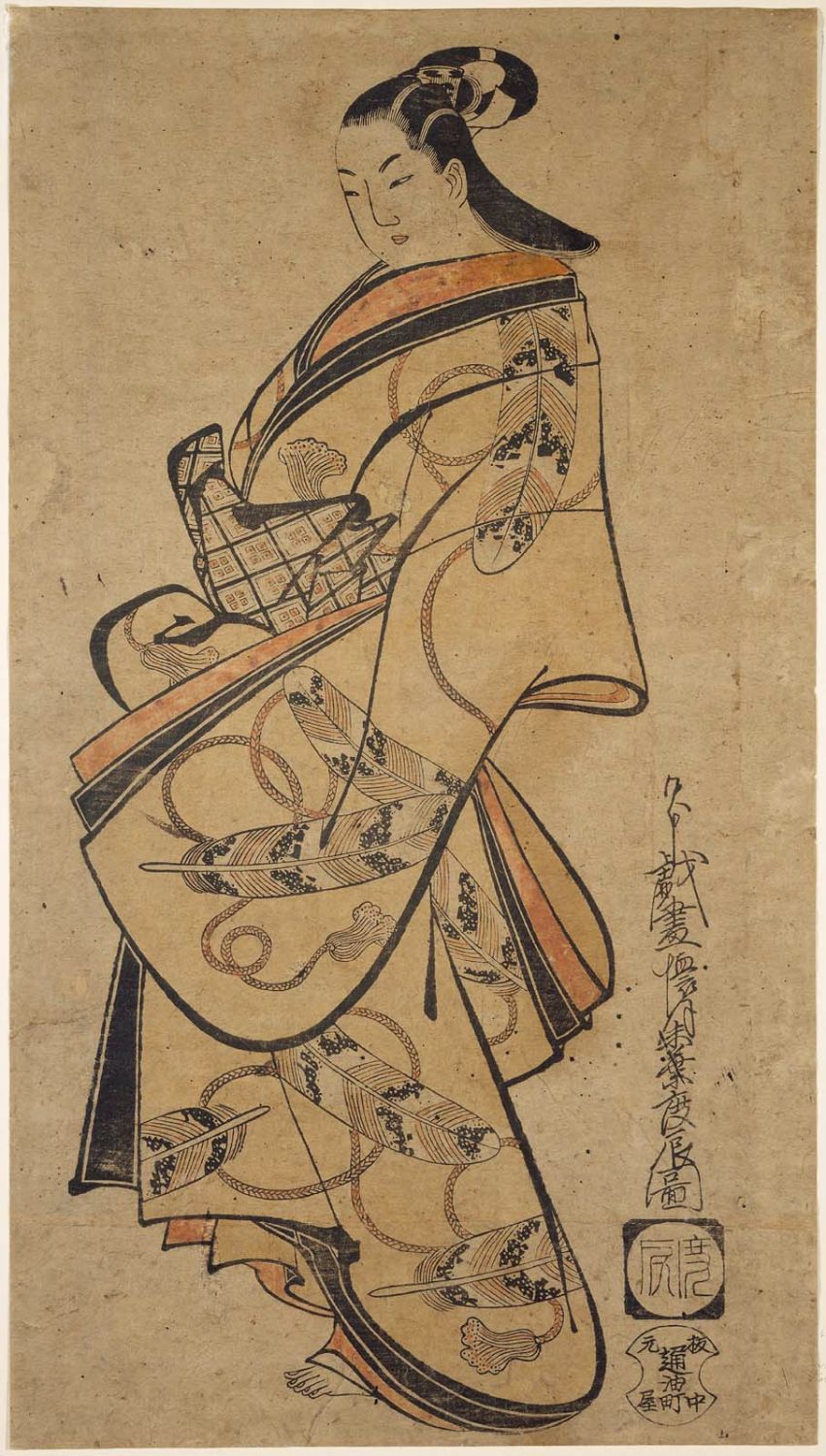
Standing Courtesan
- Date:
- before 1710
- Medium:
- Hanging scroll; ink and color on paper
- Source:
- Museum of Fine Arts, Boston
Description
Held in the Museum of Fine Arts, Boston (catalogued as sc192119 in the museum's ukiyo-e holdings) and dated before 1710, Standing Courtesan is a hanging-scroll painting that situates Doshin's work within the earliest phase of his identifiable production, when the Kaigetsudō workshop was still operating under Ando's active direction in Asakusa. The composition follows the workshop's foundational standing-figure formula: a tall solitary courtesan occupies the entire vertical sheet, set against an unornamented background that focuses every element of design onto the figure herself, her costume, and the descriptive economy of the ink line. Doshin renders the courtesan's body with the slight rotational twist that became the school's most identifiable spatial signature, the head inclined and turned so that the viewer reads the silhouette across multiple planes rather than as a frontal portrait. The kimono is rendered with the dense surface patterning that the Kaigetsudō workshop made into its trademark, with bold textile motifs across the outer robe and the obi treated as architectural fields rather than as merely decorative passages. The painting's pre-1710 dating, if accepted, makes it one of the earliest examples of Doshin's hand and a particularly valuable document of the workshop in its consolidated phase before the 1714 dispersion. Boston's Museum of Fine Arts holds one of the strongest concentrations of Kaigetsudō-school paintings in North America, and Doshin's Standing Courtesan stands as a defining example of the school's signature standing-bijin type.
Frequently Asked Questions
Standing Courtesan was created by Kaigetsudō Doshin (懐月堂度辰) in before 1710.