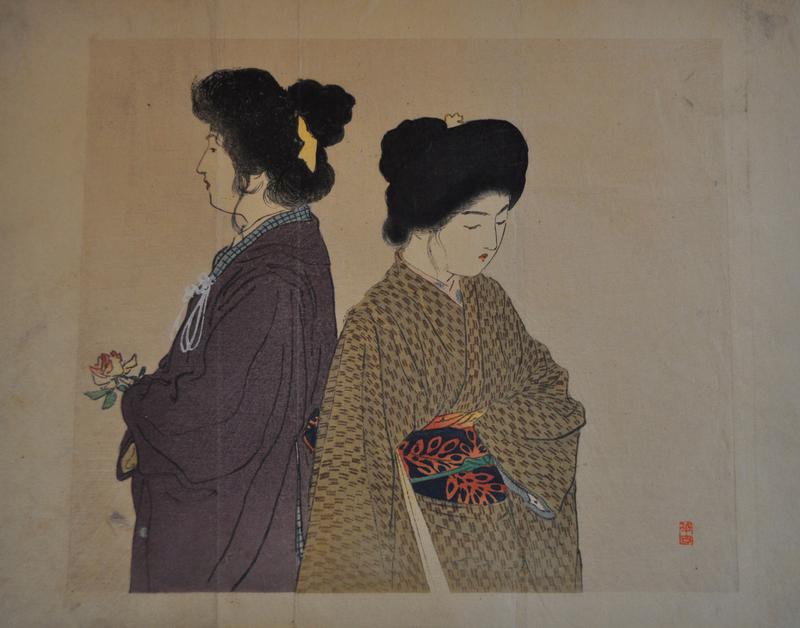
Biography
Kajita Hanko (梶田半古, 1870–1917) was a refined nihonga painter and illustrator of the Meiji and Taisho eras, known for his elegant historical and literary subjects, his prolific book and magazine illustration, and his influential role as a teacher who trained several of the leading nihonga painters of the twentieth century.
Born in the Shitaya district of Tokyo on July 23, 1870, Hanko trained in traditional Japanese painting from boyhood and developed a style marked by a delicate refinement of line and color and a deep grounding in classical subject matter. He worked in the techniques of traditional brush painting and mineral pigment, applying them with particular distinction to subjects drawn from Japanese history and classical literature.
Hanko established his reputation with paintings of historical and literary subjects rendered with grace and careful attention to costume and setting. His images of court nobles, warriors, and figures from classical literature earned him regard among connoisseurs and collectors who valued both visual beauty and cultivated subject matter.
In addition to his paintings, Hanko was a prolific illustrator who contributed designs to books and magazines, and he is especially remembered for his kuchi-e — the frontispiece illustrations for novels and literary periodicals that were a hallmark of Meiji-era publishing. This work brought his refined sensibility to a broad reading public and demonstrated his versatility across scales and formats.
Hanko's importance as a teacher may equal or exceed his significance as a painter in his own right. Among his pupils were Kobayashi Kokei, Maeda Seison, and Okumura Togyu, each of whom became a major figure in modern nihonga. Through these students, Hanko's commitment to refined draftsmanship and historical awareness was transmitted to the next generation of Japanese artists.
Hanko died on April 23, 1917, of tuberculosis, a relatively early death that cut short a distinguished career. His works are held in Japanese and international institutional collections, where they are recognized for their contribution to the nihonga tradition and their role in maintaining the connection between historical Japanese painting and the modern visual arts.
Key Facts
- Active Period
- 1870–1917
- Nationality
- 🇯🇵Japan
- Movements
- Meiji/Taishō PrintsShin-hanga
- Works Indexed
- 61
Frequently Asked Questions
Kajita Hanko (梶田半古, 1870–1917) was a refined nihonga painter and illustrator of the Meiji and Taisho eras, known for his elegant historical and literary subjects, his prolific book and magazine illustration, and his influential role as a teacher who trained several of the leading nihonga painters of the twentieth century.
Kajita Hanko was active from 1870 to 1917. They were associated with the Meiji/Taishō Prints and Shin-hanga movements.
Kajita Hanko's work was shaped by the Meiji/Taishō Prints and Shin-hanga traditions in Japanese woodblock printmaking. Meiji/Taishō Prints: Meiji and Taishō era prints (1868–1926) bridge the transition from traditional ukiyo-e to the modern shin-hanga and sosaku-hanga movements. Shin-hanga: ## What is Shin-hanga? Shin-hanga (新版画), literally "new prints," is the early twentieth-century revival of the collaborative Japanese woodblock workshop, organized between roughly 1915 and 1960 by the Tokyo publisher Watanabe Shōzaburō (1885–1962) and a handful of competing houses.
Kajita Hanko's prints frequently feature bijin-ga, figures, birds & flowers, landscapes, daily life, portraits.
Original prints by Kajita Hanko can be found in collections including Ohmi Gallery, Minneapolis Institute of Art, Japanese Art Open Database, mfa.