Biography
Katsuhira Tokushi (勝平得之, 1904–1971) was a Japanese sōsaku-hanga (creative print) printmaker whose entire artistic life was bound to a single place — Akita Prefecture, on the snow-coast of northern Honshū — and whose work constitutes one of the most sustained regional documentary projects in modern Japanese printmaking. While many of the better-known sōsaku-hanga masters of his generation gravitated to Tokyo or Kyoto and developed careers that ranged across subject and style, Katsuhira chose instead to remain in his native Akita and to spend four decades carving and printing scenes of the agricultural and festival life of the region. The result — a body of work produced from the late 1920s into the postwar decades — has become, for both art historians and Japanese folklore scholars, an invaluable visual record of pre-modern rural life on the cusp of its postwar disappearance.
He was born in Akita in 1904 into a farming family and educated locally. Before he came to printmaking he worked as a doll maker, and that early experience as a carver of forms is often credited with shaping the strong sense of material and texture in his prints. He had no formal academic art training. His path to woodblock printing began in 1928, when he took part in a woodblock-carving course connected to the Farmers Art Movement (nōmin bijutsu) that Yamamoto Kanae — the pioneer of the Japanese creative-print movement — had helped inspire in the 1920s. From that year he began designing, carving, and printing his own colour woodblocks in the jiga-jikoku-jizuri ("self-drawn, self-carved, self-printed") manner that defined sōsaku-hanga, and he began exhibiting with the Nihon Sōsaku-Hanga Kyōkai. Working essentially alone — designer, block-carver, printer, and at times even his own papermaker — he developed a slightly archaic precision of line that sets his prints apart from the avant-garde experiments of the urban print circles.
His subject was Akita: its rice paddies and irori-warmed farmhouses, its kamakura snow-huts, its bonden festival poles, and its great summer festival nights. The Kantō Matsuri of Akita — a Tanabata-related festival held each August, in which long bamboo poles hung with rice-paper lanterns are balanced on the foreheads and hips of young men in long lines down the city's streets, in prayer for an abundant harvest — became a recurring subject of his prints. The bonden, the brightly decorated rice-straw and paper ritual offerings carried in Akita's midwinter Bonden festival, are the subject of another of his prints. Together with his recurrent depictions of the irori (the sunken hearth around which rural families gathered through the long Akita winter), of snowbound village markets, of children at play, and of the seasonal foodways of the countryside, these works compose a remarkably complete ethnographic atlas of regional life as Katsuhira knew it from his own walks through the city and surrounding villages.
A notable episode in his career came in the winter of 1935–36, when the German modernist architect Bruno Taut — then living in exile in Japan after his flight from Nazi Germany, and deeply engaged in the study of Japanese vernacular architecture and craft — stayed in Akita, with Katsuhira serving as his guide to the region. Katsuhira later wrote an account of the visit, "Mr. Taut in Akita," and contributed an illustration to Taut's book Houses and People of Japan (1937). The encounter is remembered as having sharpened his sense of the irreplaceable beauty of the landscapes and customs of his own province.
His most concentrated and enduring project was the series Akita fūzoku jūdai (秋田風俗十題, "Ten Customs of Akita"), produced across the late 1930s and early 1940s. The series treated emblematic scenes of Akita life — among them the irori hearth (1939), the bamboo-leaf-wrapped sasamaki sweet cakes (1942), and the kakidate persimmon-drying rack of late autumn (1943) — each print built up from multiple colour blocks in a restrained but rich palette of indigo, umber, vermillion, and the cool greys of the long northern winter. Prints from the series are held by the Art Institute of Chicago, where the careful registration and the emphasis on textile and material texture characteristic of his mature work are clearly visible. Alongside it he produced print collections documenting the heating, cooking, and seasonal-food customs of the Akita winter at their most concentrated.
Katsuhira continued to design, carve, and print through the war years and into the postwar period, becoming a quietly central figure in the cultural life of Akita. He was awarded the Akita Prefecture Culture Prize in 1951 in recognition of the documentary and artistic value of his work, and his prints were increasingly shown in retrospective contexts in Akita and beyond. He died in 1971, having spent essentially his entire life within a few kilometres of his birthplace.
His place within twentieth-century Japanese printmaking is a distinctive one. He stands at the intersection of the sōsaku-hanga movement's modernist aesthetic, the mingei (folk-craft) movement's regionalist ethics, and the older tradition of seasonal landscape imagery that runs through Japanese visual culture. Unlike the more cosmopolitan urban sōsaku-hanga figures such as Onchi Kōshirō and Maekawa Senpan, he never fully broke with the descriptive conventions of his early work; unlike the folk craftsmen of Yanagi Sōetsu's mingei circle, he remained a self-conscious modern printmaker rather than an anonymous artisan. His prints are sometimes catalogued under both labels — sōsaku-hanga for the strict self-drawn, self-carved, self-printed procedure he followed, mingei for his regional rural subject and folk-cultural commitment — and that conjunction is part of what makes his work historically important. For collectors and scholars of mid-twentieth-century Japanese prints, Katsuhira Tokushi is the canonical Akita master, and his work is a principal surviving graphic record of how that province lived through the long transformations of the Shōwa era. His prints are held by the Art Institute of Chicago and in other public and museum collections in Japan and abroad, with significant holdings in his home prefecture of Akita, where his work continues to be collected, exhibited, and studied.
Key Facts
- Active Period
- 1904–1971
- Nationality
- 🇯🇵Japan
- Movement
- Sōsaku-hanga
- Subjects
- WinterChildrenBirds & Flowers
- Works Indexed
- 19
Frequently Asked Questions
Katsuhira Tokushi (勝平得之, 1904–1971) was a Japanese sōsaku-hanga (creative print) printmaker whose entire artistic life was bound to a single place — Akita Prefecture, on the snow-coast of northern Honshū — and whose work constitutes one of the most sustained regional documentary projects in modern Japanese printmaking. While many of the better-known sōsaku-hanga masters of his generation gravitated to Tokyo or Kyoto and developed careers that ranged across subject and style, Katsuhira chose instead to remain in his native Akita and to spend four decades carving and printing scenes of the agricultural and festival life of the region. The result — a body of work produced from the late 1920s into the postwar decades — has become, for both art historians and Japanese folklore scholars, an invaluable visual record of pre-modern rural life on the cusp of its postwar disappearance.
Katsuhira Tokushi was active from 1904 to 1971. They were associated with the Sōsaku-hanga movement.
Katsuhira Tokushi's work was shaped by the Sōsaku-hanga tradition in Japanese woodblock printmaking. Sōsaku-hanga: ## What is sōsaku-hanga? Sōsaku-hanga (創作版画, "creative prints") was a twentieth-century Japanese print movement defined by a single commitment: the artist must design, carve, and print every work alone.
Katsuhira Tokushi's prints frequently feature winter, children, birds & flowers.
Original prints by Katsuhira Tokushi can be found in collections including Museum of Fine Arts, Boston, Harvard Art Museums, Art Institute of Chicago, Honolulu Museum of Art.
Woodblock Prints by Katsuhira Tokushi (19)
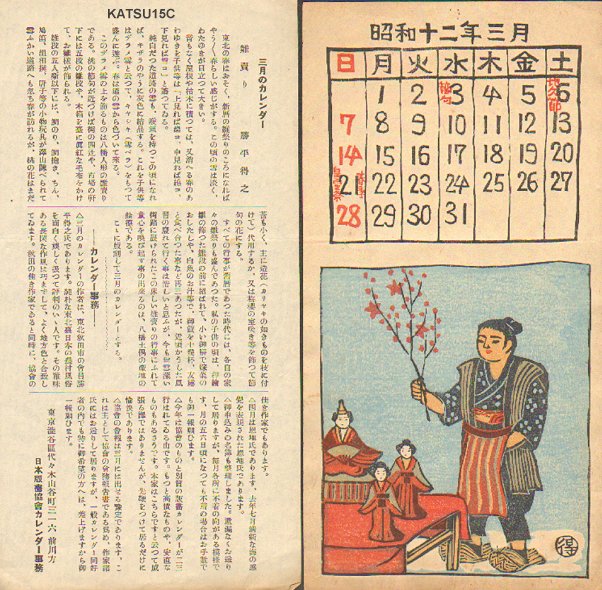
March, from Calendar Prints by Important Sōsaku-Hanga Artists
1937
Color woodblock print
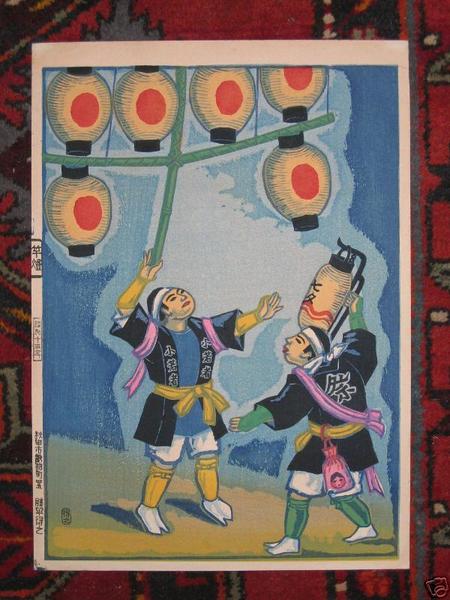
Lantern Pole (Sao-Toh)
竿燈
1938 (Shōwa 13)
Color woodblock print, ōban
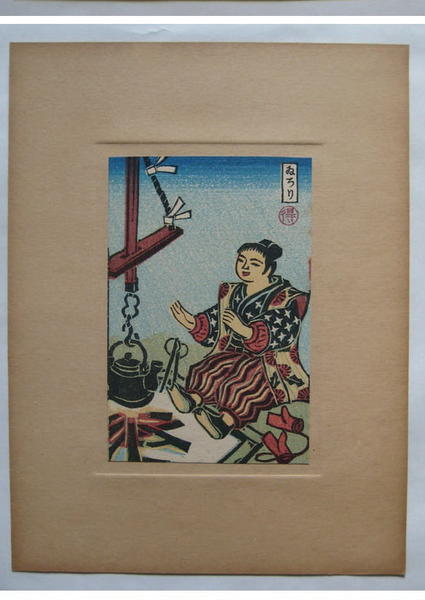
Nerori, from the Winter Print Collection (Fuyu no Hangashū)
冬の版画集 ねろり
1939
Color woodblock print
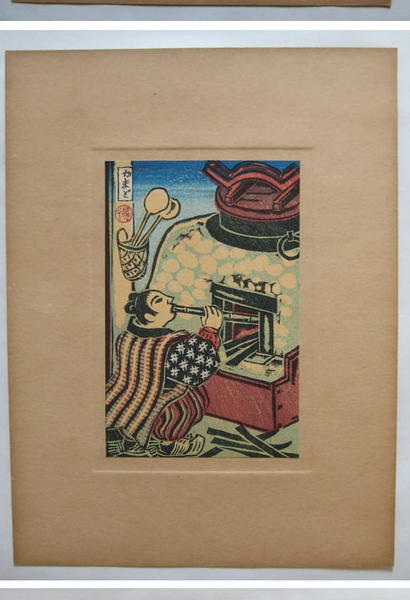
Cooking Stove, from the Winter Print Collection (Fuyu no Hangashū)
冬の版画集 竈
1939
Color woodblock print
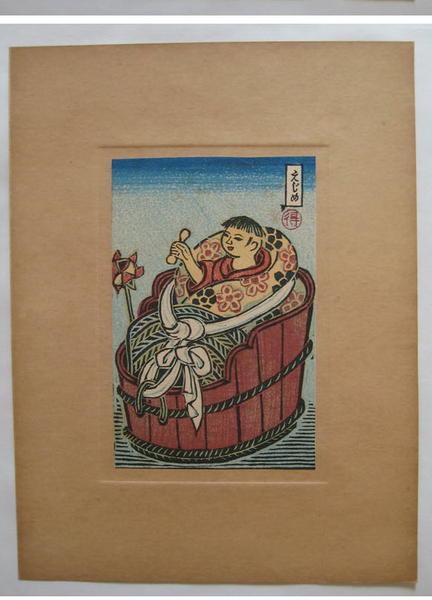
Ejime, from the Winter Print Collection (Fuyu no Hangashū)
冬の版画集 えじめ
1939
Color woodblock print

Oga Peninsula (Akita)
男鹿半島
March 1939
Color woodblock print

Hearth (Irori), from the series 'Ten Customs of Akita (Akita fuzoku judai)'
秋田風俗十題 囲炉裏
1939
Color woodblock print
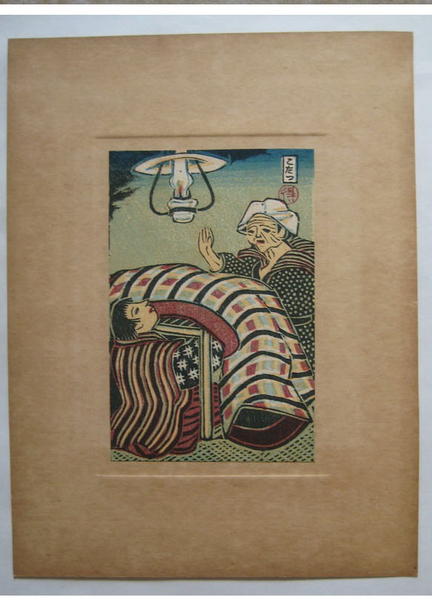
Kotatsu, from the Winter Print Collection (Fuyu no Hangashū)
冬の版画集 炬燵
1939
Color woodblock print
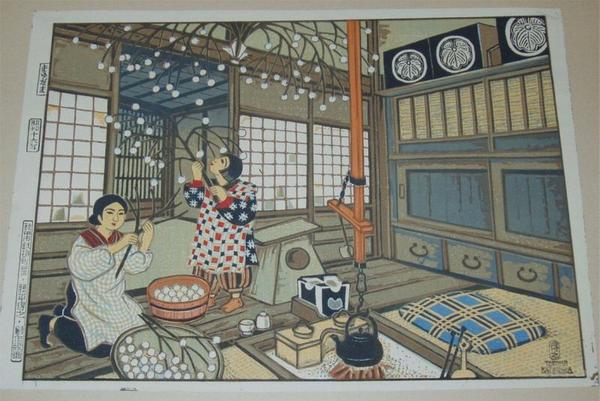
New Year Decoration with Cocoon-Shaped Cakes
1941
Color woodblock print

Sweet Cakes Wrapped in Bamboo Leaves (Sasamaki), from the series 'Ten Customs of Akita (Akita fuzoku judai)'
秋田風俗十題 笹巻
1942
Color woodblock print
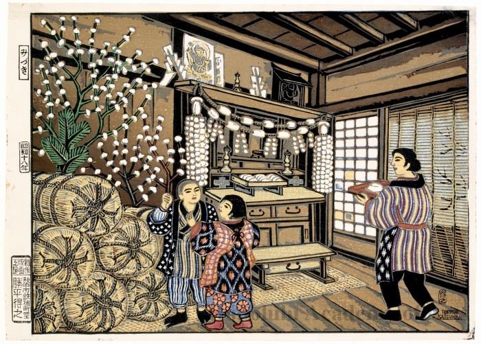
Interior of House with Family and Family Shrine
1943
Color woodblock print

Kakidate, from the series 'Ten Customs of Akita (Akita fuzoku judai)'
秋田風俗十題 柿立
1943
Color woodblock print
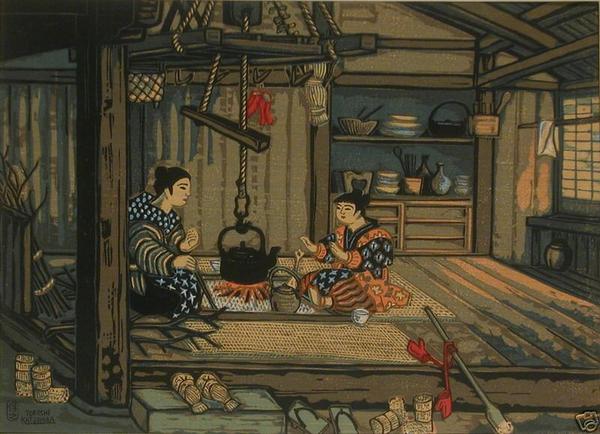
Traditional Family Home Scene
Shōwa period
Color woodblock print (self-carved and self-printed)
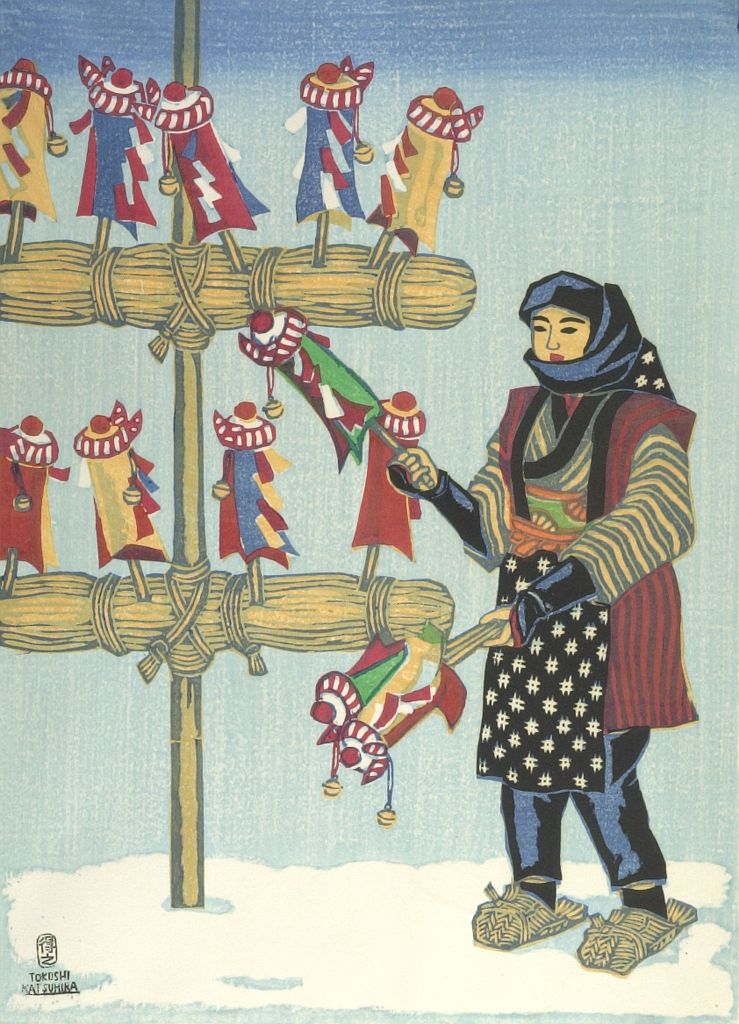
Seller of Bonden
Shōwa period (1926–1989)
Color woodblock print
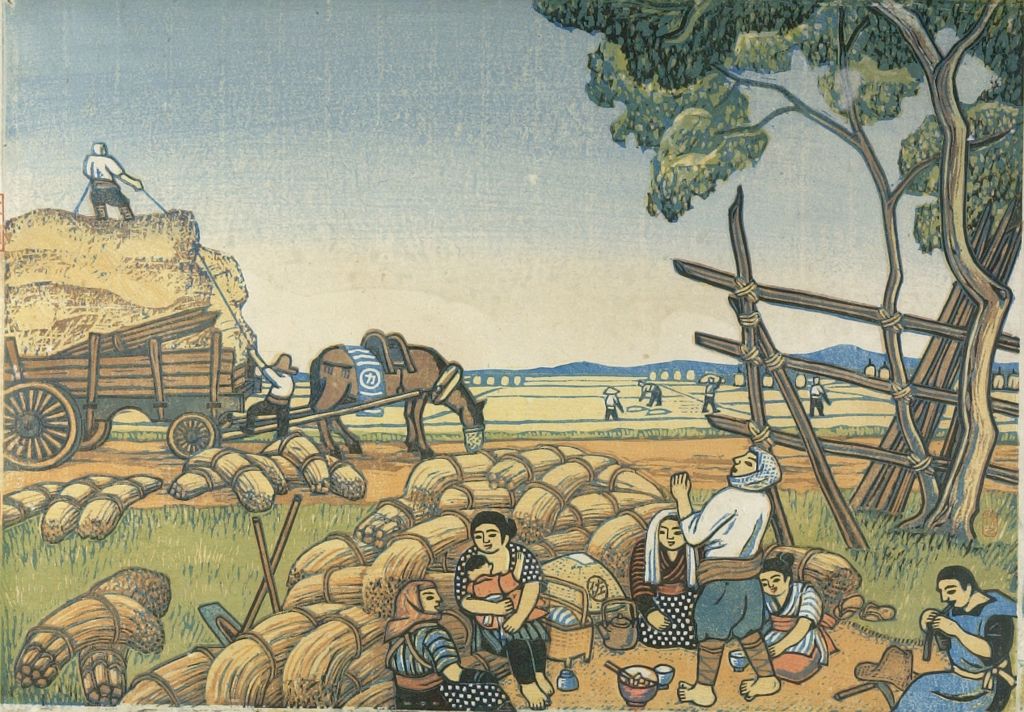
Harvest Scene
Shōwa period (1926–1989)
Color woodblock print
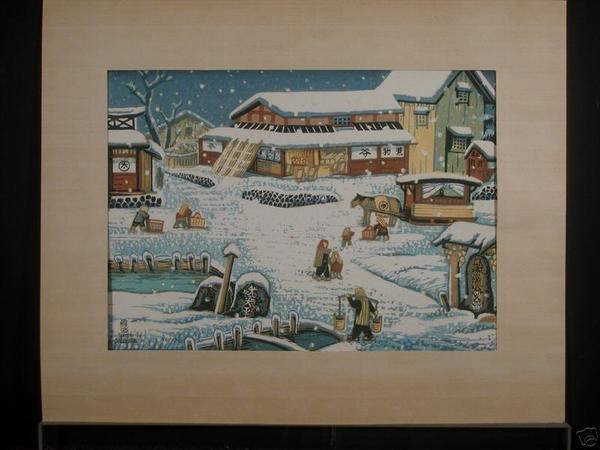
Town Snow Scene
Shōwa period
Color woodblock print (self-carved and self-printed)
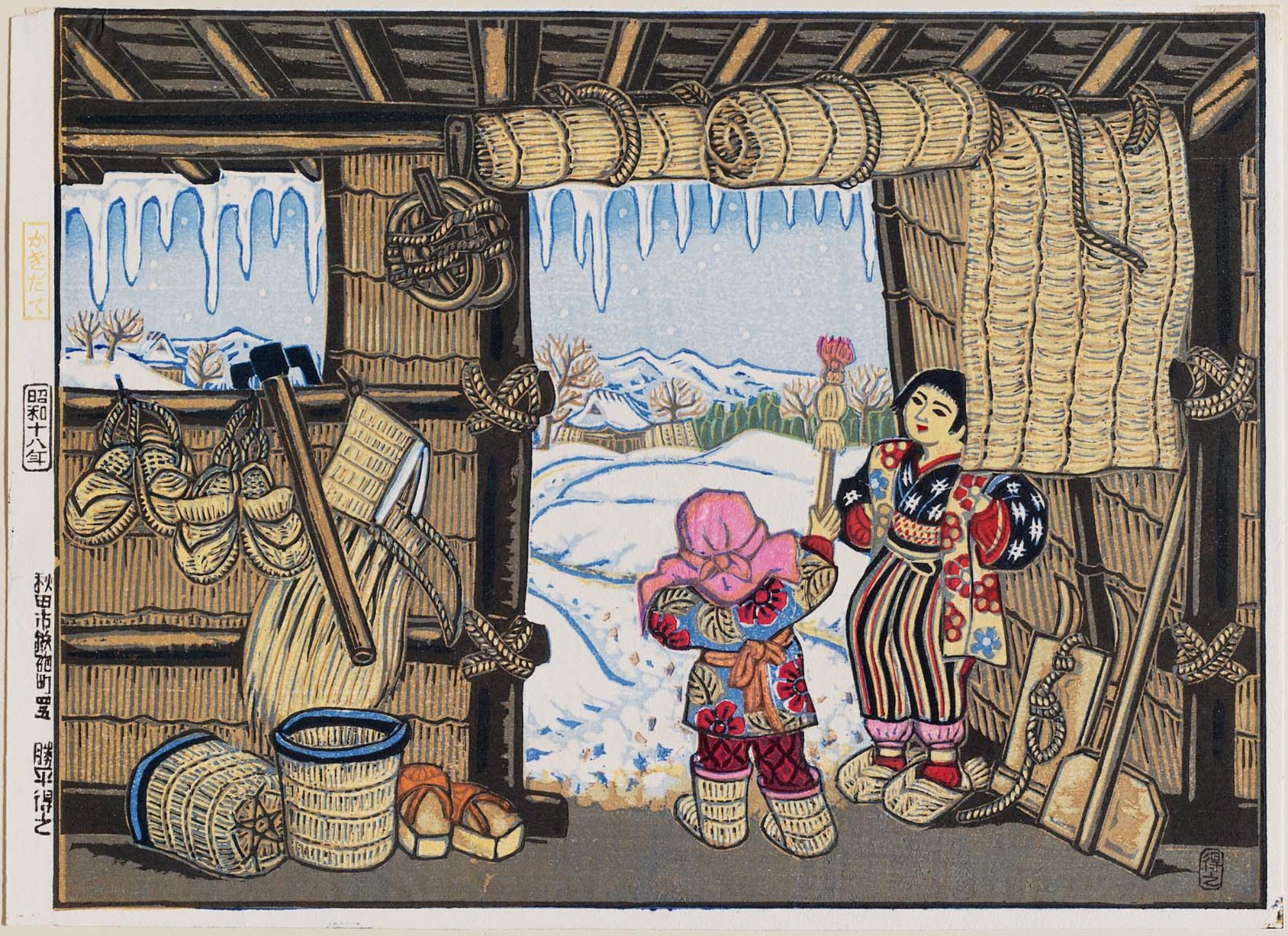
Two Children by Farm House Door
Shōwa era, 20th century
Color woodblock print
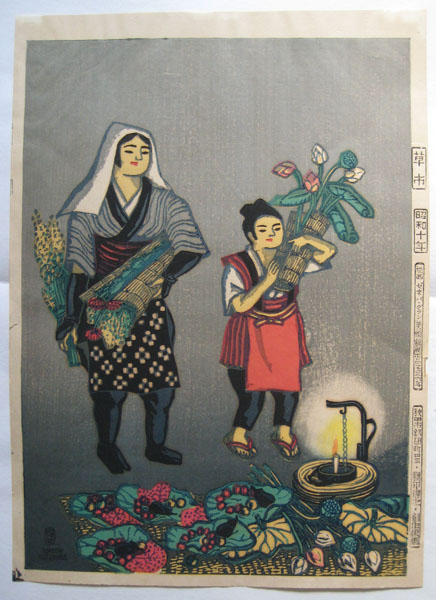
Flower Market
草市
Shōwa period
Color woodblock print
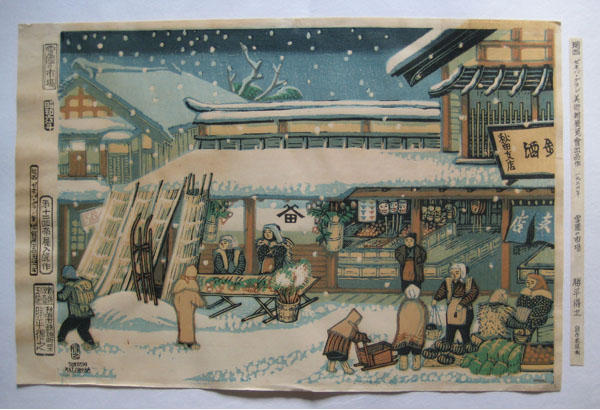
Market in the Snowy Country
雪國の市場
Shōwa period
Color woodblock print