
Biography
Katsushika Taito II (active 1810-1853) was a Japanese print designer and book illustrator who carried the Hokusai school style into the second quarter of the nineteenth century. He took his name from his teacher, Katsushika Hokusai, who used the art name Taito between roughly 1810 and 1819 before passing it to one of his most accomplished pupils. Taito II's biographical details are sparse—even his birth and death dates are unrecorded—but his surviving surimono, illustrated books, and harimaze prints document a long and productive career that bridged the late ukiyo-e of Hokusai's own generation and the print culture of the early Tempo and Koka eras.
The transmission of the Taito name was characteristic of how reputation passed through the Hokusai workshop. Hokusai cycled through many art names over his life—Shunro, Sori, Hokusai, Taito, Iitsu, Manji—and each name became, in effect, a workshop signature that could be granted to a senior student. When Hokusai relinquished Taito around 1819 and adopted Iitsu, his pupil received the name and the right to sign work with it. The pupil then signed himself Katsushika Taito, sometimes with the additional designation Beika or Beikasai, and continued to design prints in a manner closely aligned with his teacher's: bold figural compositions, decorative kacho-ga, and finely tuned surimono for poetry circles.
Taito II's surimono are his most distinctive contribution to the Hokusai-school legacy. Surimono were privately commissioned, deluxe-quality woodblock prints distributed by poetry groups (kyoka-ren) to mark seasonal occasions, New Year, or specific poetic themes. They were printed in small editions on thick hosho paper using shikishiban format—a near-square sheet of roughly 21 by 18 centimeters—and embellished with metallic pigments, blind embossing (karazuri), and elaborate color gradations that ordinary commercial prints could not afford. Taito II designed surimono for the Edo kyoka circles, most notably the Katsushika-ren, a poetry group tied to the same Katsushika lineage from which the Hokusai school took its name. His series Katsushika gosekku (Five Annual Festivals for the Katsushika Circle), produced in 1822, paired figures drawn from rural and urban Edo life with kyoka verses contributed by the group's members. Sheets from this series, such as A woman from Ohara leading an ox and Geisha looking up at a cuckoo, exemplify the surimono aesthetic—seasonally specific subjects, calligraphic poem cartouches, and the kind of refined printing effects that made these works prized objects for the poetry circles that commissioned them.
Bijin-ga, or images of beautiful women, formed a steady current in Taito II's surimono production. He often depicted women drawn from specific social roles—court ladies, itinerant musicians, geisha, women from the village of Ohara north of Kyoto known for their distinctive folk dress—rather than the generic beauties of mainstream ukiyo-e. Compositions such as Court lady standing amidst pines, Two women playing shuttlecock, and Woman on the bridge watching the moon show a designer who used the small surimono format to compress evocative moments of seasonal life into single, finely printed sheets. The pictures function as both image and gift: each one carried a poem on the same surface, and the figure's pose, costume, and setting were chosen to amplify the verse's seasonal reference.
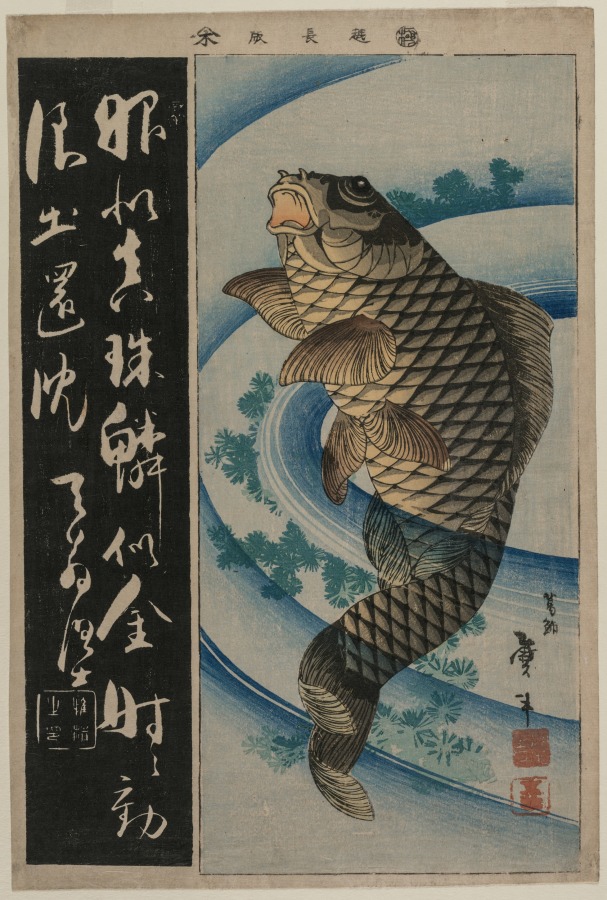
Kacho-ga, the category of bird-and-flower and plant-and-animal images, was the other major mode in which Taito II worked. His Carp, Carp and Waterweeds, Pine and cranes, and Two crabs by a spray of camellia sheets demonstrate the Hokusai-school approach to natural subjects: tightly observed forms, decorative pattern in the surrounding water or foliage, and a willingness to crop the composition for graphic impact. Several of these images survive as sections of harimaze sheets—multi-image prints in which a single oban page was divided into smaller scenes intended to be cut apart and pasted into albums or onto folding screens. The harimaze format was popular through the 1830s and 1840s, and Taito II contributed to it.
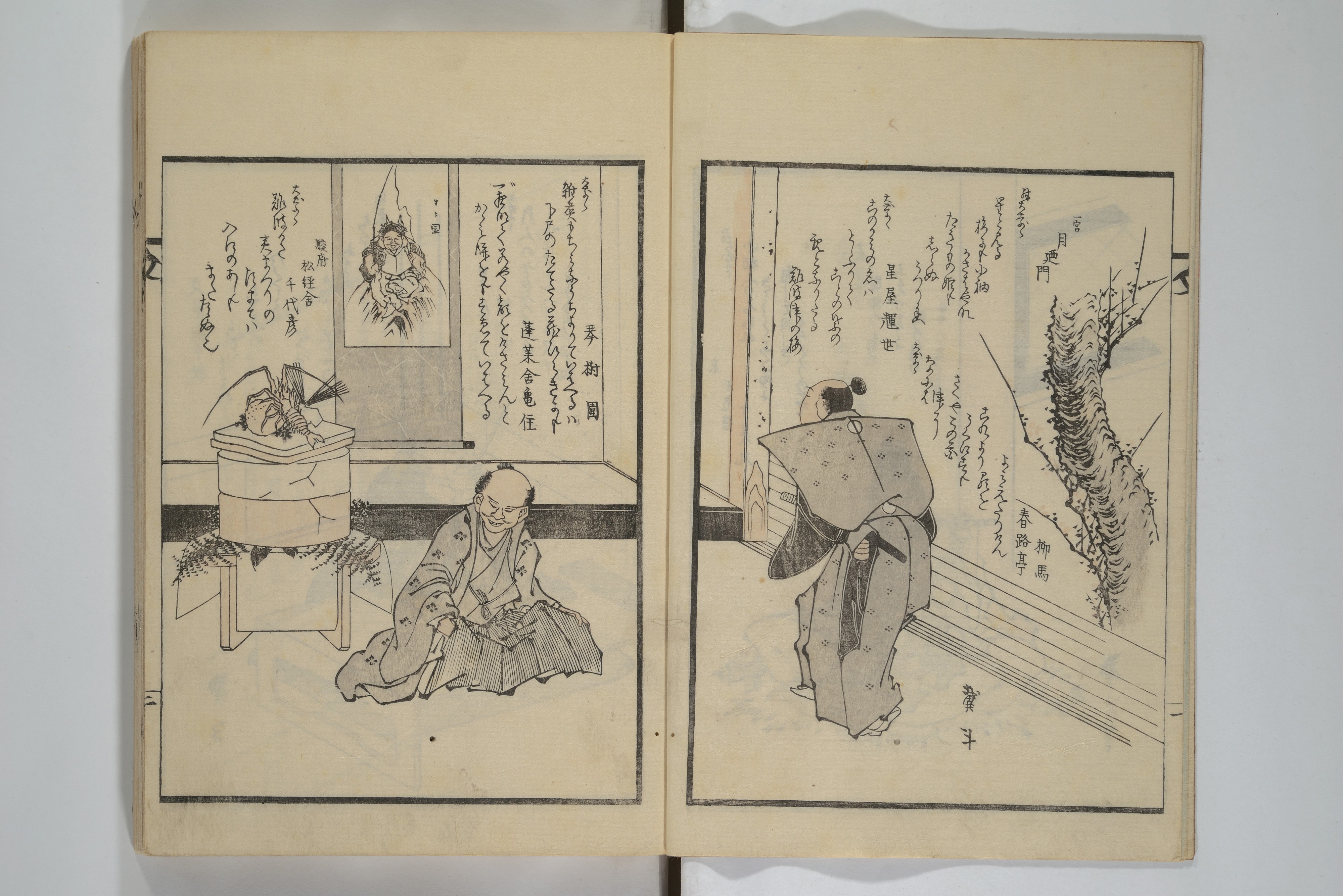
Taito II also worked extensively as a book illustrator, his ehon (picture book) projects spanning subjects from craft pattern collections to literary classics. Banshoku zuko (Pictorial Designs for All Artisans), published in multiple volumes during his active years, was a working pattern book aimed at craftsmen—lacquerers, metalsmiths, textile designers—who could draw motifs from its pages for their own work. Ehon Tsuzoku Sangoku Shi, which illustrated a text by Ikeda Tori, was a popular retelling of the Chinese Romance of the Three Kingdoms, a perennial source for nineteenth-century Japanese illustrators. Commercial books like these were Taito II's bread and butter—volumes that traveled widely and that, even today, are well represented in major museum print collections.
The question of who exactly Taito II was, beyond the art name, has occupied scholars of Japanese prints for more than a century. Old Japanese print catalogues recorded him under several names, including the go Hokusen and the personal name Kondō Fumio; modern scholarship has tended to treat "Katsushika Taito II" as a single coherent identity active across the dates his signed works cover, while acknowledging that the name may have been used by more than one hand. What is not in dispute is the consistency of style: Taito II's prints retain the broad-shouldered figural drawing, taut linear contours, and integrated calligraphic spaces that mark the Hokusai school. He is among the small group of designers—including Hokkei, Hokuju, Hokuba, and Gakutei—who kept the Hokusai manner alive into the 1830s and 1840s, decades when Hiroshige and Kuniyoshi dominated the commercial print market.
Today Katsushika Taito II's surimono and ehon are held by the Art Institute of Chicago, the Museum of Fine Arts, Boston, the British Museum, and the Cleveland Museum of Art. For collectors and students of Japanese prints, his work is essential to understanding how the Hokusai workshop functioned as a transmissible tradition and how surimono served as the high-end, privately printed counterpart to the mass-market ukiyo-e of the same decades.
Key Facts
- Nationality
- 🇯🇵Japan
- Movement
- Ukiyo-e
- Works Indexed
- 23
Frequently Asked Questions
Katsushika Taito II (active 1810-1853) was a Japanese print designer and book illustrator who carried the Hokusai school style into the second quarter of the nineteenth century. He took his name from his teacher, Katsushika Hokusai, who used the art name Taito between roughly 1810 and 1819 before passing it to one of his most accomplished pupils. Taito II's biographical details are sparse—even his birth and death dates are unrecorded—but his surviving surimono, illustrated books, and harimaze prints document a long and productive career that bridged the late ukiyo-e of Hokusai's own generation and the print culture of the early Tempo and Koka eras.
Katsushika Taito II's work was shaped by the Ukiyo-e tradition in Japanese woodblock printmaking. Ukiyo-e: ## What is ukiyo-e? Ukiyo-e ([浮世絵](/glossary/ukiyo-e)) — literally "pictures of the floating world" — is the Edo-period Japanese print and painting tradition that flourished from roughly 1660 to 1868, depicting the pleasures of urban life in Edo (modern Tokyo): courtesans, kabuki actors, sumo wrestlers, famous landscapes, and seasonal beauties.
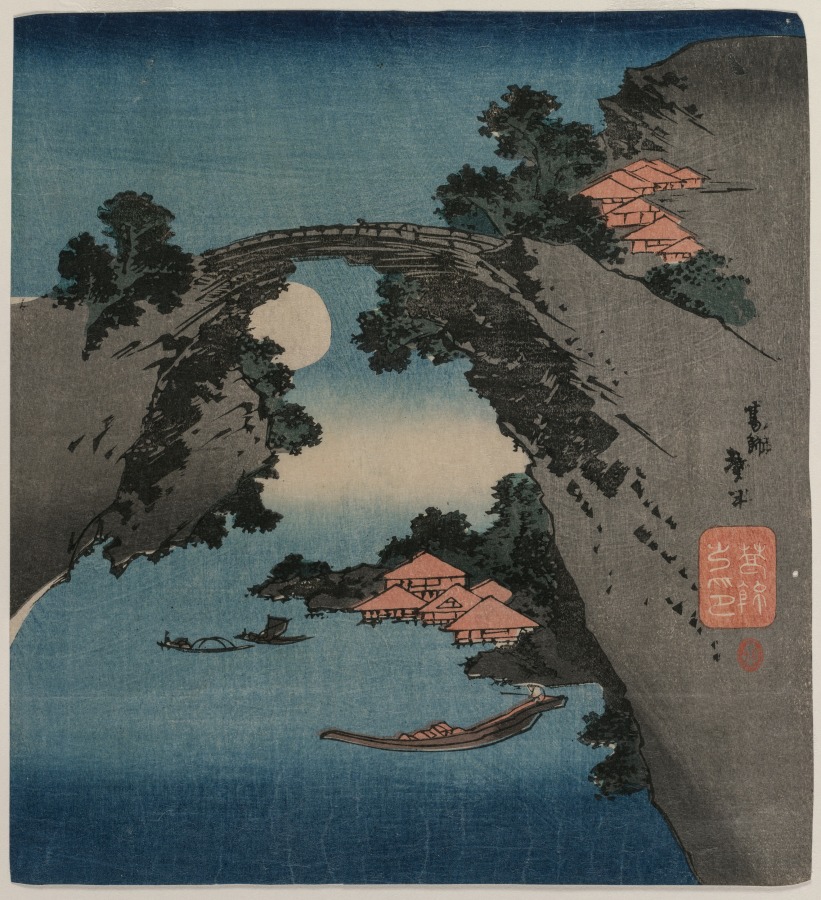
Katsushika Taito II's prints frequently feature bridges, fish, moonlight, birds & flowers.
Original prints by Katsushika Taito II can be found in collections including Art Institute of Chicago, Cleveland Museum of Art, Victoria and Albert Museum, Metropolitan Museum of Art.
Woodblock Prints by Katsushika Taito II (23)
Two Women Playing Shuttlecock
1810-53
Color woodblock print; shikishiban diptych; surimono

Court lady standing amidst pines
c. 1823
Color woodblock print; shikishiban, surimono
Illustrated Collection of the Famous Products of Japan (Nihon meibutsu gasan shū) 日本名物画賛集
ca. 1820s
Woodblock printed book; ink and color on paper

Geisha looking up at a cuckoo, from the series "Five Annual Festivals for the Katsushika Circle (Katsushika gosekku)"
1822
Color woodblock print; shikishiban, surimono

A woman from Ohara leading an ox, from the series "Five Annual Festivals for the Katsushika Ciricle (Katsushika gosekku)"
1822
Color woodblock print; shikishiban, surimono
(Transmitted from the Gods) Ippitsu Picture Book ((Denshin kaishu) Ippitsu gafu)
1823

Itinerant female musician, from the triptych "Series of Three (Sanbantsuzuki)"
c. 1830
Color woodblock print; one sheet of shikishiban triptych, surimono

Monkey bridge
c. 1830/44
Color woodblock print; oban, harimaze

Carp
c. 1830/44
Color woodblock print; section of harimaze sheet

Daoist immortal Li Tieguai (Japanese: Tekkai)
c. 1830/44
Color woodblock print; section of harimaze sheet

Two crabs by a spray of camellia
late 1820s–early 1830s
Color woodblock print; shikishiban, surimono

Hotei seated on a sack playing a zither, from an untitled series of harimaze
c. 1830s
Color woodblock print; section of harimaze sheet
Carp and Waterweeds
c. early 1830s
color woodblock print
The Monkey Bridge
early 1830s
color woodblock print

Two women gathering herbs
early 1830s
Color woodblock print; shikishiban, surimono

Woman on the bridge watching the moon
1831
Color woodblock print; shikishiban, surimono

A woman from Ohara on horseback
1834
Color woodblock print; shikishiban, surimono
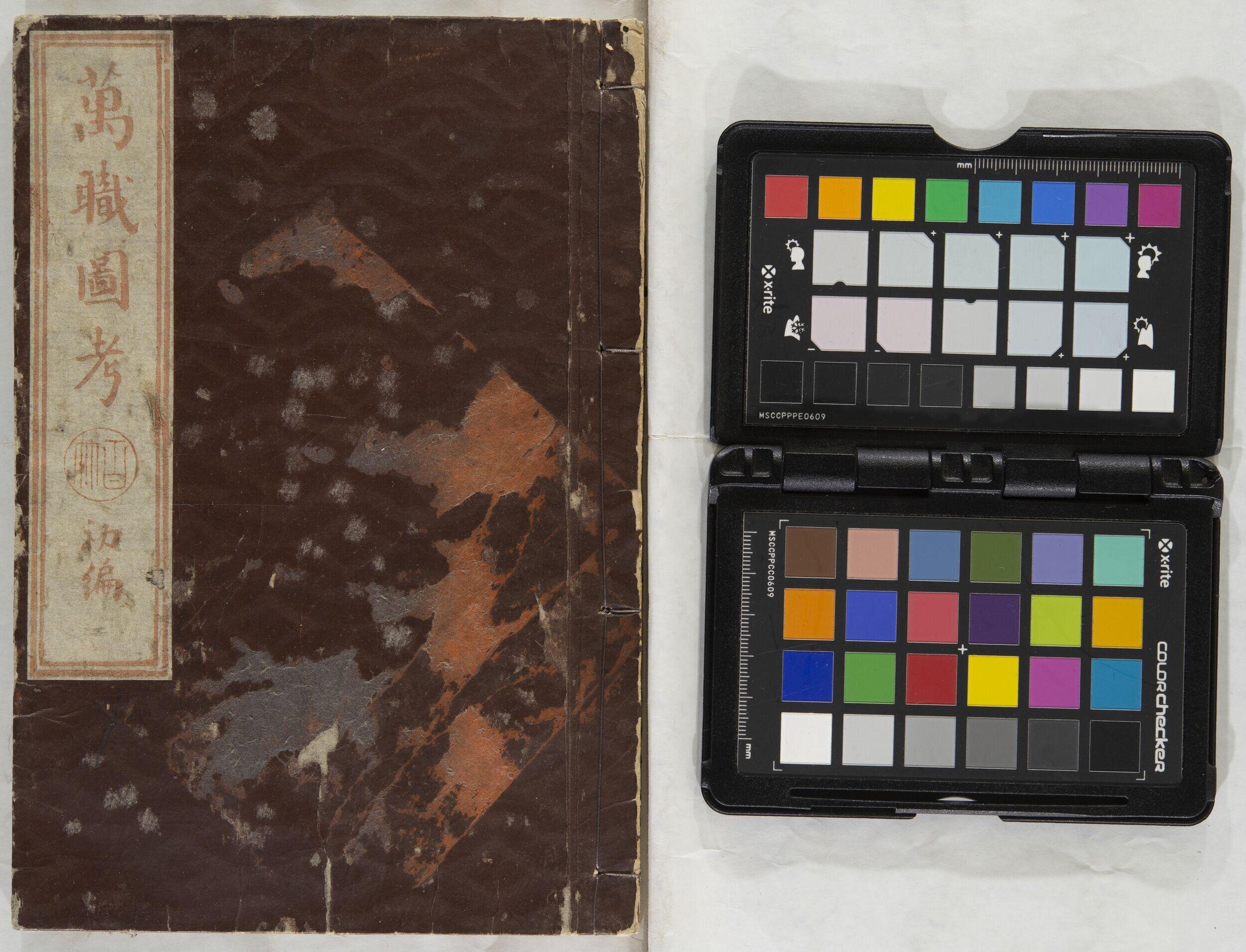
Pictorial Designs for All Artisans, (Banshoku zukō), vol.1
1835

Pine and cranes
c. 1830/44
Color woodblock print; section of harimaze sheet

Ehon Tsūzoku Sangoku Shi
19th century
Woodblock- printed book; 1 vol.

Kachō gaden
19th century
Woodblock- printed book; 2 vols.

Banshoku zukō
c. 1810-1853
Woodblock- printed book; 5 vols.

Wago Inshitsu mon E-shō
1820
Woodblock- printed book; 2 vols.