
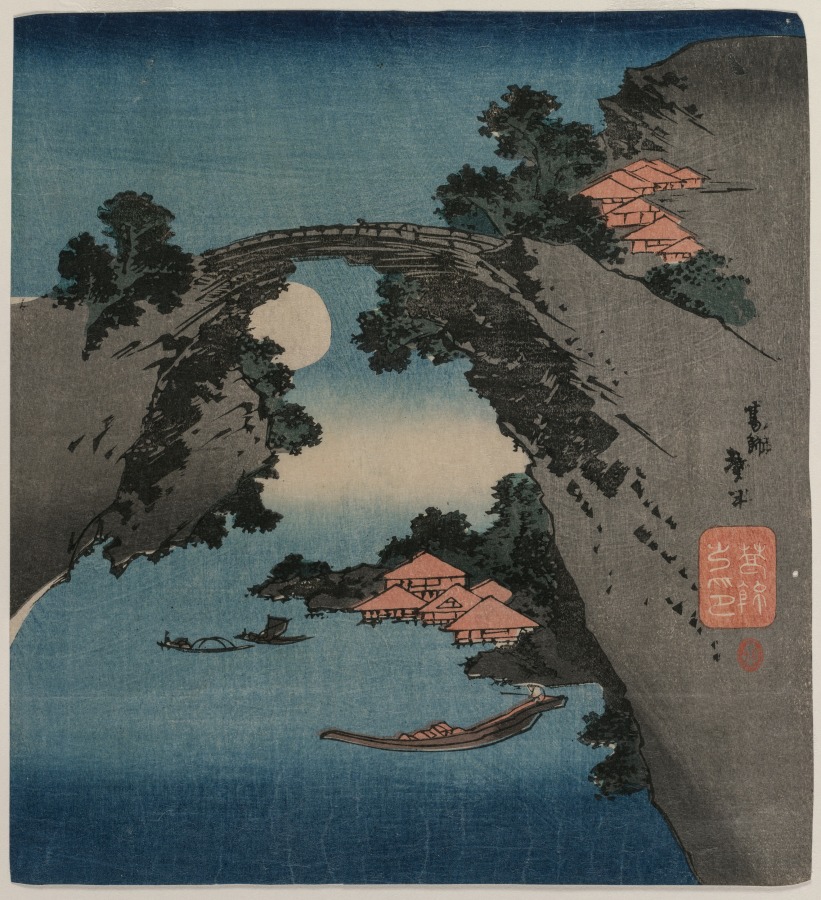
Woman on the bridge watching the moon
- Date:
- 1831
- Medium:
- Color woodblock print; shikishiban, surimono
- Source:
- Art Institute of Chicago
Description
Woman on the bridge watching the moon, dated 1831 and held by the Art Institute of Chicago, is a shikishiban surimono showing a single female figure paused on a wooden bridge, her head turned upward to look at the moon. Moon-viewing (tsukimi) was one of the most enduring poetic occasions in Japanese culture, with autumn moon-viewing parties celebrated through both classical waka and Edo-period kyoka. The bridge setting—a familiar Edo motif from Hokusai's own work—introduces additional layers of meaning: a bridge can mark transition, separation, or the literal crossing over water that linked moon and reflection in many tsukimi poems. Taito II renders the figure in a vertically elongated pose appropriate to the upright surimono composition, her face raised so that the reader's eye follows hers to the moon at the top of the sheet. The shikishiban format allowed the surimono printer to use gradated washes for the night sky and metallic pigments for the moon itself, refinements typical of the privately commissioned print.
More Prints by Katsushika Taito II


More Bridges Prints
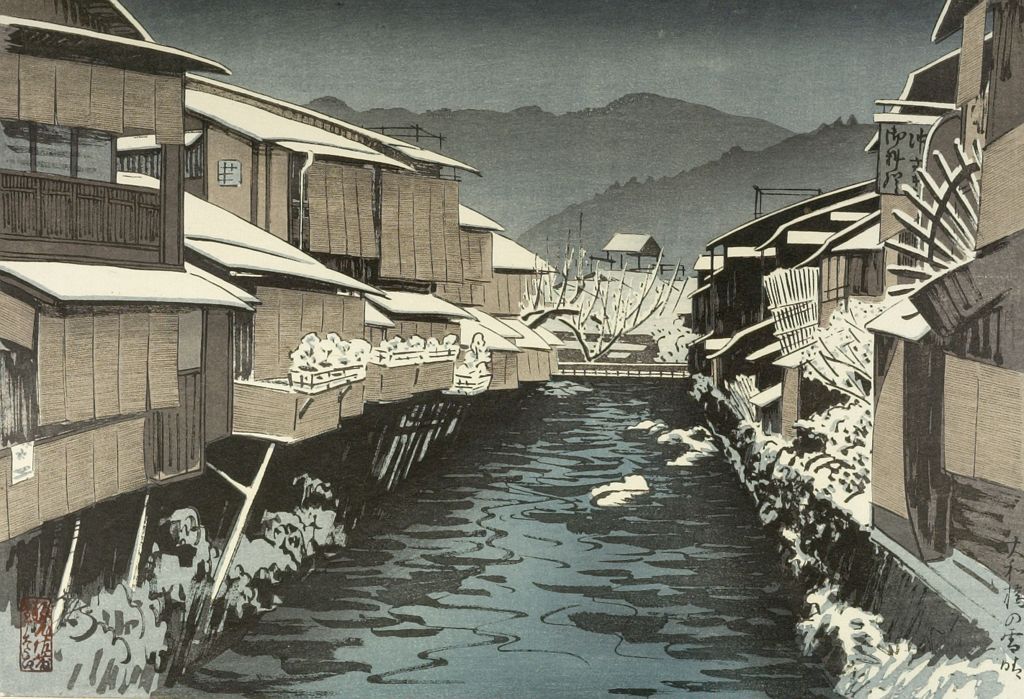
Fair Weather After Snow at Yamato Bridge, Kyoto (Yamato bashi no yukibare), Taishô period, dated 1924
Woodblock print
![Mount Fuji on a Moonlit Night, Kawai Bridge (Tsukiyo no Fuji [Kawaibashi]), from the series "Selection of Views of the Tokaido (Tokaido fukei senshu)" by Kawase Hasui](https://www.artic.edu/iiif/2/d0960668-1e73-339a-b182-fb995a54bff0/full/843,/0/default.jpg)
Mount Fuji on a Moonlit Night, Kawai Bridge (Tsukiyo no Fuji [Kawaibashi]), from the series "Selection of Views of the Tokaido (Tokaido fukei senshu)"
1947
Color woodblock print; oban

Shin Ohashi Bridge (Shin Ohashi), from the series "Twenty View of Tokyo (Tokyu nijukkei)"
1926
Color woodblock print; oban

Sacred Bridge in Nikko (Nikko Shinkyo)
1930
Color woodblock print; oban
Frequently Asked Questions
Woman on the bridge watching the moon was created by Katsushika Taito II (葛飾戴斗) in 1831.
Woman on the bridge watching the moon depicts bridges and moonlight.