
Kawabata Gyokushō
川端玉章
1842–1913
Japan
Biography
Kawabata Gyokushō (1842–1913) was one of the most influential Japanese painters and teachers of the Meiji period, a leading representative of the Maruyama-Shijō tradition transplanted from Kyoto to Tokyo, a professor at the Tokyo School of Fine Arts (Tōkyō Bijutsu Gakkō), a member of the Art Committee of the Imperial Household (Teishitsu Gigeiin), and the founder in 1909 of the Kawabata Painting School (Kawabata Gagakkō), a private Tokyo academy that trained a number of notable painters of the following generation. Working at the center of the institutional reorganization of Japanese painting that followed the Meiji Restoration, Gyokushō helped translate the eighteenth-century Kyoto naturalism of Maruyama Ōkyo into a viable modern nihonga practice for a national audience while training the next generation in the disciplines of sketching from life and ink and color on silk. He is often described as the last master of the Maruyama school.
Gyokushō was born in Kyoto on April 18, 1842, the son of a maki-e (gold-lacquer) artisan, and his earliest training came in the family workshop, where the precise drawing required for lacquer decoration gave him the foundations of a brush practice. In 1852, at about the age of eleven, he entered the studio of Nakajima Raishō (1796–1871), the leading Maruyama-Shijō painter of mid-nineteenth-century Kyoto and a lineal heir to Maruyama Ōkyo's eighteenth-century shasei (sketching from life) tradition. Under Raishō he absorbed the close observational drawing of animals, birds, flowers, and landscapes that defined the Maruyama line — a sensibility he carried throughout his long career — and he supplemented his art training with classical Chinese literary study and kokugaku (national learning). He took the art name Gyokushō (玉章) and had begun to attract notice in Kyoto art circles by his late teens.
In 1866 Gyokushō moved to Tokyo (then still called Edo), and after the Meiji Restoration of 1868 he established a practice in the capital that placed him at the center of the new national art world. The early Meiji period was a moment of acute crisis for traditional Japanese painting, as the rapid Westernization of education and the institutional rise of yōga (Western oil painting) threatened to displace the inherited brush traditions. Gyokushō engaged directly with the new methods: in the early 1870s he took up the study of Western-style oil painting, gaining a working knowledge of European perspective and naturalism that he selectively incorporated into his nihonga without abandoning its core. By the 1880s he was a recognized senior figure in the Tokyo painting world, exhibiting in the government-sponsored painting exhibitions of the period.
Gyokushō's place on the teaching staff of the Tokyo School of Fine Arts (Tōkyō Bijutsu Gakkō) — the Meiji government's official answer to the question of how Japanese painting could be transmitted in a modern educational system, established under the guidance of Okakura Kakuzō (Tenshin) and Ernest Fenollosa — was the central institutional event of his career. He was among the painters brought onto its early teaching staff, becoming a professor there in 1890 and teaching the Maruyama-school line alongside colleagues such as Hashimoto Gahō. In 1896 he was appointed an Imperial Household Artist (Teishitsu Gigeiin), the highest official honor then available to a Japanese painter. When the political conflicts of 1898 led Okakura, Yokoyama Taikan, and others to secede and found the Japan Art Institute (Nihon Bijutsuin), Gyokushō remained among the senior figures retained by the academic establishment; he continued to teach at the school until 1912 and took part in the government's new Bunten (Ministry of Education Art Exhibition) system after its founding in 1907.
In 1909, near the end of his career, Gyokushō founded the Kawabata Painting School (Kawabata Gagakkō) in Tokyo at his own expense, a private academy for training in the Maruyama-Shijō and broader nihonga traditions. Long enthusiastic about the education of younger painters, he taught a substantial number of pupils over his career — among them Hirafuku Hyakusui, Yūki Somei, Fujishima Takeji, Otake Chikuha, and Ishii Hakutei — and a group of seven of his students went on to form the painting society known as the Museikai. The school's emphasis on shasei (sketching from life) and on a careful traditional grounding before any modernist experimentation gave it a distinctive identity within the increasingly fragmented Tokyo art world of the early twentieth century, and it continued under his successors after his death.
Gyokushō's own paintings — the body of work for which he is best known to museum audiences — range across the standard genres of Meiji nihonga: kachō-e (bird-and-flower painting), sansui-ga (landscape), figure paintings of historical and literary subjects, and animal studies. Closely observed bird-and-flower and animal subjects among the album leaves in the Metropolitan Museum of Art, several of them 1914 gifts, show the Maruyama discipline in miniature, while larger works such as the Met's Spring Landscape and the Minneapolis Institute of Art's Tiger by a Stream demonstrate the larger-scale, public-facing painting expected of an Imperial Household Artist. He also produced occasional woodblock-printed and illustrated album work, reflecting the Meiji-period overlap between nihonga painters and the high-end illustrated book and album trade. Gyokushō died in Tokyo on February 14, 1913, at the age of seventy. Within the history of modern Japanese painting he is remembered both as a transmitter — the last major nineteenth-century Maruyama-school painter to teach at the highest institutional level — and as a maker of carefully crafted bird-and-flower and landscape paintings whose Edo-derived discipline survives through the collections of major museums.
Key Facts
- Active Period
- 1842–1913
- Nationality
- 🇯🇵Japan
- Subjects
- Birds & FlowersSpringMount Fuji
- Works Indexed
- 10
Frequently Asked Questions
Kawabata Gyokushō (1842–1913) was one of the most influential Japanese painters and teachers of the Meiji period, a leading representative of the Maruyama-Shijō tradition transplanted from Kyoto to Tokyo, a professor at the Tokyo School of Fine Arts (Tōkyō Bijutsu Gakkō), a member of the Art Committee of the Imperial Household (Teishitsu Gigeiin), and the founder in 1909 of the Kawabata Painting School (Kawabata Gagakkō), a private Tokyo academy that trained a number of notable painters of the following generation. Working at the center of the institutional reorganization of Japanese painting that followed the Meiji Restoration, Gyokushō helped translate the eighteenth-century Kyoto naturalism of Maruyama Ōkyo into a viable modern nihonga practice for a national audience while training the next generation in the disciplines of sketching from life and ink and color on silk. He is often described as the last master of the Maruyama school.
Kawabata Gyokushō was active from 1842 to 1913.
Kawabata Gyokushō's prints frequently feature birds & flowers, spring, mount fuji.
Original prints by Kawabata Gyokushō can be found in collections including Musée Cernuschi (via Wikimedia Commons), Metropolitan Museum of Art, Metropolitan Museum of Art (via Wikimedia Commons), Rijksmuseum (via Wikimedia Commons).
Woodblock Prints by Kawabata Gyokushō (10)
Spring Warmth (Haru atatakai no zu)
春暖之図
March 1881
Hanging scroll; ink and color on silk

Temple with Plums; Distant Sailboats
梅と寺・遠帆図
ca. 1880–1890
Color woodblock print

Eggplant Plant and Mount Fuji
茄子と富士図
ca. 1880–1890
Color woodblock print

Parasol and Irises
傘と菖蒲図
ca. 1880–1890
Color woodblock print

A Horse Washing in a River
川中洗馬図
ca. 1880–1890
Color woodblock print

Flowering Tree at a Temple
寺院花木図
ca. 1880–1890
Color woodblock print

Crane Among Reeds
葦間鶴図
1887–92
Album leaf; ink and color on silk
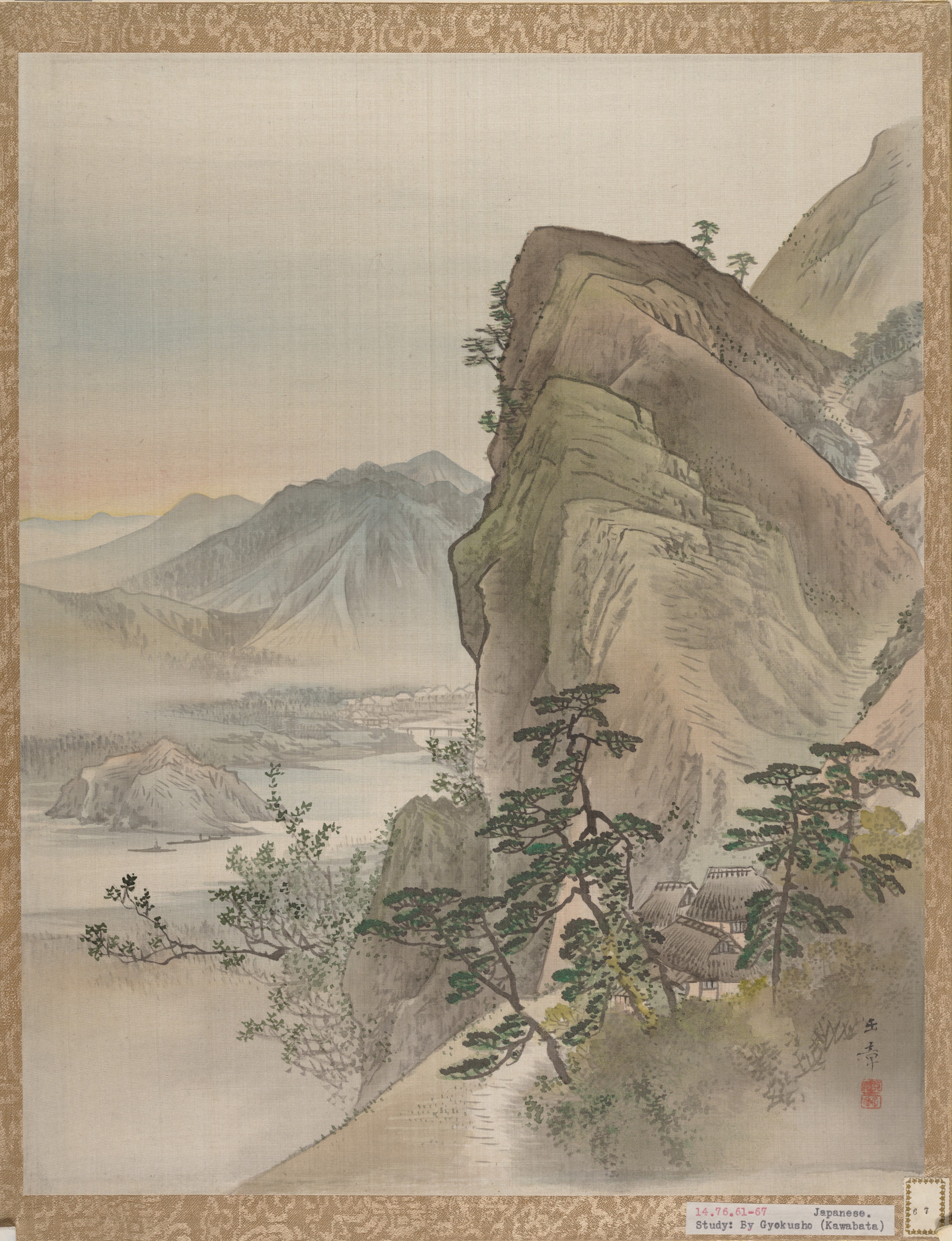
Landscape
山水図
ca. 1887–92
Album leaf; ink and color on silk
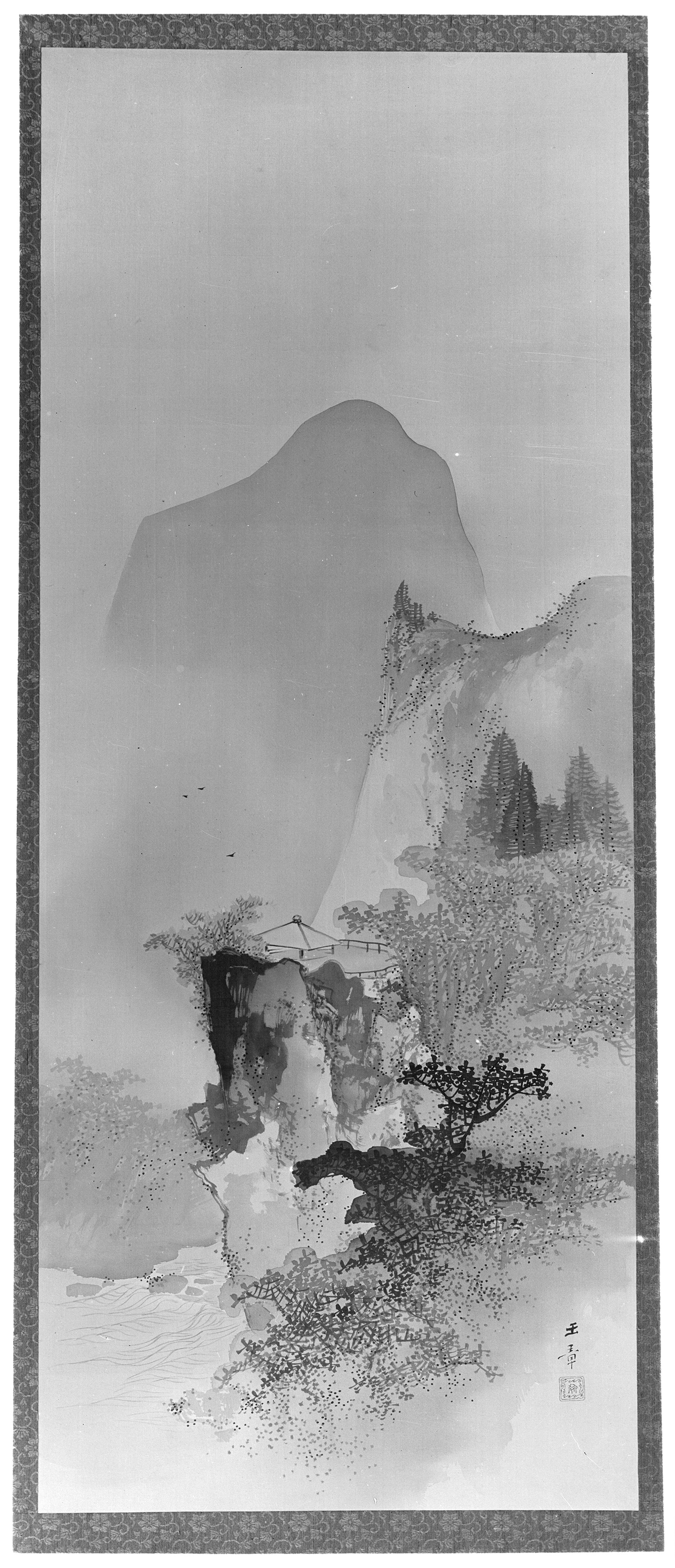
Spring Landscape
春景山水図
20th century (1900–1912)
Set of two hanging scrolls; ink and color on silk

Tiger by a Stream
渓流虎図
late 19th–early 20th century
Hanging scroll; ink and color on silk