Kawase Hasui — Japanese Shin-hanga artist

Kawase Hasui

川瀬巴水

Also known as: Hasui Kawase

1883–1957

Japan

Biography

Kawase Hasui (1883–1957) was one of the most important Japanese woodblock print artists of the twentieth century and a central figure in the shin-hanga ("new prints") movement that revitalized traditional ukiyo-e printmaking in modern Japan. Over a career spanning nearly four decades, he created more than six hundred woodblock print designs, earning him the epithets "Artist of Snow" and "Hiroshige of the Showa Era" for his masterful depictions of Japanese landscapes in rain, snow, moonlight, and mist.

Born Kawase Bunjiro on May 18, 1883, in Shiba Ward, Tokyo, Hasui grew up in a family that ran a silk braiding and thread wholesale business. His paternal uncle was the noted Meiji-era author and journalist Kanagaki Robun. As a child, Hasui suffered from meningitis, which left him with a quiet and introspective temperament. He showed an early passion for art but was expected to take over the family business. When the business went bankrupt around 1909, Hasui was finally free to pursue his artistic ambitions at the age of twenty-six.

Hasui's artistic training followed an indirect path. He initially studied painting under Aoyanagi Bokusen beginning in 1897, then with Araki Kan'yu from 1902. Around 1908, he approached the renowned nihonga master Kaburagi Kiyokata for instruction, but Kiyokata turned him away, calling him a late starter and advising him to study Western-style painting first. Hasui spent two years studying oil painting and watercolor under Okada Saburosuke before Kiyokata accepted him as a pupil around 1910. It was Kiyokata who bestowed upon him the art name "Hasui," meaning "spring water." Under Kiyokata's tutelage, Hasui studied ukiyo-e techniques and nihonga painting, and worked as an illustrator for magazines, books, and advertisements.

Hasui's career as a woodblock print designer began in August 1918, when he was inspired by an exhibition of Ito Shinsui's Eight Views of Lake Biwa. He approached Shinsui's publisher, Watanabe Shozaburo, who commissioned three experimental prints based on sketches Hasui had made at Shiobara. The success of these first designs launched a prolific partnership that would last for the rest of Hasui's life. In 1919, he produced the Twelve Scenes of Tokyo, Eight Views of the Southeast, and began the sixteen-print Souvenirs of Travel, First Series. By 1923, he had already created over one hundred landscape designs.

The Great Kanto Earthquake of September 1, 1923, proved catastrophic for Hasui. He lost his home and one hundred eighty-eight accumulated sketchbooks. Watanabe's entire workshop was also destroyed, including all woodblocks, the complete print inventory, and unsold prints from the unfinished Collection of Scenes of Japan series. Pre-earthquake prints by Hasui are consequently among the rarest and most sought-after shin-hanga. Despite this devastating loss, Watanabe financed a one-hundred-and-two-day sketching trip for Hasui through the Hokuriku, San'in, and San'yo regions later that year, the longest journey of his career. The sketches from this trip formed the basis for the twenty-nine prints of the Souvenirs of Travel, Third Series, published between 1924 and 1929.

During the late 1920s and 1930s, Hasui entered his most productive period. He created the Twenty Views of Tokyo between 1925 and 1930, which includes such iconic images as Zojoji Temple in Shiba, as well as the Selection of Views of Japan and the Collection of Scenic Views of Japan in both Eastern Japan and Kansai editions. While Watanabe remained his primary publisher throughout, Hasui also worked with several other publishers during this period, including Kawaguchi, Doi Teikichi, Iida, and Shiota Takezo. In 1939, he was invited by the Government Railways of Korea to visit the Korean Peninsula, resulting in the Eight Views of Korea series published by Watanabe.

The Second World War severely disrupted Hasui's career. The Japanese government controlled art production, and his peaceful landscape subjects were considered unsuitable for the wartime nationalist atmosphere. His Tokyo home was destroyed a second time by Allied firebombing in 1945, and he spent much of the war years in Shiobara, north of Tokyo. Despite these hardships, the few prints he produced during this era depicted remarkably peaceful scenes of traditional Japan.

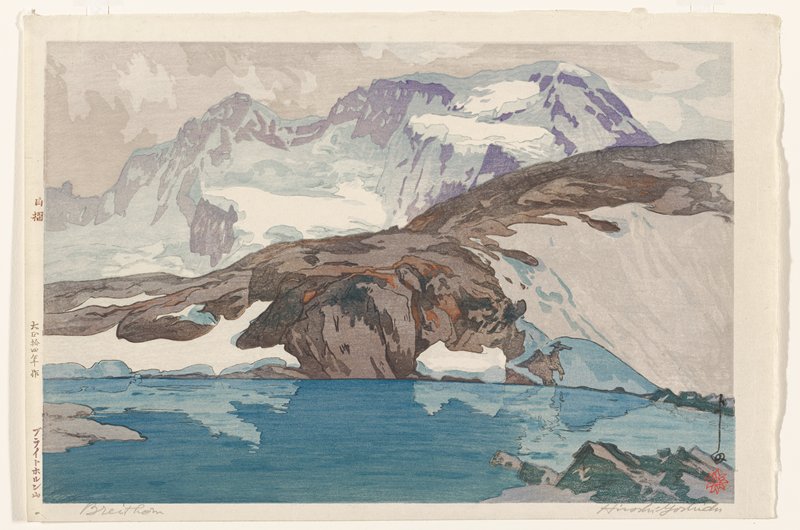
Hasui's style is defined by his extraordinary ability to capture atmosphere and mood in landscape scenes. Working within the shin-hanga collaborative system, he designed the prints while professional carvers and printers at the Watanabe workshop executed the woodblocks and printing under his supervision. His subjects were almost exclusively landscapes—temples, shrines, coastlines, village streets, and famous scenic views throughout Japan. Of his more than six hundred designs, over four hundred were landscapes. Hasui traveled extensively throughout Japan, sketching on location with detailed color notations that he later refined into finished designs at his studio. Human figures in his compositions are typically absent or minimal, allowing the natural environment to dominate. His palette featured rich, dense colors and solid forms, blending the traditional Japanese aesthetic of the ukiyo-e landscape tradition with the Western realism he had learned from Okada Saburosuke.

After the war, the Japanese government used Hasui's work to represent a gentler side of Japan in tourist publications. In 1953, the Committee for Preservation of Intangible Cultural Treasures commissioned him to create Snow at Zojoji Temple, with the entire printmaking process documented by woodblock historian Narazaki Muneshige. The resulting print was designated an Intangible Cultural Asset. In 1956, Hasui was designated a Living National Treasure by the Japanese government, becoming the first woodblock print artist to receive this distinction.

Hasui completed his final design, Hall of the Golden Hue, Hiraizumi, while hospitalized with cancer in 1957. He did not live to see the finished print. He died on November 7, 1957, at the age of seventy-four. The first edition of his last print was distributed by his widow at a memorial service held one hundred days after his death. Today, his works are held in major museum collections worldwide, including the Metropolitan Museum of Art, the British Museum, the Art Institute of Chicago, and the Museum of Fine Arts, Boston. His prints continue to be among the most recognized and collected examples of Japanese woodblock printmaking.

Key Facts

Active Period
1883–1957
Nationality
🇯🇵Japan
Movement
Shin-hanga
Works Indexed
498

Frequently Asked Questions

What is Kawase Hasui known for?

Kawase Hasui (1883–1957) was one of the most important Japanese woodblock print artists of the twentieth century and a central figure in the shin-hanga ("new prints") movement that revitalized traditional ukiyo-e printmaking in modern Japan. Over a career spanning nearly four decades, he created more than six hundred woodblock print designs, earning him the epithets "Artist of Snow" and "Hiroshige of the Showa Era" for his masterful depictions of Japanese landscapes in rain, snow, moonlight, and mist.

When was Kawase Hasui active?

Kawase Hasui was active from 1883 to 1957. They were associated with the Shin-hanga movement.

What artistic movements influenced Kawase Hasui?

Kawase Hasui's work was shaped by the Shin-hanga tradition in Japanese woodblock printmaking. Shin-hanga: The "new prints" movement (c.

What subjects did Kawase Hasui depict?

Kawase Hasui's prints frequently feature landscapes, temples & shrines, rivers & lakes, night scenes, urban scenes, snow scenes.

Where can I see Kawase Hasui's original prints?

Original prints by Kawase Hasui can be found in collections including Art Institute of Chicago.

How much do Kawase Hasui prints cost?

Kawase Hasui is one of the most popular and widely collected shin-hanga artists, and his market spans a vast price range. Common posthumous editions can be found for as little as $300, while his rarest pre-earthquake prints in fine condition have sold for over $30,000. The edition hierarchy is the single most important pricing factor. Pre-earthquake editions (printed before September 1923, when the Great Kanto Earthquake destroyed Watanabe's blocks and stock): $5,000–$30,000+ for major subjects. Post-earthquake recut editions (from re-carved blocks, 1923–1957): $1,500–$8,000. Posthumous editions (printed after Hasui's death in 1957): $300–$1,500. The Watanabe publisher seal is the key identifier — look for the small circular 6mm seal on pre-earthquake prints. Later editions carry progressively larger rectangular seals, and the most recent posthumous editions often show visible woodblock wear with softer lines and flatter colors. Hasui's most iconic subjects command the highest prices regardless of edition: "Snow at Zojoji Temple," "Rain at Maekawa," "Shiba Zojoji Temple," and prints from his "Twenty Views of Tokyo" and "Souvenirs of Travel" series. Night scenes and snow scenes are especially popular with collectors. For new collectors, later Watanabe lifetime editions ($1,500–$4,000) offer excellent quality at moderate prices. Pre-earthquake prints are increasingly scarce on the market and represent the strongest long-term investment. Condition, color vibrancy, and margin quality are the primary factors beyond edition type.

External Resources

Series by Kawase Hasui

Woodblock Prints by Kawase Hasui (498)

Shimohonda-machi, Kanazawa, from the series "Souvenirs of Travel, Second Series (Tabi miyage dai nishu)" by Kawase Hasui

Shimohonda-machi, Kanazawa, from the series "Souvenirs of Travel, Second Series (Tabi miyage dai nishu)"

1921

Color woodblock print; oban

Shimohonda-machi, Kanazawa, from the series "Souvenirs of Travel, Second Series (Tabi miyage dai nishu)" by Kawase Hasui

Shimohonda-machi, Kanazawa, from the series "Souvenirs of Travel, Second Series (Tabi miyage dai nishu)"

1921

Color woodblock print; oban

Gosai Canal in Niigata (Niigata Gosaibori), from the series "Souvenirs of Travel, Second Series (Tabi miyage dai nishu)" by Kawase Hasui

Gosai Canal in Niigata (Niigata Gosaibori), from the series "Souvenirs of Travel, Second Series (Tabi miyage dai nishu)"

Niigata Gosaibori

1921

Color woodblock print; oban

Nishimikawazaka on Sado Island (Sado Nishimikawazaka), from the series "Souvenirs of Travel, Second Series (Tabi miyage dai nishu)" by Kawase Hasui

Nishimikawazaka on Sado Island (Sado Nishimikawazaka), from the series "Souvenirs of Travel, Second Series (Tabi miyage dai nishu)"

1921

Color woodblock print; oban

Sunset Glow in Yanaka (Yanaka no yube), from the series "Twelve Months of Tokyo (Tokyo junikagetsu)" by Kawase Hasui

Sunset Glow in Yanaka (Yanaka no yube), from the series "Twelve Months of Tokyo (Tokyo junikagetsu)"

1921

Color woodblock print

A Water Conduit, A Scene in Sado (Mizuagehi [Sado shoken]), from the series "Souvenirs of Travel, Second Series (Tabi miyage dai nishu)" by Kawase Hasui

A Water Conduit, A Scene in Sado (Mizuagehi [Sado shoken]), from the series "Souvenirs of Travel, Second Series (Tabi miyage dai nishu)"

1921

Color woodblock print; oban

A Water Conduit, A Scene in Sado (Mizuagehi [Sado shoken]), from the series "Souvenirs of Travel, Second Series (Tabi miyage dai nishu)" by Kawase Hasui

A Water Conduit, A Scene in Sado (Mizuagehi [Sado shoken]), from the series "Souvenirs of Travel, Second Series (Tabi miyage dai nishu)"

1921

Color woodblock print; oban

Some River, Koshu (Koshu Somegawa), from the series "Souvenirs of Travel, Second Series (Tabi miyage dai nishu)" by Kawase Hasui

Some River, Koshu (Koshu Somegawa), from the series "Souvenirs of Travel, Second Series (Tabi miyage dai nishu)"

1921

Color woodblock print; oban

Gosai Canal in Niigata (Niigata Gosaibori), from the series "Souvenirs of Travel, Second Series (Tabi miyage dai nishu)" by Kawase Hasui

Gosai Canal in Niigata (Niigata Gosaibori), from the series "Souvenirs of Travel, Second Series (Tabi miyage dai nishu)"

1921

Color woodblock print; oban

A Section of the Byodo Temple at Uji (Uji Byodoin no ichibu), from the series "Souvenirs of Travel, Second Series (Tabi miyage dai nishu)" by Kawase Hasui

A Section of the Byodo Temple at Uji (Uji Byodoin no ichibu), from the series "Souvenirs of Travel, Second Series (Tabi miyage dai nishu)"

Uji Byodoin no ichibu

1921

Color woodblock print; oban

Takamatsu Castle in Sanuki (Sanuki no Takamatsujo), from the series "Souvenirs of Travel, Second Series (Tabi miyage dai nishu)" by Kawase Hasui

Takamatsu Castle in Sanuki (Sanuki no Takamatsujo), from the series "Souvenirs of Travel, Second Series (Tabi miyage dai nishu)"

1921

Color woodblock print; oban

Afternoon at Nino Bridge, Azabu (Azabu Ninohashi no gogo), from the series "Twelve Months of Tokyo (Tokyo junikagetsu)" by Kawase Hasui

Afternoon at Nino Bridge, Azabu (Azabu Ninohashi no gogo), from the series "Twelve Months of Tokyo (Tokyo junikagetsu)"

1921

Color woodblock print

Gosai Canal in Niigata (Niigata Gosaibori), from the series "Souvenirs of Travel, Second Series (Tabi miyage dai nishu)" by Kawase Hasui

Gosai Canal in Niigata (Niigata Gosaibori), from the series "Souvenirs of Travel, Second Series (Tabi miyage dai nishu)"

1921

Color woodblock print; oban

Misty Night at Miyajima (Oboroyo [Miyajima]), from the series "Souvenirs of Travel, Second Series (Tabi miyage dai nishu)" by Kawase Hasui

Misty Night at Miyajima (Oboroyo [Miyajima]), from the series "Souvenirs of Travel, Second Series (Tabi miyage dai nishu)"

1921

Color woodblock print; oban

Asahi Bridge, Ojiya, from the series "Souvenirs of Travel, Second Series" (Tabi miyage dai nishu, Ojiya Asahibashi) by Kawase Hasui

Asahi Bridge, Ojiya, from the series "Souvenirs of Travel, Second Series" (Tabi miyage dai nishu, Ojiya Asahibashi)

1921

Color woodblock print

A Water Conduit, A Scene in Sado (Mizuagehi [Sado shoken]), from the series "Souvenirs of Travel, Second Series (Tabi miyage dai nishu)" by Kawase Hasui

A Water Conduit, A Scene in Sado (Mizuagehi [Sado shoken]), from the series "Souvenirs of Travel, Second Series (Tabi miyage dai nishu)"

Mizuagehi [Sado shoken]

1921

Color woodblock print; oban

Evening Shower at Teradomari (Teradomari no yau), from the series "Souvenirs of Travel, Second Series (Tabi miyage dai nishu)" by Kawase Hasui

Evening Shower at Teradomari (Teradomari no yau), from the series "Souvenirs of Travel, Second Series (Tabi miyage dai nishu)"

Teradomari no yau

1921

Color woodblock print; oban

Snow on a Fine Day at Miyajima (Seiten no yuki [Miyajima]), from the series "Souvenirs of Travel, Second Series (Tabi miyage dai nishu)" by Kawase Hasui

Snow on a Fine Day at Miyajima (Seiten no yuki [Miyajima]), from the series "Souvenirs of Travel, Second Series (Tabi miyage dai nishu)"

Seiten no yuki [Miyajima]

1921

Color woodblock print; oban

A Section of the Byodo Temple at Uji (Uji Byodoin no ichibu), from the series "Souvenirs of Travel, Second Series (Tabi miyage dai nishu)" by Kawase Hasui

A Section of the Byodo Temple at Uji (Uji Byodoin no ichibu), from the series "Souvenirs of Travel, Second Series (Tabi miyage dai nishu)"

1921

Color woodblock print; oban

Nigatsu Hall, Nara (Nara Nigatsudo), from the series "Souvenirs of Travel, Second Series (Tabi miyage dai nishu)" by Kawase Hasui

Nigatsu Hall, Nara (Nara Nigatsudo), from the series "Souvenirs of Travel, Second Series (Tabi miyage dai nishu)"

Nara Nigatsudo

1921

Color woodblock print; oban

Moonlight over Lake Kamo in Sado Island (Getsumei no Kamoko [Sado]), from the series "Souvenirs of Travel, Second Series (Tabi miyage dai nishu)" by Kawase Hasui

Moonlight over Lake Kamo in Sado Island (Getsumei no Kamoko [Sado]), from the series "Souvenirs of Travel, Second Series (Tabi miyage dai nishu)"

1921

Color woodblock print; oban

Some River, Koshu (Koshu Somegawa), from the series "Souvenirs of Travel, Second Series (Tabi miyage dai nishu)" by Kawase Hasui

Some River, Koshu (Koshu Somegawa), from the series "Souvenirs of Travel, Second Series (Tabi miyage dai nishu)"

Koshu Somegawa

1921

Color woodblock print; oban

Sunset Glow in Yanaka (Yanaka no yube), from the series "Twelve Months of Tokyo (Tokyo junikagetsu)" by Kawase Hasui

Sunset Glow in Yanaka (Yanaka no yube), from the series "Twelve Months of Tokyo (Tokyo junikagetsu)"

Yanaka no yube

1921

Color woodblock print

Snow on a Fine Day at Miyajima (Seiten no yuki [Miyajima]), from the series "Souvenirs of Travel, Second Series (Tabi miyage dai nishu)" by Kawase Hasui

Snow on a Fine Day at Miyajima (Seiten no yuki [Miyajima]), from the series "Souvenirs of Travel, Second Series (Tabi miyage dai nishu)"

1921

Color woodblock print; oban

Takamatsu Castle in Sanuki (Sanuki no Takamatsujo), from the series "Souvenirs of Travel, Second Series (Tabi miyage dai nishu)" by Kawase Hasui

Takamatsu Castle in Sanuki (Sanuki no Takamatsujo), from the series "Souvenirs of Travel, Second Series (Tabi miyage dai nishu)"

Sanuki no Takamatsujo

1921

Color woodblock print; oban

Evening Shower, Teradomari (Teradomari no yō), from the series Souvenirs of Travel, Second Series (Tabi miyage dai nishū) by Kawase Hasui

Evening Shower, Teradomari (Teradomari no yō), from the series Souvenirs of Travel, Second Series (Tabi miyage dai nishū)

1921

Color woodblock print

Afternoon at Nino Bridge, Azabu (Azabu Ninohashi no gogo), from the series "Twelve Months of Tokyo (Tokyo junikagetsu)" by Kawase Hasui

Afternoon at Nino Bridge, Azabu (Azabu Ninohashi no gogo), from the series "Twelve Months of Tokyo (Tokyo junikagetsu)"

Azabu Ninohashi no gogo

1921

Color woodblock print

Dawn Snow at the Port of Ogi, Sado (Yuki no akebono, Sado Ogi wan), from the series "Souvenirs of Travel, Second Series (Tabi miyage dai nishu)" by Kawase Hasui

Dawn Snow at the Port of Ogi, Sado (Yuki no akebono, Sado Ogi wan), from the series "Souvenirs of Travel, Second Series (Tabi miyage dai nishu)"

December 1921

Color woodblock print

Nishimikawazaka on Sado Island (Sado Nishimikawazaka), from the series "Souvenirs of Travel, Second Series (Tabi miyage dai nishu)" by Kawase Hasui

Nishimikawazaka on Sado Island (Sado Nishimikawazaka), from the series "Souvenirs of Travel, Second Series (Tabi miyage dai nishu)"

1921

Color woodblock print; oban

Water conduit, a scene in Sado by Kawase Hasui

Water conduit, a scene in Sado

August 21, 1921

Woodblock print, ink and color on paper

Takamatsu Castle, Sanuki (Sanuki no Takamatsujō), from the series Souvenirs of Travel, Second Series (Tabi miyage dai nishū) by Kawase Hasui

Takamatsu Castle, Sanuki (Sanuki no Takamatsujō), from the series Souvenirs of Travel, Second Series (Tabi miyage dai nishū)

1921, February

Woodblock print; ink and color on paper

A Section of the Byodo Temple at Uji (Uji Byodoin no ichibu), from the series "Souvenirs of Travel, Second Series (Tabi miyage dai nishu)" by Kawase Hasui

A Section of the Byodo Temple at Uji (Uji Byodoin no ichibu), from the series "Souvenirs of Travel, Second Series (Tabi miyage dai nishu)"

1921

Color woodblock print; oban

Moonlight over Lake Kamo, Sado by Kawase Hasui

Moonlight over Lake Kamo, Sado

August 16, 1921

Woodblock print, ink and color on paper

Snow on a Fine Day at Miyajima (Seiten no yuki [Miyajima]), from the series "Souvenirs of Travel, Second Series (Tabi miyage dai nishu)" by Kawase Hasui

Snow on a Fine Day at Miyajima (Seiten no yuki [Miyajima]), from the series "Souvenirs of Travel, Second Series (Tabi miyage dai nishu)"

1921

Color woodblock print; oban

Morning at Dotonbori, Osaka (Osaka Dotonbori no asa), from the series "Souvenirs of Travel, Second Series (Tabi miyage dai nishu)" by Kawase Hasui

Morning at Dotonbori, Osaka (Osaka Dotonbori no asa), from the series "Souvenirs of Travel, Second Series (Tabi miyage dai nishu)"

1921

Color woodblock print; oban

Kasuga Shrine, Nara (Nara Kasuga jinja), from the series "Souvenirs of Travel, Second Series (Tabi miyage dai nishu)" by Kawase Hasui

Kasuga Shrine, Nara (Nara Kasuga jinja), from the series "Souvenirs of Travel, Second Series (Tabi miyage dai nishu)"

February 1921

Color woodblock print; oban

Lingering in the Snow at Sanno (Sanno no zansetsu) by Kawase Hasui

Lingering in the Snow at Sanno (Sanno no zansetsu)

1926

Color woodblock print

Spring in Mount Atago (Haru no Atagoyama), from the series "Twelve Scenes of Tokyo (Tokyo junidai)" by Kawase Hasui

Spring in Mount Atago (Haru no Atagoyama), from the series "Twelve Scenes of Tokyo (Tokyo junidai)"

1921

Color woodblock print; oban

Kosho Temple, Himi, Etchu, from the series "Souvenirs of Travel, Second Series" (Tabi miyage dai nishu, Etchu Himi Koshoji) by Kawase Hasui

Kosho Temple, Himi, Etchu, from the series "Souvenirs of Travel, Second Series" (Tabi miyage dai nishu, Etchu Himi Koshoji)

6 September 1921

Color woodblock print

Seaside Cottage, Himi, Etchu, from the series "Souvenirs of Travel, Second Series" (Tabi miyage dai nishu, Hama shooku (Etchu Himi)) by Kawase Hasui

Seaside Cottage, Himi, Etchu, from the series "Souvenirs of Travel, Second Series" (Tabi miyage dai nishu, Hama shooku (Etchu Himi))

6 September 1921

Color woodblock print

Kamoson Village, Sado, from the series "Souvenirs of Travel, Second Series" (Tabi miyage dai nishu, Sado Kamoson) by Kawase Hasui

Kamoson Village, Sado, from the series "Souvenirs of Travel, Second Series" (Tabi miyage dai nishu, Sado Kamoson)

17 August 1921

Color woodblock print

Ogi Harbor, Sado Island (Sado Ogi no minato), from the series "Souvenirs of Travel, Second Series (Tabi miyage dai nishu)" by Kawase Hasui

Ogi Harbor, Sado Island (Sado Ogi no minato), from the series "Souvenirs of Travel, Second Series (Tabi miyage dai nishu)"

19 August 1921

Color woodblock print; oban

Kiyomizu Temple in Rain (Ame no Kiyomizudo), from the series "Souvenirs of Travel, Second Series (Tabi miyage dai nishu)" by Kawase Hasui

Kiyomizu Temple in Rain (Ame no Kiyomizudo), from the series "Souvenirs of Travel, Second Series (Tabi miyage dai nishu)"

1921

Color woodblock print; oban

Mano Bay, Sado Island (Sado Manowan), "Souvenirs of Travel, Second Series (Tabi miyage dai nishu)" by Kawase Hasui

Mano Bay, Sado Island (Sado Manowan), "Souvenirs of Travel, Second Series (Tabi miyage dai nishu)"

1921

Color woodblock print; oban

Amanohashidate in Snow (Yuki no Hashidate), from the series "Souvenirs of Travel, Second Series (Tabi miyage dai nishu)" by Kawase Hasui

Amanohashidate in Snow (Yuki no Hashidate), from the series "Souvenirs of Travel, Second Series (Tabi miyage dai nishu)"

1921

Color woodblock print; oban

Urahama, Echigo (Echigo no Urahama), from the series Souvenirs of Travel, Second Series (Tabi miyage dai nishū) by Kawase Hasui

Urahama, Echigo (Echigo no Urahama), from the series Souvenirs of Travel, Second Series (Tabi miyage dai nishū)

1921

Woodblock print; ink and color on paper

Asahi Bridge, Ojiya, from the series "Souvenirs of Travel, Second Series" (Tabi miyage dai nishu, Ojiya Asahibashi) by Kawase Hasui

Asahi Bridge, Ojiya, from the series "Souvenirs of Travel, Second Series" (Tabi miyage dai nishu, Ojiya Asahibashi)

14 August 1921

Color woodblock print

Dawn Snow at the Port of Ogi, Sado (Yuki no akebono, Sado Ogi wan), from the series "Souvenirs of Travel, Second Series (Tabi miyage dai nishu)" by Kawase Hasui

Dawn Snow at the Port of Ogi, Sado (Yuki no akebono, Sado Ogi wan), from the series "Souvenirs of Travel, Second Series (Tabi miyage dai nishu)"

Yuki no akebono, Sado Ogi wan

December 1921

Color woodblock print

Night Rainfall on Bridge by Kawase Hasui

Night Rainfall on Bridge

1921

Woodblock print

Beach Shed at Himi in Etchū Province by Kawase Hasui

Beach Shed at Himi in Etchū Province

September 6, 1921

Woodblock print, ink and color on paper

Kannon Temple at Abuto (Abuto no Kannon), from the series "Selection of Views of Japan (Nihon fukei senshu)" by Kawase Hasui

Kannon Temple at Abuto (Abuto no Kannon), from the series "Selection of Views of Japan (Nihon fukei senshu)"

1922

Color woodblock print; oban

Kannon Temple at Abuto (Abuto no Kannon), from the series "Selection of Views of Japan (Nihon fukei senshu)" by Kawase Hasui

Kannon Temple at Abuto (Abuto no Kannon), from the series "Selection of Views of Japan (Nihon fukei senshu)"

Abuto no Kannon

1922

Color woodblock print; oban

Kotsuki River, Kagoshima, from the series "Selection of Scenes from Japan" (Nihon fukei senshu, Kagoshima Kotsukigawa) by Kawase Hasui

Kotsuki River, Kagoshima, from the series "Selection of Scenes from Japan" (Nihon fukei senshu, Kagoshima Kotsukigawa)

1922

Color woodblock print

Karikachi Mountain Pass (Karikachi toge) by Kawase Hasui

Karikachi Mountain Pass (Karikachi toge)

c. 1927

Color woodblock print; oban

Snow at Zojo Temple (Yuki no Zojoji) by Kawase Hasui

Snow at Zojo Temple (Yuki no Zojoji)

1922

Color woodblock print; oban

Kankai Temple, Beppu (Beppu Kankaiji) by Kawase Hasui

Kankai Temple, Beppu (Beppu Kankaiji)

c. 1927

Color woodblock print

Sakurajima, Kagoshima, from the series "Selection of Views of Japan (Nihon fukei senshu)" by Kawase Hasui

Sakurajima, Kagoshima, from the series "Selection of Views of Japan (Nihon fukei senshu)"

1922

Color woodblock print; oban

Mount Unzen, Hizen (Hizen Unzendake) by Kawase Hasui

Mount Unzen, Hizen (Hizen Unzendake)

c. 1927

Color woodblock print; oban

Kankaiji Temple in Beppu (Beppu Kankaiji) by Kawase Hasui

Kankaiji Temple in Beppu (Beppu Kankaiji)

c. 1927

Color woodblock print; oban

Kiso River at Inuyama (Kisogawa [Inuyama]) by Kawase Hasui

Kiso River at Inuyama (Kisogawa [Inuyama])

c. 1927

Color woodblock print; oban

Similar Artists