Biography
Kikuchi Hōbun (1862-1918) was one of the leading Kyoto painters of the Shijō school in the Meiji era, counted among the 'four best disciples' of Kōno Bairei alongside Takeuchi Seihō, Taniguchi Kōkyō, and Tsuji Kakō. Working chiefly in landscape and kachō-e (bird-and-flower painting), he became one of the institutionally central figures of late-Meiji Kyoto nihonga, admired for a restrained, closely observed manner that critics regarded as a disciplined late expression of the Maruyama-Shijō tradition. He is especially remembered as a master of cherry-blossom subjects.
Hōbun was born in Osaka in 1862, the son of a picture-mounter (hyōgushi), and was later adopted into the Kikuchi family; his given name was Tsunejirō. He first studied painting under Shigeno Hōen in Osaka, and in 1881 he entered the Kyoto studio of Kōno Bairei (1844-1895), the senior Shijō-school master whose academy was then the principal training ground for the new generation of Kyoto Japanese-style painters. Under Bairei he absorbed the Shijō method of close observation from nature, restrained brushwork, and decoratively disciplined composition descended from Maruyama Ōkyo and Matsumura Goshun a century before. He proved one of Bairei's most gifted pupils in the kachō-e specialty, took the art-name Hōbun (芳文), and began exhibiting at Kyoto and Osaka shows in the late 1880s and early 1890s.
From the mid-1890s Hōbun held a central place in the Kyoto art establishment. By 1894 he was teaching at the Kyoto City School of Arts and Crafts, and after the Kyoto City Specialist School of Painting (Kaiga Senmon Gakkō) was established in 1909 he served there as a professor, helping to train the second generation of Kyoto nihonga painters. In 1907 he was named to the jury of the first Bunten (the Ministry of Education Fine Arts Exhibition), the new state-run annual salon, taking his place among the senior Kyoto and Tokyo painters who shaped the official taste of the period.
His pictorial range extended beyond the bird-and-flower pieces for which he is best remembered to landscape and screen compositions and hanging-scroll subjects rendered in the close drawing and restrained color of the Shijō tradition. Kyoto woodblock publishers issued color prints (kachō-e) adapted from his bird-and-flower designs — studies of sparrows, white-eyes, and small autumn subjects — and these prints, surviving in many impressions in Japanese and Western collections, form the channel by which his work most widely entered the international market.
Hōbun's teaching shaped a number of younger Kyoto painters; his pupils included Kawakita Kahō, Yamada Kōun, and Abe Shumpō, and the painter Kikuchi Keigetsu was adopted as his heir. In 1917, near the end of his life, his name was put forward for appointment as an Imperial Household Artist (teishitsu gigeiin), though surviving official records do not confirm that the honor was formalized. He died in Kyoto in 1918, at his home in the Kinugasa district of the city where he had trained, taught, and worked for much of his life.
Hōbun's mature style is recognized as among the most restrained and observationally disciplined of Bairei's senior pupils. Where Takeuchi Seihō, after his 1900-1901 study trip to Europe, developed a more atmospheric and tonally varied manner, Hōbun retained the close drawing and quiet color of the Shijō school in a form critics took as a direct late expression of the Maruyama-Shijō inheritance. His handling of birds, cherry blossoms, and autumn grasses combined the close observation of feather, petal, and stem that the Shijō school had refined in the late eighteenth and early nineteenth centuries with a controlled, almost ink-painterly treatment of background space. His work survives in Japanese and Western museum collections, where it continues to mark the disciplined wing of the late-Meiji Kyoto Shijō revival.
Key Facts
- Active Period
- 1862–1918
- Nationality
- 🇯🇵Japan
- Movement
- Meiji/Taishō Prints
- Subjects
- Birds & Flowers
- Works Indexed
- 7
Frequently Asked Questions
Kikuchi Hōbun (1862-1918) was one of the leading Kyoto painters of the Shijō school in the Meiji era, counted among the 'four best disciples' of Kōno Bairei alongside Takeuchi Seihō, Taniguchi Kōkyō, and Tsuji Kakō. Working chiefly in landscape and kachō-e (bird-and-flower painting), he became one of the institutionally central figures of late-Meiji Kyoto nihonga, admired for a restrained, closely observed manner that critics regarded as a disciplined late expression of the Maruyama-Shijō tradition. He is especially remembered as a master of cherry-blossom subjects.
Kikuchi Hōbun was active from 1862 to 1918. They were associated with the Meiji/Taishō Prints movement.
Kikuchi Hōbun's work was shaped by the Meiji/Taishō Prints tradition in Japanese woodblock printmaking. Meiji/Taishō Prints: Meiji and Taishō era prints (1868–1926) bridge the transition from traditional ukiyo-e to the modern shin-hanga and sosaku-hanga movements.
Kikuchi Hōbun's prints frequently feature birds & flowers.
Original prints by Kikuchi Hōbun can be found in collections including Vanderbilt Fine Arts Gallery (via Wikimedia Commons), Honolulu Museum of Art (via Wikimedia Commons), Shima Art Co. edition (via ukiyo-e.org / Asian Collection Internet Auction), Shima Art Co. edition (via ukiyo-e.org / Japanese Art Open Database).
Woodblock Prints by Kikuchi Hōbun (7)
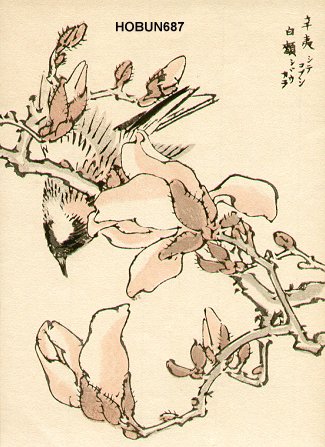
Sparrow
雀
c. 1900s (late Meiji)
Color woodblock print (kachō-e)
Nihon Mōhitsu Gachō (Japanese Paintbrush Picture Album), Volume 1
日本毛筆画帖
1900
Woodblock-printed picture album; ink and color on paper
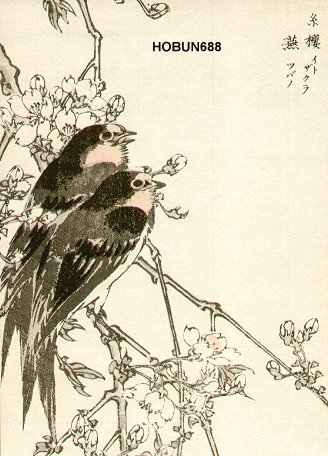
Sparrows
群雀
c. 1900s (late Meiji)
Color woodblock print (kachō-e)
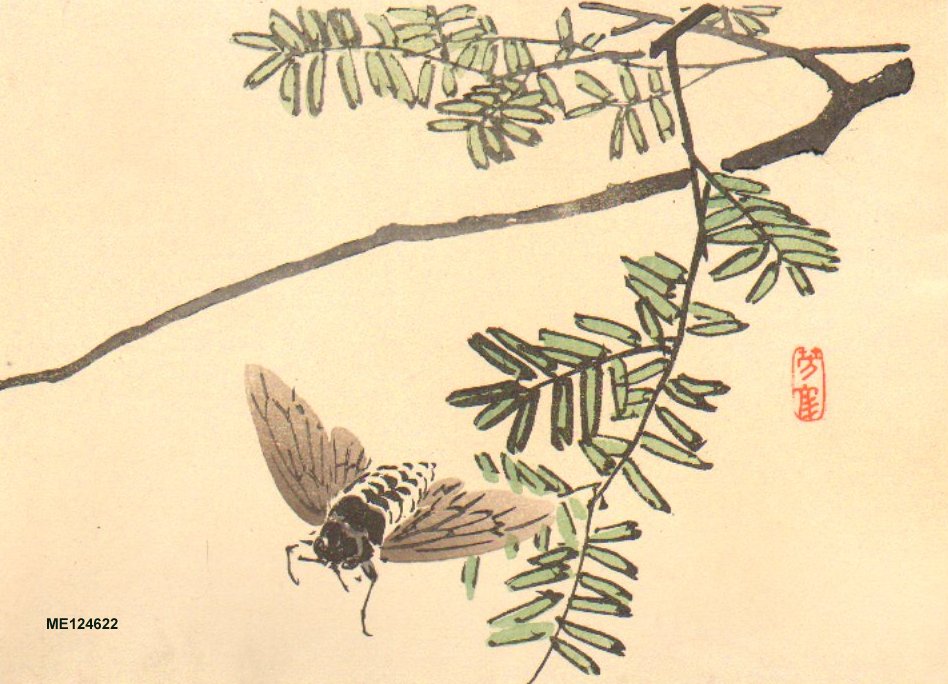
Cicada
蝉
late Meiji period
Color woodblock print (kachō-e)

Five Painted Lacquer-on-Wood Plates (with Taniguchi Kōkyō, Tsuji Kakō, and Yamamoto Shunkyo)
c. 1910
Painted lacquer on wood; set of five plates
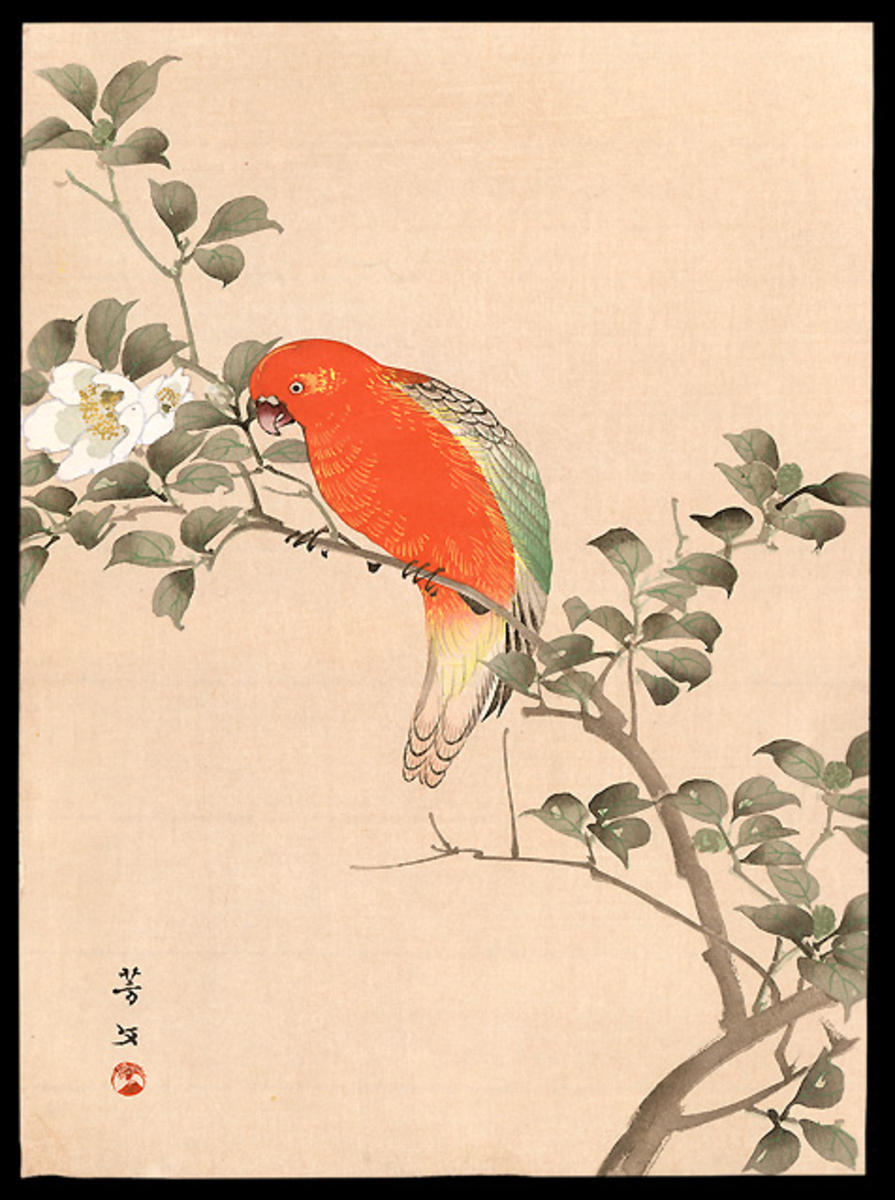
Orange Parrot
20th century (posthumous printing, c. 1930s)
Color woodblock print (kachō-e); approx. 10 × 7⅜ in.
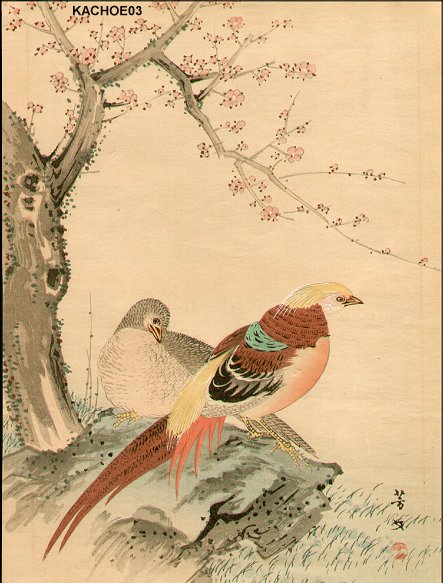
Pheasant
雉
1930s (posthumous printing)
Color woodblock print (kachō-e)