Kikuchi Yōsai
菊池容斎
1788–1878
Japan
Biography
Kikuchi Yōsai (菊池容斎, 1788-1878) was one of the foremost late-Edo and early-Meiji painters of historical figures, a draughtsman whose monochrome portraits of emperors, courtiers, monks, generals, scholars, and heroines shaped how nineteenth-century Japan pictured its own past. He was born in Edo in 1788 into a samurai family named Kawahara. From around 1805 he studied under the painter Takada Enjō, training in the Kanō academic idiom — disciplined brush, classical compositional schemas, and the apprentice tradition of copying old masters. He later took the surname Kikuchi, his father's original family name, restoring it in mid-life. Beyond the orthodox Kanō line he absorbed the naturalistic observation of the Maruyama and Shijō schools, and from that study he built a personal idiom — clean drawing, sober color, and an unembarrassed seriousness about subject — that set him apart from both the Kanō establishment and the floating-world print tradition that dominated commercial Edo painting.
His lifework, and the project on which his reputation rests, was the Zenken kojitsu (前賢故実, 'Notable Deeds of Worthy Predecessors'), a ten-volume illustrated compendium of biographies of more than five hundred Japanese historical figures — some 585 in all — reaching from the legendary age through the Nanbokuchō period. Yōsai began the project in the 1820s, conducting his own research into court records, temple chronicles, and antiquarian collections to establish what costume, armor, hairstyle, and attribute each figure should wear. Though the drawings were substantially finished by the 1830s, publication was long delayed, and the complete ten-volume set did not appear until 1868, when it was presented to the Meiji emperor; an expanded edition, the Kōshō Zenken kojitsu, was issued posthumously in 1903. The work became foundational to Meiji visual culture: its carefully researched portraits served as canonical likenesses for figures who had no surviving contemporary image, informing history textbooks, illustrated histories, and the history paintings of later nineteenth- and early twentieth-century artists. In recognition of the Zenken kojitsu, the Meiji court honored him with the title Nihon Gashi ('Painter of Japan').
Alongside the Zenken kojitsu, Yōsai produced hanging scrolls, fan paintings, and screen paintings in the same restrained, drawing-led manner — historical figures and Confucian-style worthies above all, but also seasonal subjects and courtly genre scenes. He remained active to the end of his long life, surviving the Meiji Restoration as a respected elder of the painting world, and died in Tokyo in 1878 at the age of eighty-nine. His students included Matsumoto Fūko and Watanabe Seitei, and his archaeologically grounded approach to historical dress and likeness shaped the historical portraiture inherited by later nihonga painters; the Zenken kojitsu itself remained in use as a reference well into the twentieth century.
Key Facts
- Active Period
- 1788–1878
- Nationality
- 🇯🇵Japan
- Subjects
- Birds & FlowersFish
- Works Indexed
- 6
Frequently Asked Questions
Kikuchi Yōsai (菊池容斎, 1788-1878) was one of the foremost late-Edo and early-Meiji painters of historical figures, a draughtsman whose monochrome portraits of emperors, courtiers, monks, generals, scholars, and heroines shaped how nineteenth-century Japan pictured its own past. He was born in Edo in 1788 into a samurai family named Kawahara. From around 1805 he studied under the painter Takada Enjō, training in the Kanō academic idiom — disciplined brush, classical compositional schemas, and the apprentice tradition of copying old masters. He later took the surname Kikuchi, his father's original family name, restoring it in mid-life. Beyond the orthodox Kanō line he absorbed the naturalistic observation of the Maruyama and Shijō schools, and from that study he built a personal idiom — clean drawing, sober color, and an unembarrassed seriousness about subject — that set him apart from both the Kanō establishment and the floating-world print tradition that dominated commercial Edo painting.
Kikuchi Yōsai was active from 1788 to 1878.
Kikuchi Yōsai's prints frequently feature birds & flowers, fish.
Original prints by Kikuchi Yōsai can be found in collections including The Metropolitan Museum of Art, Minneapolis Institute of Art.
Woodblock Prints by Kikuchi Yōsai (6)
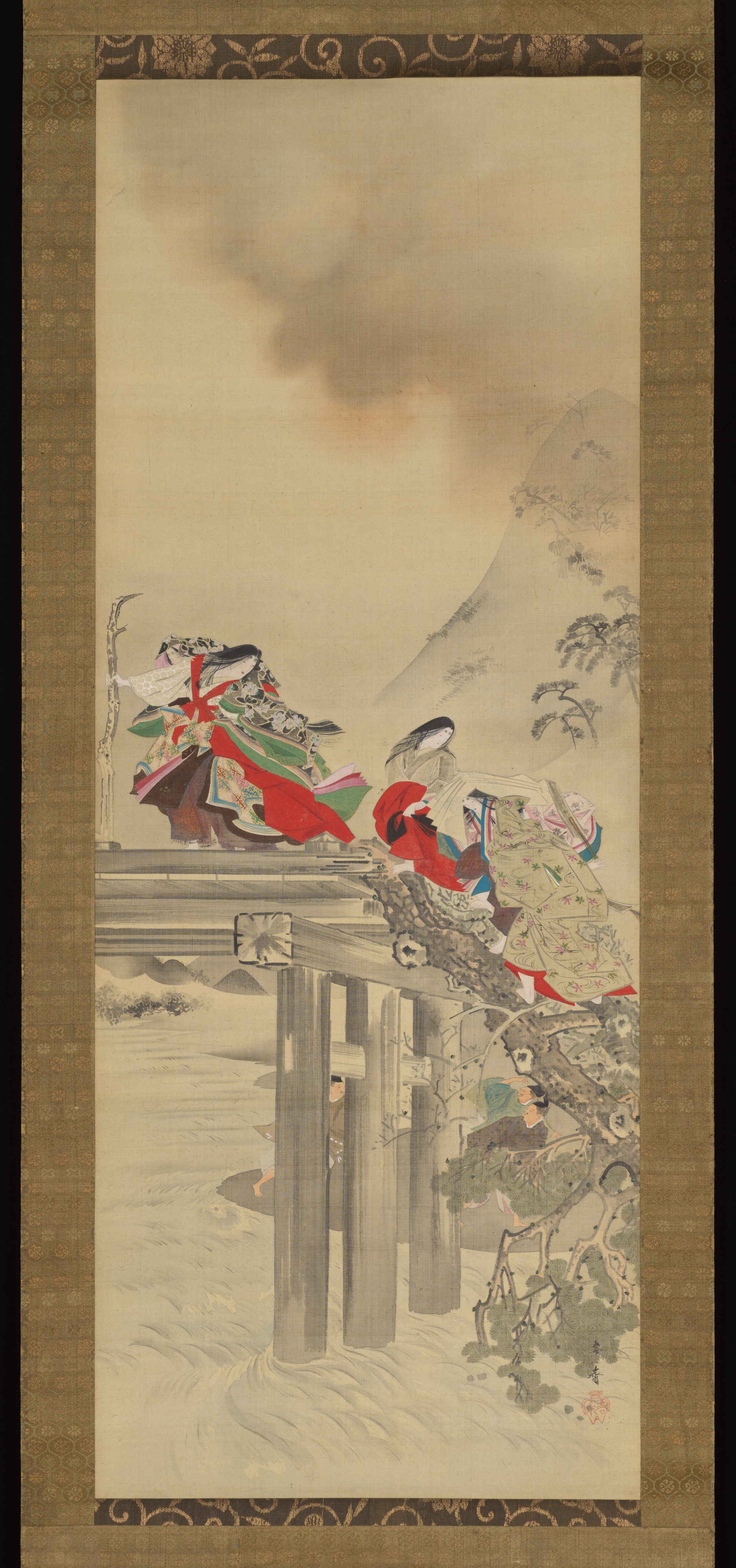
Lady Iga
伊賀局図
1860s
Hanging scroll; ink and color on silk
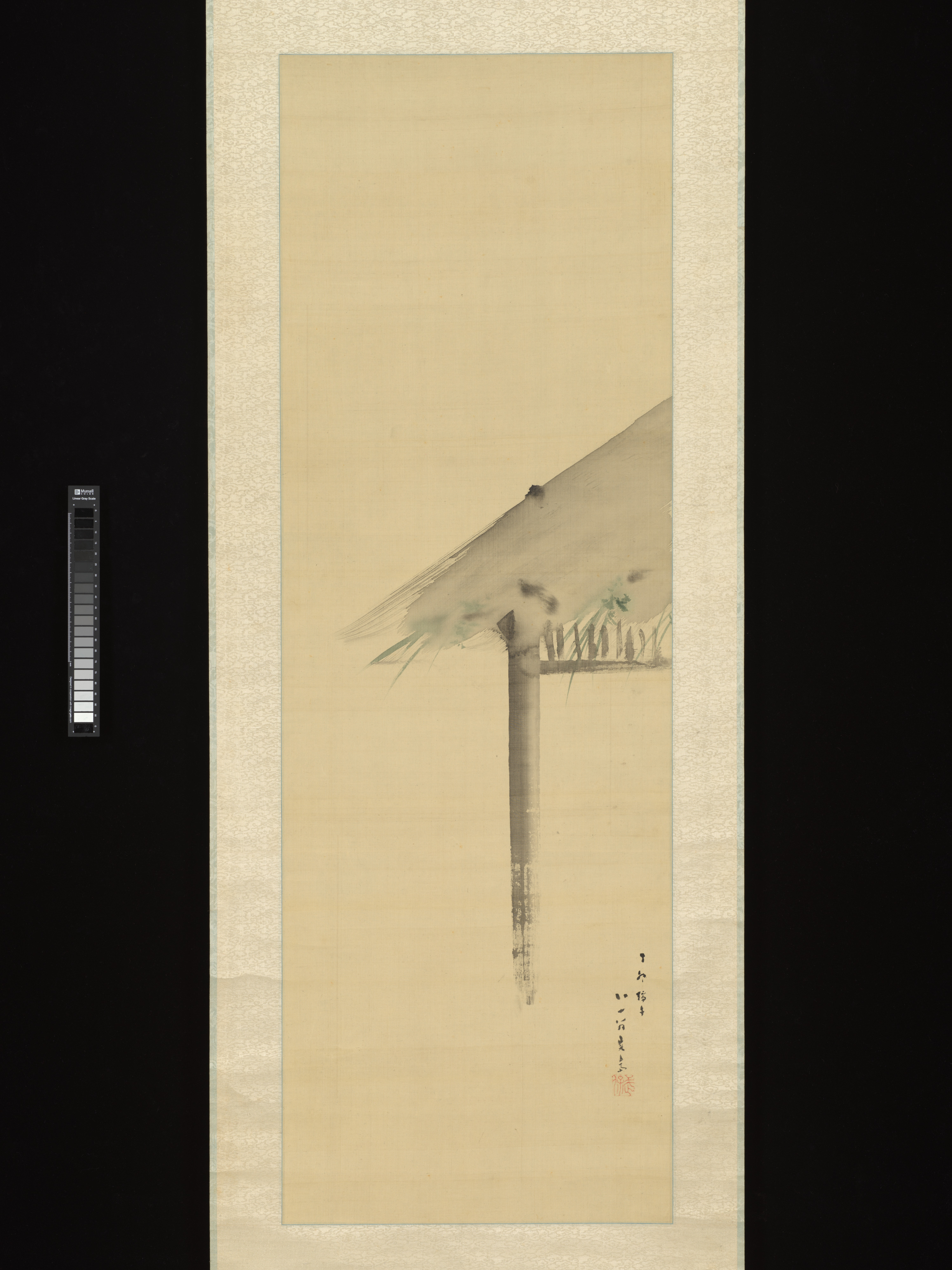
Eaves Decorated with Irises for the Tango Festival
1867
Hanging scroll; ink and color on silk

Cherry Flowers
19th century
Woodblock print (surimono); ink and color on paper

Cuttle Fish
Early 19th century
Woodblock print (surimono); ink and color on paper
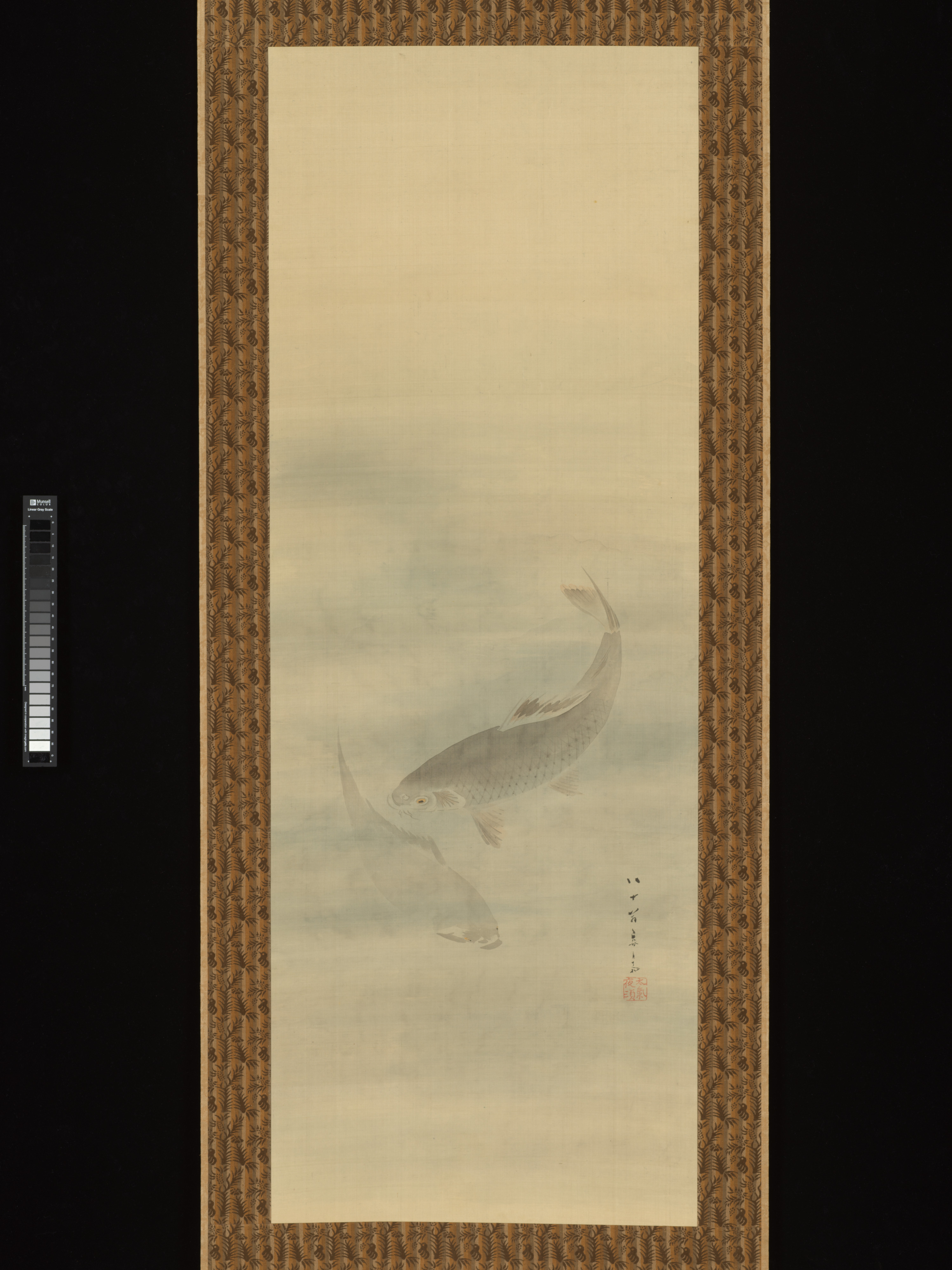
Two Carp
19th century
Hanging scroll; ink and color on silk

Ogre Accompanying the Wisteria Maiden
19th century
Hanging scroll; ink and color on paper