
Biography
Kimura Shōhachi (木村荘八, 1893-1958) was one of the central figures of the Taishō and early Shōwa Tokyo art world, a yōga (Western-style) painter, printmaker, illustrator, and essayist whose work distilled the texture, light, and disappearing daily life of his native city as it lurched from the Meiji into the modern era. Born in the Nihonbashi district of Tokyo on August 21, 1893, the eighth son of the proprietor of the Iroha chain of beef-and-sukiyaki (gyūnabe) houses — a downtown institution that helped popularize Western-style beef cuisine after the Meiji opening — Shōhachi grew up surrounded by the sights, smells, and rhythms of shitamachi life: the merchants, geisha, kabuki crowds, sukiyaki kitchens, festival processions, and bridges of the low-lying eastern wards. That immersion in Edo-into-modern-Tokyo street life shaped the subject matter to which he returned for the rest of his career, even as his stylistic vocabulary moved through Fauvist experiments, German Expressionist influences, creative-print community efforts, and finally a mature manner that combined oil-paint richness with the linear vivacity of woodblock illustration.
Kimura's formal training in Western painting began in 1911, when he entered the Hakuba-kai's Western-painting research institute and absorbed the academic plein-air manner that dominated official yōga instruction. He almost immediately broke from it. In 1912, still only nineteen, he took part in founding the short-lived but historically pivotal Fyūzan-kai (ヒュウザン会, sometimes romanized Hyūzan or Fusain), a youthful, anti-academic exhibiting society organized by Kishida Ryūsei, Saitō Yori, Takamura Kōtarō, and Yorozu Tetsugorō, among others. Fyūzan-kai gathered Tokyo's most ambitious yōga modernists for two raucous exhibitions in 1912 and 1913 and is generally considered the moment when Post-Impressionism, Fauvism, and German Expressionism arrived in Japan as live working influences rather than reproductions. Kimura's Fyūzan-kai canvases were thickly brushed and high in color, deliberately stripped of academic finish, and brought him into the inner circle of the early-Taishō avant-garde alongside Kishida and Yorozu.
Kimura was also drawn to the world of the Pan no Kai (パンの会), the literary-artistic salon that met in the cafés along the Sumida River from 1908 into the early 1910s in self-conscious imitation of Parisian café-bohemia, gathering poets such as Kitahara Hakushū and Kinoshita Mokutarō with painters including Ishii Hakutei and Yamamoto Kanae. His lifelong attachment to the bridges, eel-houses, and gas-lit waterfront of Sumida-gawa Tokyo runs through his work, and his 1928 painting Pan no Kai, reconstructing the salon from memory, stands as both an act of homage and a manifesto of the modern Tokyo painter's place at the center of the city's literary life.
Although his primary medium remained oil paint on canvas, Kimura was also drawn to the ethos of the sōsaku-hanga (creative print) movement, which emphasized self-design, self-carving, and self-printing as opposed to the divided commercial production of traditional ukiyo-e. He made woodblock prints, designed book covers and frontispieces, and produced illustrations for innumerable books and magazines, becoming one of the most prolific yōga illustrators of the Taishō and early Shōwa decades. He developed a recognizable style of line-and-wash drawing that translated the energy of Tokyo street life onto the printed page.
His most celebrated work in the illustrative mode is the long sequence of pen-and-ink and color illustrations he produced for Nagai Kafū's novella Bokutō Kidan (墨東綺譚, A Strange Tale from East of the River), serialized in the Asahi Shimbun in 1937. Kafū's text — a melancholy survey of the unlicensed pleasure quarters of Tamanoi on the east bank of the Sumida — pairs perfectly with Kimura's intimate, slightly nostalgic Tokyo eye, and the resulting illustrated edition is often celebrated as one of the finest collaborations between a modern Japanese novelist and an illustrator. The Bokutō Kidan drawings cemented Kimura's reputation as the visual chronicler of disappearing shitamachi Tokyo.
Through the 1920s and 1930s Kimura exhibited regularly with the Shun'yō-kai (春陽会), the Western-style painting society founded in 1922; he took part as a guest that year, became a full member in 1924, and remained one of its central figures — alongside Kosugi Hōan and Nakagawa Kazumasa — until his death. His mature oil paintings of Tokyo subjects — the Ginza, Asakusa, the Sumida bridges, Shinjuku Station, beef restaurants, Ōtori shrine festivals — combine confident drawing with warm, slightly muted tonalities and a Bonnard-like sensitivity to interior light. They are, taken collectively, one of the most important pictorial records of Tokyo between the Great Kantō Earthquake of 1923 and the firebombings of 1945.
Kimura was also a prolific writer who published numerous essay collections on Tokyo topography, kabuki theater, sukiyaki history, and Edo material culture, still cited by historians of late-Meiji and Taishō urban culture. He died of a brain tumor on November 18, 1958, at the University of Tokyo Hospital, at the age of sixty-five. His works are held in Japanese public collections, including the National Museum of Modern Art, Tokyo, and the Yayoi Museum. For collectors and students of Japanese modernism, Kimura Shōhachi represents the moment when Western-style yōga painting, the creative print, and modern book illustration came together to produce a distinctly Tokyo-modern visual sensibility, at once cosmopolitan and rooted in the city's shitamachi memory.
Key Facts
- Active Period
- 1893–1958
- Nationality
- 🇯🇵Japan
- Movement
- Sōsaku-hanga
- Subjects
- Children
- Works Indexed
- 8
Frequently Asked Questions
Kimura Shōhachi (木村荘八, 1893-1958) was one of the central figures of the Taishō and early Shōwa Tokyo art world, a yōga (Western-style) painter, printmaker, illustrator, and essayist whose work distilled the texture, light, and disappearing daily life of his native city as it lurched from the Meiji into the modern era. Born in the Nihonbashi district of Tokyo on August 21, 1893, the eighth son of the proprietor of the Iroha chain of beef-and-sukiyaki (gyūnabe) houses — a downtown institution that helped popularize Western-style beef cuisine after the Meiji opening — Shōhachi grew up surrounded by the sights, smells, and rhythms of shitamachi life: the merchants, geisha, kabuki crowds, sukiyaki kitchens, festival processions, and bridges of the low-lying eastern wards. That immersion in Edo-into-modern-Tokyo street life shaped the subject matter to which he returned for the rest of his career, even as his stylistic vocabulary moved through Fauvist experiments, German Expressionist influences, creative-print community efforts, and finally a mature manner that combined oil-paint richness with the linear vivacity of woodblock illustration.
Kimura Shōhachi was active from 1893 to 1958. They were associated with the Sōsaku-hanga movement.
Kimura Shōhachi's work was shaped by the Sōsaku-hanga tradition in Japanese woodblock printmaking. Sōsaku-hanga: ## What is sōsaku-hanga? Sōsaku-hanga (創作版画, "creative prints") was a twentieth-century Japanese print movement defined by a single commitment: the artist must design, carve, and print every work alone.
Kimura Shōhachi's prints frequently feature children.
Original prints by Kimura Shōhachi can be found in collections including Tokyo National Museum of Modern Art, Kitano Art Museum, Fukushima Prefectural Museum of Art, Fukutomi Tarō Collection Materials Room.
Woodblock Prints by Kimura Shōhachi (8)
Children Playing Under a Tree (Ki no shita de asondeiru kodomo)
樹の下で遊んでいる子供
1915
Oil on canvas

Woman Holding a Pot (Tsubo wo motsu onna)
壺を持つ女
c. 1915
Oil on canvas
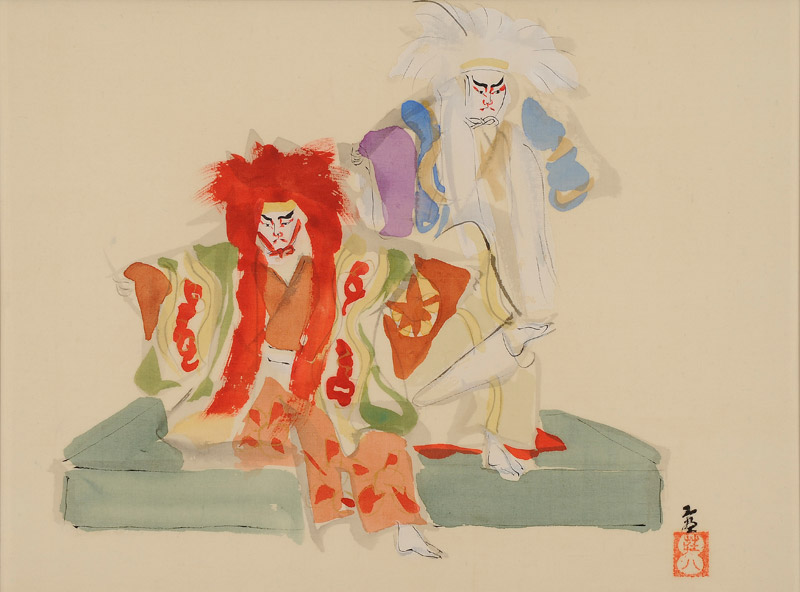
Renjishi, from Eighteen Best Kabuki Plays (Kabuki jūhachiban yori: Renjishi)
歌舞伎十八番より「連獅子」
1928
Painted illustration; reproduced as woodblock print

The Pan Society Gathering (Pan no kai)
パンの会
1928
Oil on canvas

Beef Shop Counter (Gyūnikuten chōba)
牛肉店帳場
1932
Oil on canvas

The Prewar Shinjuku Station Yard (Senzen no Shinjuku-eki kōnai)
戦前の新宿駅構内
1938
Oil on canvas

Sanbasō
三番叟
1938
Painted illustration

Festival of Ōtori Shrine (Ōtori jinja sairei)
大鷲神社祭礼
1943
Oil on canvas