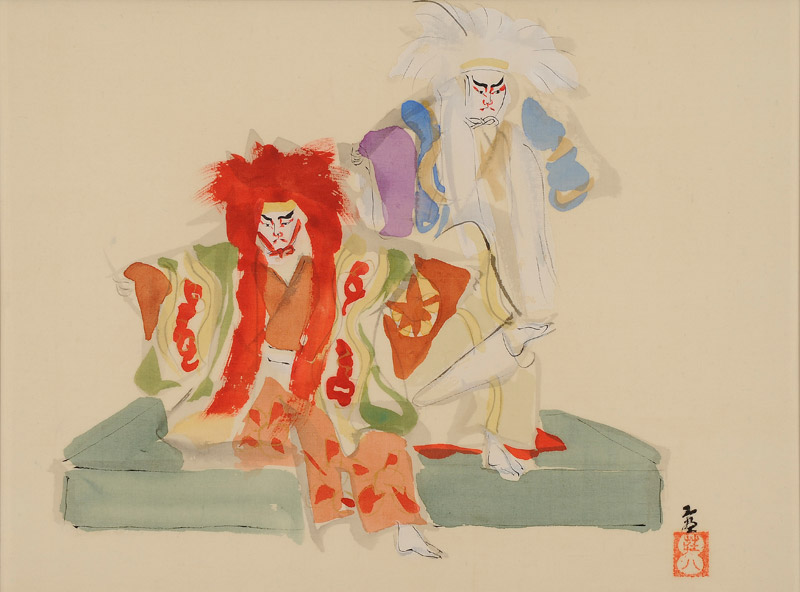
Renjishi, from Eighteen Best Kabuki Plays (Kabuki jūhachiban yori: Renjishi)
歌舞伎十八番より「連獅子」
- Date:
- 1928
- Medium:
- Painted illustration; reproduced as woodblock print
- Source:
- Yamatane Museum
Description
Renjishi, from Eighteen Best Kabuki Plays (Kabuki jūhachiban yori: Renjishi), produced by Kimura Shōhachi in 1928 and now held in the Yamatane Museum, depicts a scene from one of the most spectacular dances in the kabuki repertoire. Renjishi, the Two Lions, is performed in the Nagauta dance style by a father-and-son pair representing the parent and offspring of the mythic Chinese lion family, the climactic shishi-mai head-tossing sequence — in which both performers whirl long flowing manes in synchronized circles — being among the most physically demanding and visually intoxicating set-pieces of the entire classical theater. Kimura's composition captures the moment of the great mane-tossing, the figures rendered with the bold linear drawing and saturated color he had developed for his theatrical subjects, and reads simultaneously as a portrait of specific actors and as an emblem of the kabuki tradition. The piece belongs to a 1928 sequence in which Kimura, a lifelong kabuki enthusiast and theater critic, set himself the task of depicting each of the Eighteen Best Kabuki Plays (Kabuki Jūhachiban), the canonical aragoto repertoire codified by the Ichikawa family of actors in the early nineteenth century. The series stands as one of the major monuments of modern Japanese theatrical illustration and reflects Kimura's deep engagement with kabuki as a living tradition central to Tokyo cultural life. The Yamatane Museum example is the most-reproduced sheet from the series and remains a key document of his Taishō-to-Shōwa theatrical art.
More Prints by Kimura Shōhachi

The Prewar Shinjuku Station Yard (Senzen no Shinjuku-eki kōnai)
戦前の新宿駅構内
1938
Oil on canvas

Beef Shop Counter (Gyūnikuten chōba)
牛肉店帳場
1932
Oil on canvas

Children Playing Under a Tree (Ki no shita de asondeiru kodomo)
樹の下で遊んでいる子供
1915
Oil on canvas

Festival of Ōtori Shrine (Ōtori jinja sairei)
大鷲神社祭礼
1943
Oil on canvas
Featured in Collections
Curated cross-cuts that include this print.
Frequently Asked Questions
Renjishi, from Eighteen Best Kabuki Plays (Kabuki jūhachiban yori: Renjishi) (歌舞伎十八番より「連獅子」) was created by Kimura Shōhachi (木村荘八) in 1928.