
Biography
Kobayashi Kokei (小林古径, 1883–1957) was one of the central figures of twentieth-century nihonga (Japanese-style painting) and a leading voice within the generation of artists who reformed the medium during the late Meiji, Taishō, and Shōwa eras. Born Kobayashi Shigeru in Takada (today part of Jōetsu City), Niigata Prefecture, on 11 February 1883, he grew up in modest provincial circumstances. Orphaned early in life, he was raised in part by relatives, and the discipline, reserve, and almost ascetic refinement that contemporaries later identified as the defining qualities of his art were already visible in his earliest training.
In 1899, still in his mid-teens, Kokei went up to Tokyo to study under Kajita Hanko (1870–1917), an established Meiji-period painter who specialised in historical figure painting and bijin-ga. From Kajita he received a thorough grounding in classical brush technique, in the systematic copying of older Tosa- and Kanō-school models, and in the literary-historical iconography of court tales and military romances that would inform his early work. He took the artist name ‘Kokei,’ a name carrying connotations of antiquity and depth, which he would use for the rest of his career. He began exhibiting before long, showing at the Nihon Bijutsuin (Japan Art Institute) and at the Bunten — the Ministry of Education’s annual government salon, founded in 1907 — and quickly attracted notice for the controlled, slightly archaic refinement of his line.
The decisive turn of his career came in 1914, when the Nihon Bijutsuin was reorganised under the leadership of Yokoyama Taikan (1868–1958) after the death of its founder Okakura Tenshin. Kokei joined the revived Institute, and from that point onward his exhibition career was tied almost exclusively to the Inten, the Institute’s autumn exhibition, rather than to the official Bunten/Teiten salon. Within the reformed Bijutsuin he found himself in the company of painters with whom he would be permanently associated — Maeda Seison (1885–1977), Yasuda Yukihiko (1884–1978), and Imamura Shikō (1880–1916) — and through whom the Institute pursued its programme of restoring the historical and spiritual seriousness of Japanese painting against the pull of academic Western realism. The early Taishō period produced from Kokei a series of grave, archaising figure compositions on historical and legendary themes, drawn from the medieval war tales and from his study of Heian and Kamakura narrative scrolls. The lines in these works are extraordinarily controlled, and the colour is sparing, with a preference for ground-mineral pigments laid in flat planes and accented with the merest touches of gold and vermillion.
In 1922 the Nihon Bijutsuin sent Kokei and Maeda Seison together to Europe for an extended period of study. The pair spent time in London, Paris, and Italy, examining Renaissance painting and ancient sculpture and — crucially for Kokei’s later development — copying, at the British Museum, the celebrated handscroll Admonitions of the Instructress to the Court Ladies attributed to the early Chinese master Gu Kaizhi. The British Museum copy, made in fine linear brush, marked a permanent deepening of Kokei’s commitment to drawing as the foundation of nihonga; from this point onward his line work became, if anything, still more austere and more deeply indebted to the linear traditions of early Chinese and Yamato-e figure painting. The European trip also reinforced his sense that the path of Japanese painting was not to adopt Western chiaroscuro and aerial perspective but to refine its native pictorial language in a self-conscious, scholarly way. He returned to Japan in 1923.
The later 1920s and 1930s established Kokei as one of the most respected mature figures of the Inten. Works such as Ideyu (1918) and a steady output of bird-and-flower (kachō) compositions on silk gave him a position at the centre of nihonga’s mid-century synthesis between historical figural painting and the kachō tradition. Characteristic of his mature manner are large hanging-scroll subjects — flowers, birds, and calm still lifes such as his studies of eggplants — placed against unbroken, atmospheric grounds and outlined with the same fine, even, unhurried brush he had spent decades refining. His draughtsmanship in these compositions is regularly cited as a model of the modern nihonga still life and bird-and-flower genres.
Kokei’s institutional honours accumulated steadily. He was appointed a member of the Imperial Art Academy (Teikoku Bijutsuin, the predecessor of today’s Japan Art Academy) in 1935, and in 1944 he became a professor at the Tokyo School of Fine Arts (today the Tokyo University of the Arts). In 1950 he received the Order of Culture (Bunka Kunshō), one of the highest honours available to a living Japanese artist, and in 1951 he was named a Person of Cultural Merit (Bunka Kōrōsha). He continued to paint and to teach throughout the 1950s, admired to the end for the restraint of his late flower-and-bird compositions. He died at his home in Tokyo on 3 April 1957, at the age of seventy-four.
The critical literature on Kobayashi Kokei is broadly agreed in identifying him as the painter who, more than any other of his generation, demonstrated that a fully modern nihonga could be built out of the most classical of Japanese pictorial means. His drawing was treated as exemplary by the post-war academy, held up as a standard against which modern nihonga line could be measured, and his students carried the Inten tradition into the second half of the twentieth century. Outside Japan his work is comparatively under-collected; the major holdings remain in Japanese institutions, including the Adachi Museum of Art in Yasugi, the Yamatane Museum of Art in Tokyo, the National Museum of Modern Art in Tokyo (MOMAT), the Tokyo Fuji Art Museum, and the Niigata Prefectural Museum of Modern Art, near his birthplace. For the audience of a print-focused project such as Hanga, Kokei’s interest lies not in original block-printing — he did not practice woodblock in the publisher-led manner of his shin-hanga contemporaries — but in the intimate dialogue between his nihonga line and the older woodblock tradition of careful linear drawing on which both his historical figures and his late kachō compositions ultimately rest.
Key Facts
- Active Period
- 1883–1957
- Nationality
- 🇯🇵Japan
- Movement
- Meiji/Taishō Prints
- Subjects
- SpringBirds & Flowers
- Works Indexed
- 9
Frequently Asked Questions
Kobayashi Kokei (小林古径, 1883–1957) was one of the central figures of twentieth-century nihonga (Japanese-style painting) and a leading voice within the generation of artists who reformed the medium during the late Meiji, Taishō, and Shōwa eras. Born Kobayashi Shigeru in Takada (today part of Jōetsu City), Niigata Prefecture, on 11 February 1883, he grew up in modest provincial circumstances. Orphaned early in life, he was raised in part by relatives, and the discipline, reserve, and almost ascetic refinement that contemporaries later identified as the defining qualities of his art were already visible in his earliest training.
Kobayashi Kokei was active from 1883 to 1957. They were associated with the Meiji/Taishō Prints movement.
Kobayashi Kokei's work was shaped by the Meiji/Taishō Prints tradition in Japanese woodblock printmaking. Meiji/Taishō Prints: Meiji and Taishō era prints (1868–1926) bridge the transition from traditional ukiyo-e to the modern shin-hanga and sosaku-hanga movements.
Kobayashi Kokei's prints frequently feature spring, birds & flowers.
Original prints by Kobayashi Kokei can be found in collections including Reproduction postcard (via Wikimedia Commons), Yamatane Museum of Art, Tokyo (via Wikimedia Commons), Adachi Museum of Art, Yasugi (via Wikimedia Commons / Google Art Project), National Museum of Modern Art, Tokyo (MOMAT) (via Wikimedia Commons).
Woodblock Prints by Kobayashi Kokei (9)
Kumawakamaru
阿新丸
1907
Hanging scroll; color on silk

Fruit
果実
1910
Ink and color on paper

In the Bath (Ideyu)
出湯
1918
Color on silk

Magnolia Tree
木蓮
1919
Hanging scroll; color on silk
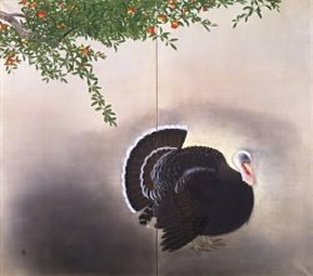
Turkey
七面鳥
1928
Color on silk

Crane
鶴
1928
Color on silk

Eggplants
茄子
1930
Color on silk

Cherry Blossoms
桜花
1930s
Color on silk

Hydrangea
紫陽花
c. 1937
Hanging scroll; color on silk