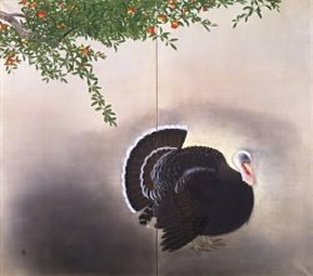
Turkey
七面鳥
- Date:
- 1928
- Medium:
- Color on silk
Description
Turkey (Shichimenchō, c. 1928) is one of the more unexpected entries in Kokei's late-1920s kachō series and reflects the somewhat cosmopolitan eye that he had brought back from his European travel. The turkey was a comparatively recent arrival in the Japanese pictorial vocabulary, having been introduced as an exotic bird through the foreign settlements of Yokohama and Kobe during the Meiji period, and Kokei's decision to take it as a serious nihonga subject reflects both his interest in expanding the kachō repertoire and his characteristic willingness to apply the same disciplined linear treatment to subjects of every status. The composition on silk shows the bird in three-quarter view, with the wattle and the iridescent ruff of the neck handled in dark colour and the long fan of the tail-feathers laid out in patient overlapping line. As with the Crane of the same period, the bird stands against a near-empty ground; the picture's interest is concentrated almost entirely in the contour and in the quiet rhythm of repeated curved lines.
More Prints by Kobayashi Kokei


Frequently Asked Questions
Turkey (七面鳥) was created by Kobayashi Kokei (小林古径) in 1928.