Biography
Kumi Obata (born 1966, Kanagawa Prefecture) is a Japanese etcher whose practice has bridged fine-art print and applied design for more than two decades. She lives and works in Tokyo, where her studio is focused on intaglio printmaking, and her output has migrated steadily across editioned etchings, illustrated books, calendars, matchbox labels, and book covers. The combination of fine-art rigour and graphic-design sensibility has made her one of the more accessible contemporary Japanese printmakers in the international market.
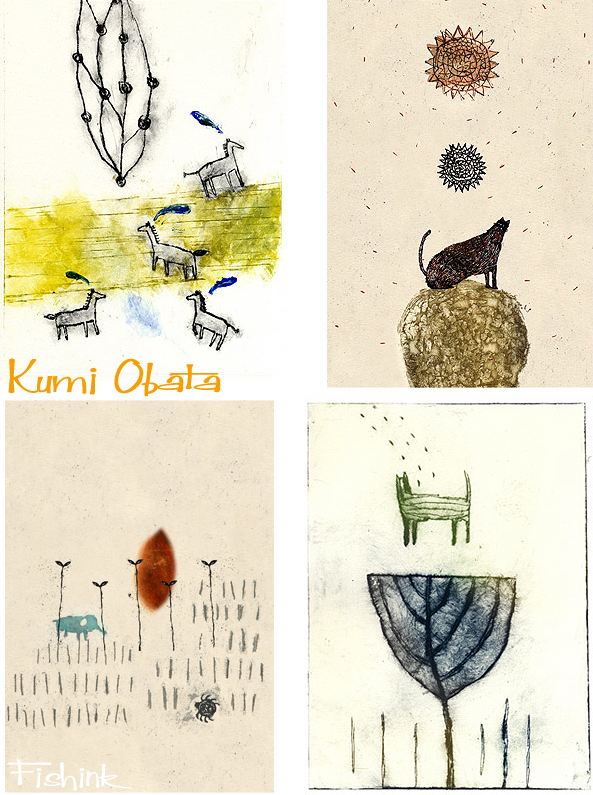
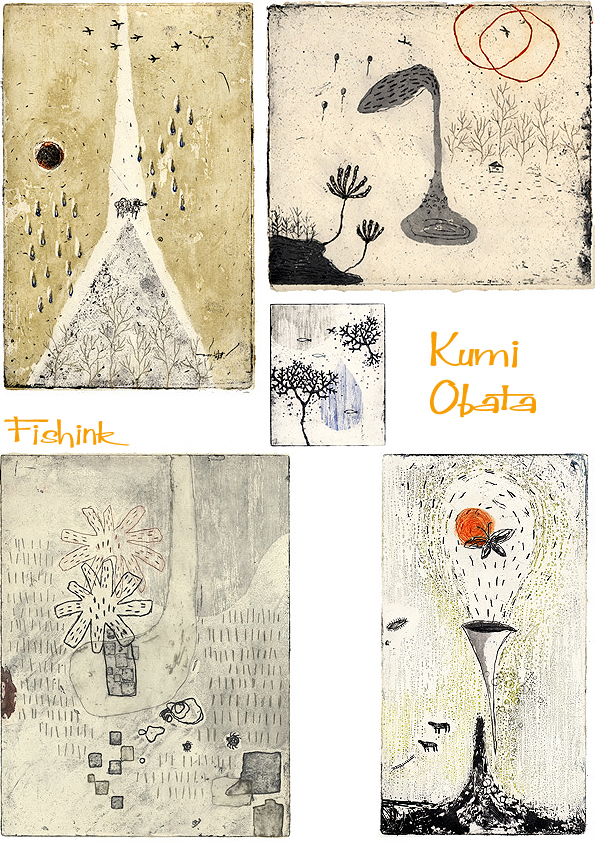
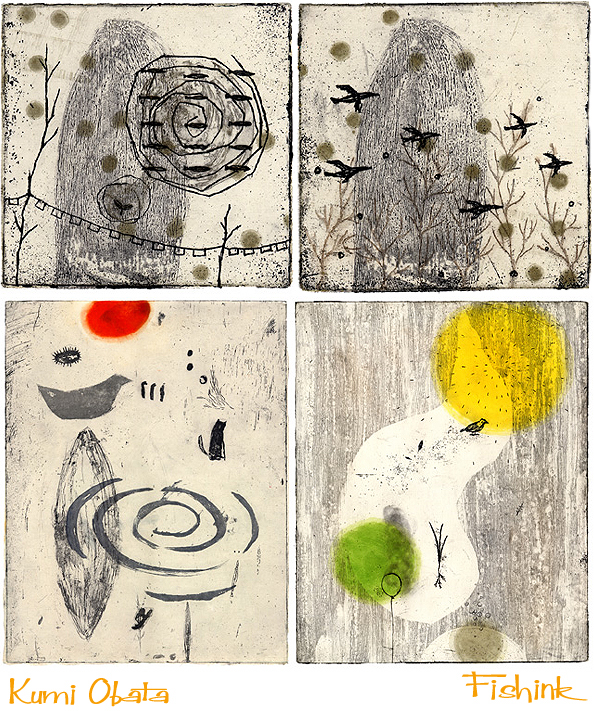
Obata began creating etchings in 2000, a relatively late entry into the medium for an artist of her generation, and the technical discipline she has developed since then is unusually consistent. She works predominantly in black-line etching on white paper, sometimes with restrained colour, and her plates are characterised by dense, slightly nervous mark-making — long parallel hatchings, scratched textures, and sharp graphic outlines that collectively give the prints their recognisable scratchy, hand-drawn quality. Animals such as cats, fish and dogs, small figures, and patterned floral compositions recur as her dominant subjects.
Her prints reach the international market through a small group of specialist galleries. Davidson Galleries / Gallery No.85 in Seattle has been a long-running U.S. dealer, and her editions also appear through Davidson's online storefront and on the secondary market via Artsy. In Japan she sells through her own online shop and through the design-driven retail channels — book covers, matchboxes, illustrations — that have given her work some of its broadest reach.
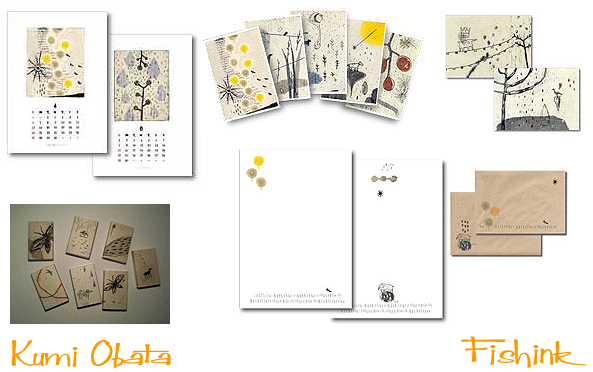
Alongside her plate-based work she has produced illustrated picture books and translated the same intaglio imagery into product design — creating not just gallery editions but also calendars, illustrations, and applied products. The crossover gives the etchings an unusual second life: a small image first pulled in an edition of a couple dozen for the gallery market may also appear, in a different form, on a printed calendar or a children's book in commercial distribution. The result is a body of work that operates simultaneously as collected fine art and as widely distributed graphic design.
Commentary in the design blogosphere has emphasised the appeal of her stark black-and-white compositions, the lightly imperfect surface of the etched line, and the hand-drawn warmth that the technique gives to imagery that could otherwise read as pure graphic illustration. A 2012 write-up on the Fishink blog described the appeal of her etchings' stark lines and slightly uneven textures, locating her work within a broader contemporary Japanese intaglio tradition that prioritises warmth and subjective hand-feel over the cool minimalism of much postwar Japanese print.
Obata's practice continues to develop along the same dual axis — gallery editions in Seattle and other Western markets, applied product design and book illustration in Japan — and she remains one of the steadier figurative voices on the contemporary Japanese print scene for collectors interested in narrative, graphically driven intaglio work.
Key Facts
- Active Period
- 1966
- Nationality
- 🇯🇵Japan
- Movement
- Contemporary Mokuhanga
- Works Indexed
- 5
Frequently Asked Questions
Kumi Obata (born 1966, Kanagawa Prefecture) is a Japanese etcher whose practice has bridged fine-art print and applied design for more than two decades. She lives and works in Tokyo, where her studio is focused on intaglio printmaking, and her output has migrated steadily across editioned etchings, illustrated books, calendars, matchbox labels, and book covers. The combination of fine-art rigour and graphic-design sensibility has made her one of the more accessible contemporary Japanese printmakers in the international market.
Kumi Obata was active born in 1966. They were associated with the Contemporary Mokuhanga movement.
Kumi Obata's work was shaped by the Contemporary Mokuhanga tradition in Japanese woodblock printmaking. Contemporary Mokuhanga: Contemporary mokuhanga (literally "wood-block print") encompasses artists working from approximately 1970 to the present who continue or reinvent traditional Japanese woodblock printing techniques.