Biography
Utagawa Kunihiro (歌川国広, active circa 1815–1843) was an Osaka kamigata-e print designer who worked at the center of the city's yakusha-e (kabuki actor print) tradition during the Bunsei and Tenpō eras. His personal name, birth date, and death date are not recorded, a pattern typical of Osaka print designers whose biographies were rarely preserved with the care given to Edo masters such as Hokusai or Kunisada. What survives is his signed and dated work, which places him in active production from roughly 1815 into the early 1840s and concentrates almost entirely on actor portraits drawn from the Osaka kabuki stage.
Kunihiro signed his prints with several alternative go (art names) over the course of his career, including Ganjōsai, Konantei, Sanshōtei, and Takigawa, a multiplicity of signatures characteristic of nineteenth-century kamigata-e and one reason the corpus of his work has been slow to be fully consolidated by modern scholarship. The Utagawa surname situates him within the dominant nineteenth-century lineage of Japanese print designers; some sources suggest he may have received instruction from Utagawa Toyokuni I of Edo, though the precise relationship of training or association is not documented in surviving records. As with most Osaka designers, his connection to the Utagawa school is best understood as a signed affiliation that placed his prints within the recognized commercial brand of the period rather than as evidence of a formal Edo apprenticeship.
Kamigata-e, the Osaka print tradition, differs significantly from the better-known Edo ukiyo-e of the same period. Osaka prints were typically produced in smaller editions, often privately commissioned by fan clubs (renju) or theater patrons, and were aimed at a knowledgeable kabuki audience rather than the broad tourist market of Edo. The kamigata-e idiom favored close character studies of specific actors in specific roles, prominent inscription of role and actor name, and a willingness to use lavish printing techniques such as metallic pigments, mica grounds, and embossing on prestige editions. Kunihiro's work fits squarely within this idiom: his actor portraits show Osaka stars including Arashi Kichisaburō II (later Arashi Kitsusaburō I), Ichikawa Ebijūrō I, Nakamura Utaemon III, and Arashi Rikan in tightly framed dramatic moments, with their roles and play titles inscribed directly on the sheet. He worked as a younger contemporary of Shunkōsai Hokushū, the leading Osaka designer of the 1810s and 1820s, and his career overlaps with the rise of Shunbaisai Hokuei and the next generation of Osaka yakusha-e designers in the early 1830s.
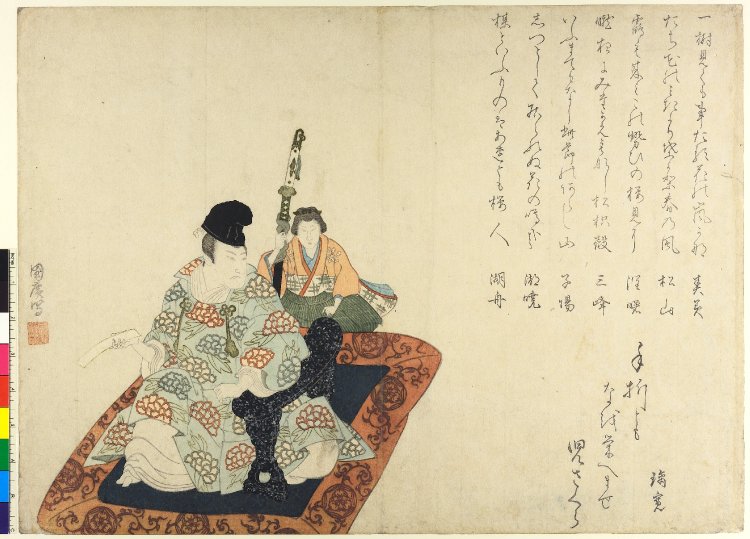
Beyond single-sheet actor prints, Kunihiro also produced surimono — privately commissioned, lavishly printed deluxe prints that gave him a venue for the most ambitious printing techniques of the Osaka tradition. A representative example, held by the British Museum, is his surimono commemorating Arashi Kichisaburō II's 1820 assumption of the name Kitsusaburō I: a formal portrait of the actor at the center of the composition, accompanied by eight congratulatory poems and finished with applied lacquer and mother-of-pearl.
Kunihiro's prints are held today by the British Museum, which preserves the lacquered 1820 surimono of Arashi Kichisaburō II among its Osaka holdings, as well as by the Cleveland Museum of Art and other institutions with significant Osaka kamigata-e collections. His work is studied within the scholarship on Osaka yakusha-e alongside that of Hokushū, Hokuei, Hirosada, and Yoshitaki. For scholars and collectors of kamigata-e, Utagawa Kunihiro is a representative Osaka designer whose surviving prints document specific Osaka theatrical productions and individual actors of the Bunsei and Tenpō periods that would otherwise be largely lost to the visual record.
Key Facts
- Nationality
- 🇯🇵Japan
- Movement
- Ukiyo-e
- Works Indexed
- 6
Frequently Asked Questions
Utagawa Kunihiro (歌川国広, active circa 1815–1843) was an Osaka kamigata-e print designer who worked at the center of the city's yakusha-e (kabuki actor print) tradition during the Bunsei and Tenpō eras. His personal name, birth date, and death date are not recorded, a pattern typical of Osaka print designers whose biographies were rarely preserved with the care given to Edo masters such as Hokusai or Kunisada. What survives is his signed and dated work, which places him in active production from roughly 1815 into the early 1840s and concentrates almost entirely on actor portraits drawn from the Osaka kabuki stage.
Utagawa Kunihiro's work was shaped by the Ukiyo-e tradition in Japanese woodblock printmaking. Ukiyo-e: ## What is ukiyo-e? Ukiyo-e ([浮世絵](/glossary/ukiyo-e)) — literally "pictures of the floating world" — is the Edo-period Japanese print and painting tradition that flourished from roughly 1660 to 1868, depicting the pleasures of urban life in Edo (modern Tokyo): courtesans, kabuki actors, sumo wrestlers, famous landscapes, and seasonal beauties.
Utagawa Kunihiro's prints frequently feature winter, children.
Original prints by Utagawa Kunihiro can be found in collections including Minneapolis Institute of Art, British Museum, Art Institute of Chicago.
Woodblock Prints by Utagawa Kunihiro (6)
Surimono: Portrait of Arashi Kichisaburō II Commemorating Name Change to Kitsusaburō I
c. 1820
Color woodblock surimono with applied lacquer and mother-of-pearl

The Actor Arashi Kitsusaburō I as Nagai Genzaburō
1821
Color woodblock print (nishiki-e), yakusha-e

Ichikawa Ebijurō I as Kezori Kuemon and Arashi Tomisaburō as the Courtesan Kojorō (from Yamato kotoba Suikoden)
c. 1822
Color woodblock print from an album of 104 sheets
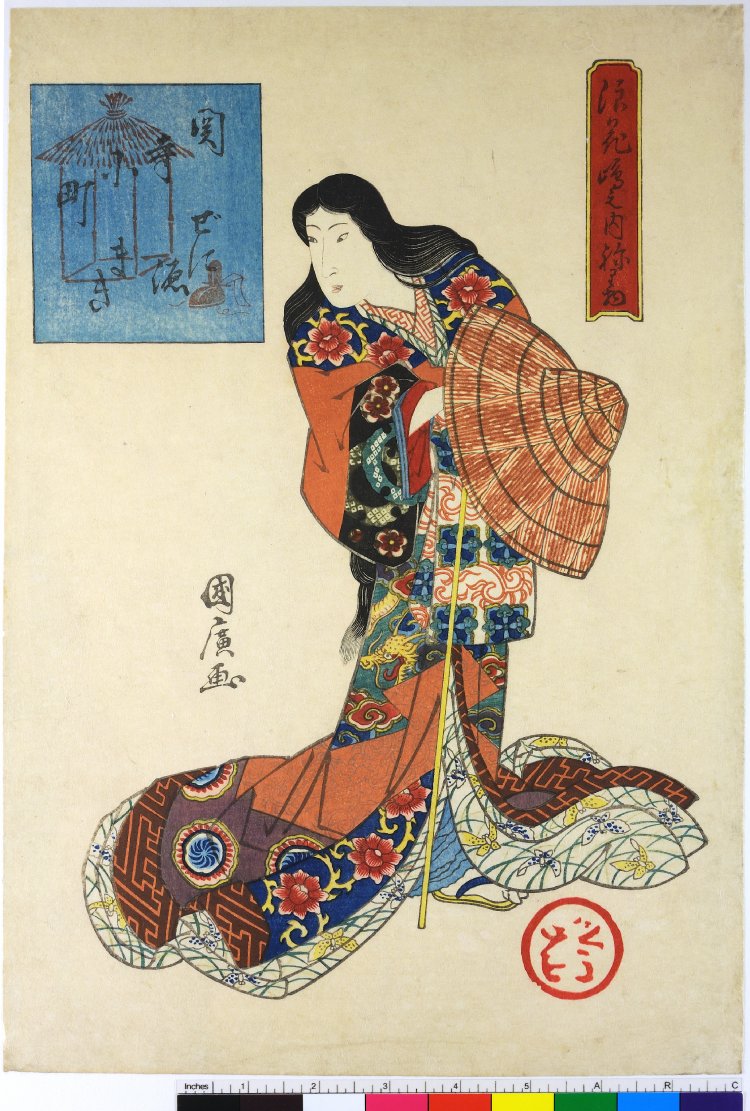
Naniwa Shima-no-uchi nerimono: Sekidera Komachi
c. 1815-1820
Color woodblock print

Actor Arashi Rikan as Miyamoto Musashi, Journeying through the Snow with his Boy Attendant
c. 1815-1830
Color woodblock print (yakusha-e)

Actors as Benkei and Minamoto no Yoshitsune
19th century
Color woodblock print (nishiki-e); oban