Biography
Lilian May Miller (1895-1943), known professionally by the gō Gyokka (玉華, 'Jeweled Flower'), was an American painter and woodblock printmaker who occupies a singular position in the history of shin-hanga: a Tokyo-born Westerner trained from childhood inside the Japanese atelier system, who designed, carved, and printed her own blocks at a level of technical fluency that none of the other foreign artists associated with the Watanabe circle (Helen Hyde, Bertha Lum, Elizabeth Keith, Charles Bartlett, Paul Jacoulet) ever approached. Born on 20 July 1895 in Tokyo to the American diplomat Ransford Stevens Miller (1867-1932) and his English-teacher wife Lily Murray Miller, she grew up between the legations of Tokyo and Seoul and the family's American base in Washington, D.C., bilingual in English and Japanese from infancy. Her father, who would later head the State Department's Far Eastern Affairs desk, gave her access to a stratum of Meiji and Taisho Tokyo that was effectively closed to other foreigners.
Miller's training in the Japanese painting tradition began at the age of nine, in 1904, when the American printmaker Helen Hyde — then living and working in Tokyo — suggested to her parents that their precociously gifted daughter be enrolled in the studio of Kanō Tomonobu (1843-1912), the ninth-generation head of the Kobikichō line of the Kanō school. Kanō Tomonobu's atelier gave Miller a rigorous grounding in the conservative literati and academic painting of the late Edo and Meiji Kanō tradition — line, brush discipline, copy of model books, ink wash — at exactly the age at which a Japanese disciple would have begun. Three years into her training she exhibited her first works publicly and received the artist-name Gyokka, which she would inscribe on her woodblock prints for the rest of her career. She attended Central High School in Washington while her father was posted to the State Department, won a Washington Post drawing prize at fourteen, and then enrolled at Vassar College, where she was a classmate of the poet Edna St. Vincent Millay and from which she graduated with honours in 1917.
From 1917 to 1918 she returned to Tokyo for a second round of formal Japanese training, this time under Shimada Bokusen (1867-1943), a Nihonga painter and teacher. With Bokusen, Miller refined her command of the brush and absorbed the modernised Nihonga vocabulary that the early twentieth-century Tokyo art world was using to bridge traditional and contemporary subjects. Her 1920 ink painting In a Korean Palace Garden, a view of Queen Min's Gyeongbokgung in Seoul, was admitted to the Japanese Imperial Salon — an extraordinary achievement for a foreign artist — and her formal status within the Japanese art world was established.
In September 1920 Miller turned to woodblock printing, the medium with which she is now identified. The shin-hanga ('new prints') movement, formally articulated by the publisher Watanabe Shōzaburō (1885-1962) from the 1910s onward, was beginning its first major commercial expansion. Miller's connection to its foreign-artist branch came through Helen Hyde and Bertha B. Lum (1869-1954), the American woodblock artist with whom she shared rooms in Tokyo. Unlike her foreign contemporaries, who handed their drawings to Watanabe's professional block-carvers and printers, Miller learned the full workflow herself — working initially with the block-carver Matsumoto and the printer Nishimura Kumakichi (Hyde's old team) but ultimately taking the entire process into her own hands. Her ability to perform jiga-jikoku-jizuri ('self-drawn, self-carved, self-printed') from inside the shin-hanga tradition rather than the sōsaku-hanga ('creative print') world made her almost unique in interwar Japanese printmaking.
The Great Kantō Earthquake of September 1923 destroyed most of her stock; she withdrew to Seoul, where her parents lived, and spent 1923 to 1927 producing stylised Korean subjects — moonlight farmhouses, women carrying water, palace gates — while recovering from a serious illness. The mature Miller style crystallised in this Korean period: a clear, almost stark line, low-keyed atmospheric colour, and an economy of compositional means that reflects both her Kanō training and her familiarity with the modernised Nihonga of the post-1910 Tokyo salons. From 1929 to 1930 she undertook an American demonstration tour, presenting woodblock printing in kimono and sash in cities including Boston, New York, Philadelphia, Washington, Chicago, Kansas City, Denver, and San Francisco, and at Grace Nicholson's gallery in Pasadena, producing a small but durable American audience that included the patrons Lou Henry Hoover and Anne Morrow Lindbergh.
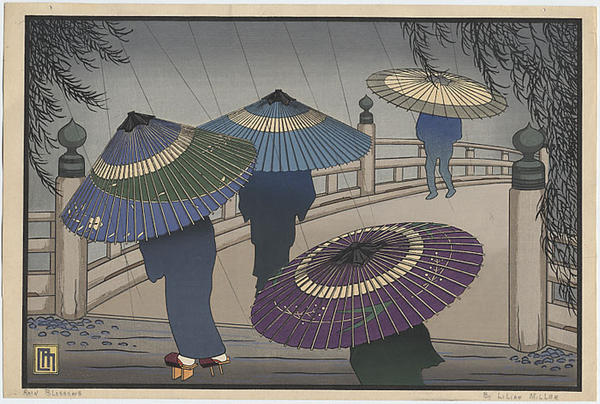
In 1930 she returned to Japan, took an old machiya in Kyoto, and produced what is now considered her finest period of work: the large 1928 plates (Nikko Gateway, Rain Blossoms, A Korean Shrine, Japanese Dwarf Plum Tree) and the early-1930s Kyoto and Nara views (Festival of Lanterns, Nara and Moonlight on Mt. Fuji, Japan). The Empress Nagako of Japan was among her collectors. The political climate of late-1930s Japan became increasingly difficult for an American with formal connections to the Imperial household, and in early 1936 Miller left for Honolulu and on to San Francisco in autumn 1938, where she lived for the rest of her life. The California years saw a shift toward watercolour and lithography — watercolours of redwoods, cypresses and coastal landscapes, and the 1937 lithotint A Spray of Bamboo, which won the Honolulu Print Makers gift-print prize. After Pearl Harbor she enlisted in the U.S. Navy's counter-propaganda branch as a Japanese-language censor and research analyst. She underwent surgery for abdominal cancer at Stanford on 9 December 1942 and died at San Francisco on 11 January 1943, aged forty-seven.
Miller's prints are held in the principal Western shin-hanga collections — the Smithsonian American Art Museum, the Art Institute of Chicago, the British Museum, the San Diego Museum of Art, the Pacific Asia Museum in Pasadena, the Library of Congress and the National Museum of Modern Art, Tokyo. The Kendall H. Brown retrospective at the Pacific Asia Museum in 1998 (Between Two Worlds: The Life and Art of Lilian May Miller) established the scholarly framework within which she is now read. She survives as the most technically accomplished Western shin-hanga artist and as one of the small number of foreign women — Hyde, Lum, Keith, Royds, Miller — whose Tokyo, Kyoto and Seoul careers between 1900 and 1940 formed the parallel transnational current of the shin-hanga movement.
Key Facts
- Active Period
- 1895–1943
- Nationality
- 🇯🇵Japan
- Movement
- Shin-hanga
- Works Indexed
- 7
Frequently Asked Questions
Lilian May Miller (1895-1943), known professionally by the gō Gyokka (玉華, 'Jeweled Flower'), was an American painter and woodblock printmaker who occupies a singular position in the history of shin-hanga: a Tokyo-born Westerner trained from childhood inside the Japanese atelier system, who designed, carved, and printed her own blocks at a level of technical fluency that none of the other foreign artists associated with the Watanabe circle (Helen Hyde, Bertha Lum, Elizabeth Keith, Charles Bartlett, Paul Jacoulet) ever approached. Born on 20 July 1895 in Tokyo to the American diplomat Ransford Stevens Miller (1867-1932) and his English-teacher wife Lily Murray Miller, she grew up between the legations of Tokyo and Seoul and the family's American base in Washington, D.C., bilingual in English and Japanese from infancy. Her father, who would later head the State Department's Far Eastern Affairs desk, gave her access to a stratum of Meiji and Taisho Tokyo that was effectively closed to other foreigners.
Lillian May Miller was active from 1895 to 1943. They were associated with the Shin-hanga movement.
Lillian May Miller's work was shaped by the Shin-hanga tradition in Japanese woodblock printmaking. Shin-hanga: ## What is Shin-hanga? Shin-hanga (新版画), literally "new prints," is the early twentieth-century revival of the collaborative Japanese woodblock workshop, organized between roughly 1915 and 1960 by the Tokyo publisher Watanabe Shōzaburō (1885–1962) and a handful of competing houses.
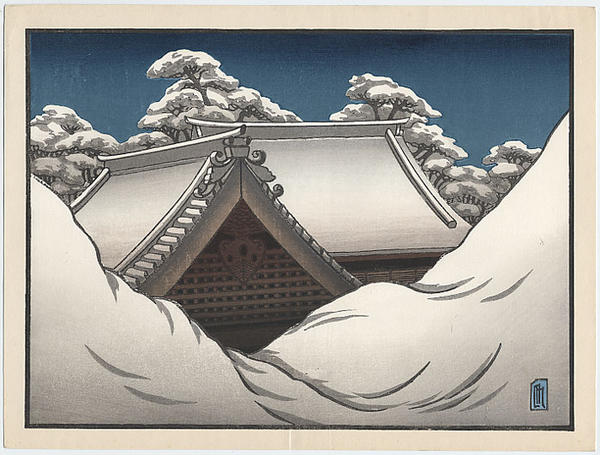
Lillian May Miller's prints frequently feature snow scenes, temples & shrines, landscapes, abstract, mount fuji, moonlight.
Original prints by Lillian May Miller can be found in collections including Wikimedia Commons (Lilian May Miller estate), Japanese Art Open Database, Smithsonian American Art Museum, San Diego Museum of Art.