
Higashi- Hirakata
- Source:
- ukiyo-e.org
Description
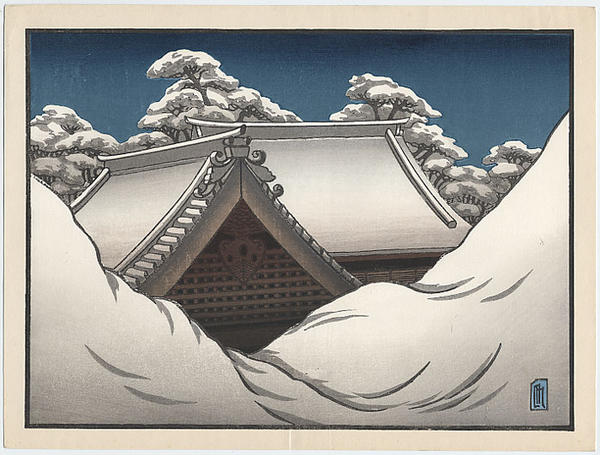
Higashi-Hirakata is a Japanese landscape print by Lilian May Miller (1895-1943), the Tokyo-born American printmaker whose self-printed shin-hanga compositions occupy a singular place in the history of American Japonisme. The daughter of a U.S. diplomat stationed in Japan, Miller grew up bilingual and bicultural, studying brush painting under Kano Tomonobu from the age of nine and later training in woodblock cutting and printing with Bonkotsu Igami and Nishimura Kumakichi. Unlike most foreign artists working in the shin-hanga revival, who relied on Japanese craftsmen to translate their designs into prints, Miller carved her own blocks and pulled her own impressions, a discipline she pursued from her studio in Tokyo and later Kyoto. This commitment to the full hanmoto process placed her within a small circle of Western shin-hanga practitioners that included Helen Hyde, Bertha Lum, and Elizabeth Keith. Higashi-Hirakata renders a quiet provincial scene whose subject matter aligns with the shin-hanga movement's broader project of preserving views of an older, rural Japan against the rapid modernization of the early twentieth century. Miller favored compositions that balanced atmospheric weather effects, restrained color palettes, and the careful registration of bokashi gradations across the sky and water. Her line work, sharpened by years of brush practice, gives her prints a calligraphic clarity that distinguishes them from purely decorative Japonisme imagery produced by American contemporaries who never set foot in Japan. Working at the intersection of two artistic traditions, Miller signed many of her prints with the Japanese name Gyo-Getsu Maru, a sobriquet meaning 'Dawn Moon Circle' bestowed on her in childhood. The present impression is documented through the ukiyo-e.org reference image archive, which catalogs Western and Japanese woodblock prints from museum and dealer holdings worldwide. Miller's surviving body of work is small, having been partially destroyed by the 1923 Great Kanto earthquake and again disrupted by her wartime service in U.S. naval intelligence during the Second World War, making each documented composition an important record of her cross-cultural shin-hanga practice.
More Prints by Lillian May Miller



Featured in Collections
Curated cross-cuts that include this print.
Frequently Asked Questions
Higashi- Hirakata was created by Lillian May Miller.