
Biography
Terauchi Manjirō (寺内萬治郎, 25 November 1890 – 14 December 1964) was one of the most accomplished yōga (Western-style) painters of the Taishō and Shōwa periods, widely celebrated as Japan's foremost twentieth-century painter of the female nude — a reputation that earned him the epithet 'Terauchi of the nudes.' Across a career of nearly half a century he produced a body of figure paintings whose volumetric solidity, low-keyed ochre and umber palette and almost devotional patience of observation distinguished him sharply from the brighter plein-air manner of his teachers and made him, in the period after 1945, the model against whom most subsequent Japanese painters of the figure were measured.
Terauchi was born in Osaka and showed an early talent for drawing, studying watercolour as a youth before turning to Western-style oil painting. He trained at the Hakubakai (White Horse Society) Western-painting research institute under Kuroda Seiki (1866–1924) — the founder of the Hakubakai and of the gaiyō (bright-palette) academic manner Kuroda had brought back from his Paris years with Raphaël Collin — and entered the Western-painting (yōga) division of the Tokyo School of Fine Arts (Tōkyō Bijutsu Gakkō, now Tokyo University of the Arts), graduating in 1916. His first acceptance at the Bunten (Ministry of Education annual) came in 1918, and over the following decade he became a fixture of the official salon, twice winning the special selection (tokusen) at the Teiten and, in 1933, being appointed one of its jurors. From this point on the Bunten/Teiten/Shin-Bunten/Nitten system would be the principal arena of his career, and he would remain one of its central yōga figures until his death.
The Tokyo art world of the 1920s was riven between the bright Kuroda academicism, which was already being criticised as decorative, and a number of more rigorously volumetric reactions to it. In 1926 Terauchi established the Sekkaisha (石榴社, the 'Pomegranate Society'), a small study and exhibition group. In 1929 he joined the Kōfūkai (光風会), the leading independent yōga society founded by former Hakubakai members in 1912, where he became a senior figure — later serving as a councillor and juror — and exhibited the major nudes that would define his later reputation, giving him a permanent national exhibition platform outside the contested official salon.
In 1934 Terauchi moved his household and studio to Urawa in Saitama prefecture, north of Tokyo, where he would live and work for the rest of his life. Urawa in the inter-war years was becoming a colony of Tokyo painters who sought a quieter setting within commuting distance of the city, and Terauchi's presence helped concentrate it; the surviving Urawa Art Museum preserves work by him and his circle. During the 1930s his work matured in the direction that would become his signature manner — single-figure female nudes, often shown in reverie or repose in a shallow studio space, modelled in long, smoke-coloured halftones over a warm ground, with the contour drawn firmly but never harshly and the flesh weighed against muted ochres, mossy greens and the deep red-browns of textiles, cushions or studio drapery.
The war years interrupted but did not transform the work. Like many Japanese yōga painters of his generation Terauchi was mobilised as an army painter (jūgun gaka) for the Southern campaigns, travelling to the Philippines and Celebes, and in 1943 he produced Awaiting Manila (マニラを望む), a meditative view toward the Philippine capital. Unlike the more grandly heroic war pictures of some of his contemporaries, his wartime work retained the contemplative cast of the studio nudes — valued less as propaganda than as a quiet document of the artist's persistent inwardness under extreme circumstances.
After 1945 Terauchi emerged as one of the senior figures of the reconstituted Nitten (Japan Fine Arts Exhibition) and as an influential teacher of figure painting. He had taught at his Tokyo School of Fine Arts alma mater as a lecturer from 1943, and in 1944 he founded the Musashino Kai (武蔵野会, the Musashino Association) — a private study and exhibition society named for the wide central-Honshū plain on which Tokyo sits — with a group of some twenty pupils, and through it and the later Yono-kai he trained a generation of figure painters who would come to prominence in the Nitten of the 1950s and 1960s. In 1951 he received the Japan Art Academy Prize (Nihon Geijutsuin-shō) for Reclining Nude, the painting that became the canonical statement of his post-war manner. In 1960 he was named a full member of the Japan Art Academy (Nihon Geijutsu-in).
Terauchi's late nudes refined this formula without altering it: a single figure, weighed against a few stable warm-and-cool relationships, drawn with the patience of an artist who had looked at the same problem for forty years. He died on 14 December 1964 at the age of seventy-four. His paintings are held at the National Museum of Modern Art, Tokyo, and in museums across Saitama — among them the Urawa Art Museum and the Saitama Prefectural Museum of Modern Art — and through the societies he led and his many pupils his manner remained a central tradition of academic figure painting in Japan well into the late twentieth century.
Key Facts
- Active Period
- 1890–1964
- Nationality
- 🇯🇵Japan
- Movement
- Sōsaku-hanga
- Subjects
- Children
- Works Indexed
- 10
Frequently Asked Questions
Terauchi Manjirō (寺内萬治郎, 25 November 1890 – 14 December 1964) was one of the most accomplished yōga (Western-style) painters of the Taishō and Shōwa periods, widely celebrated as Japan's foremost twentieth-century painter of the female nude — a reputation that earned him the epithet 'Terauchi of the nudes.' Across a career of nearly half a century he produced a body of figure paintings whose volumetric solidity, low-keyed ochre and umber palette and almost devotional patience of observation distinguished him sharply from the brighter plein-air manner of his teachers and made him, in the period after 1945, the model against whom most subsequent Japanese painters of the figure were measured.
Manjirō Terauchi was active from 1890 to 1964. They were associated with the Sōsaku-hanga movement.
Manjirō Terauchi's work was shaped by the Sōsaku-hanga tradition in Japanese woodblock printmaking. Sōsaku-hanga: ## What is sōsaku-hanga? Sōsaku-hanga (創作版画, "creative prints") was a twentieth-century Japanese print movement defined by a single commitment: the artist must design, carve, and print every work alone.
Manjirō Terauchi's prints frequently feature children.
Original prints by Manjirō Terauchi can be found in collections including Wikimedia Commons (Terauchi Manjirō catalogue), Japanese Art Open Database (JAODB) via ukiyo-e.org.
Woodblock Prints by Manjirō Terauchi (10)
Yukata (Girl in Bath Robe)
浴衣
1935
Oil on canvas

Awaiting Manila
マニラを望む
January 1943
Oil on canvas
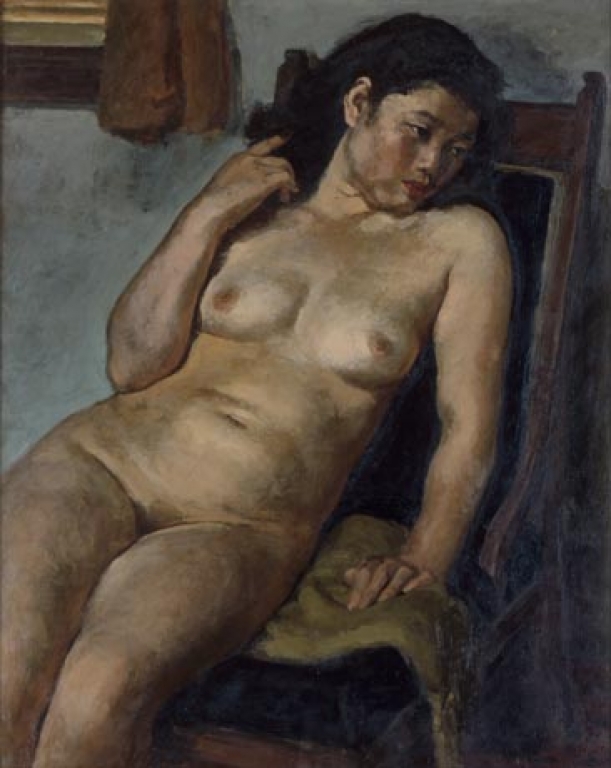
Nude (1947)
裸婦
1947
Oil on canvas

Reclining Nude
横たわる裸婦
1950
Oil on canvas
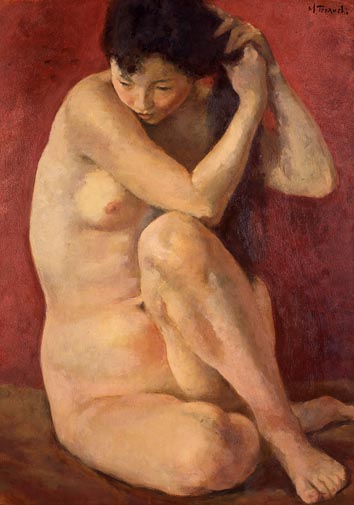
Nude (1963)
裸婦
1963
Oil on canvas

Nude Study I
裸婦習作
before 1964
Oil on canvas

Nude Study II
裸婦習作
before 1964
Oil on canvas

Nude Study V
裸婦習作
before 1964
Oil on canvas

Nude Study III
裸婦習作
before 1964
Oil on canvas
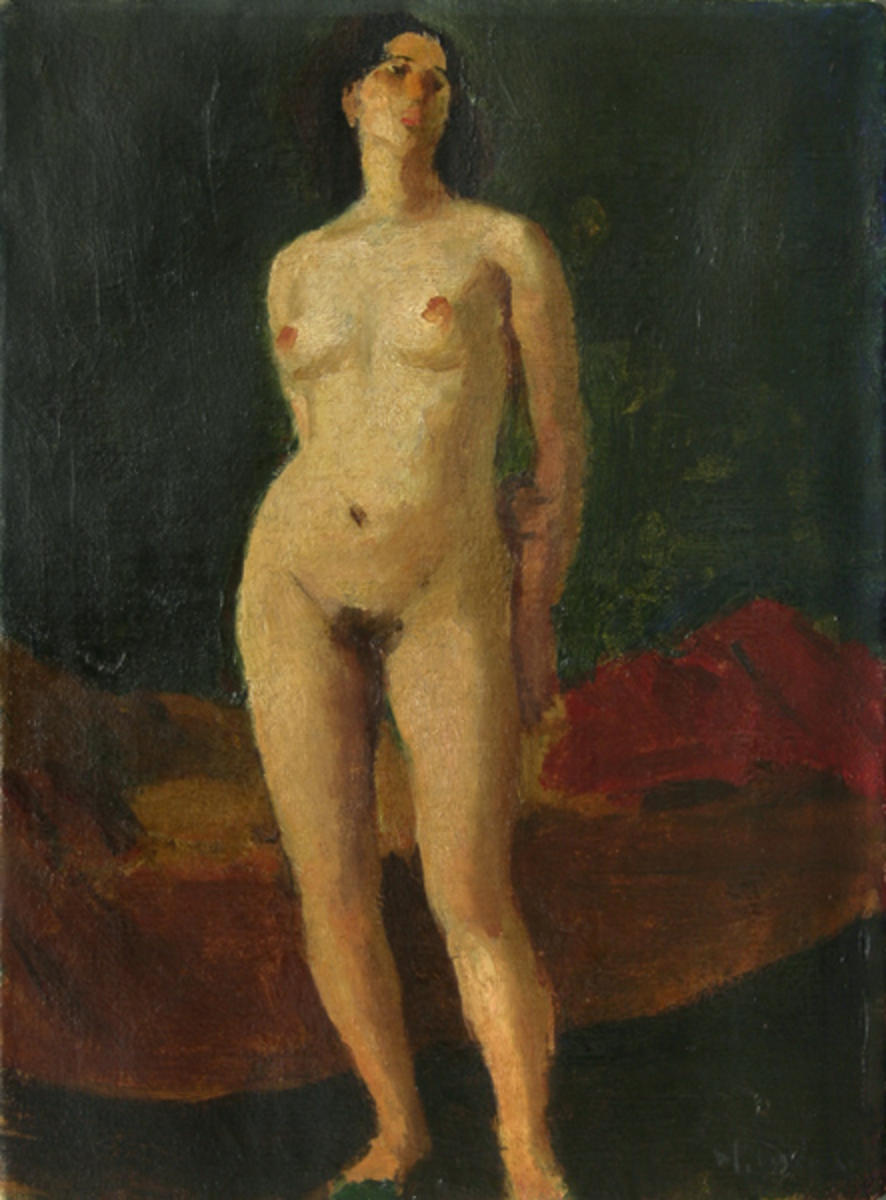
Nude Woman
裸婦
20th century
Oil on canvas