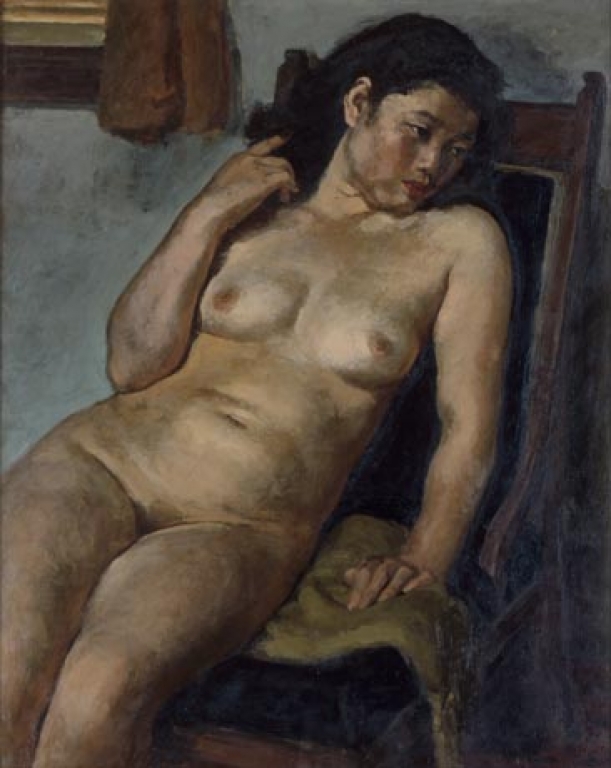
Nude (1947)
裸婦
- Date:
- 1947
- Medium:
- Oil on canvas
Description
Nude (裸婦, 1947), now in the collection of the National Museum of Modern Art, Tokyo (MOMAT), is the principal early-postwar statement of the figure-painting manner that would carry Terauchi Manjirō to the Imperial Academy of the Arts Prize three years later. The single female figure is shown half-length against a warm ochre ground, the head inclined, the hands resting one over the other in the inwardly absorbed pose Terauchi favoured in this period; the modelling is built up in long smoke-coloured halftones over the warm underpainting, with the contour drawn firmly along the curve of the shoulder and arm and the flesh weighed against a few muted accessories — the wine-red of a drape, the dull green of a cushion, the dusty olive of the background. Painted in Urawa in the difficult second year after defeat, the picture marks the resumption of Terauchi's studio practice on its pre-war scale and registers no trace of national catastrophe in its subject or its facture; instead it carries forward, with characteristic patience, the long Tokyo-school project of constructing a Japanese figure painting capable of bearing comparison with the European masters of the nude. It is among the most reproduced of his works and one of the canonical post-war Japanese yōga nudes.
More Prints by Manjirō Terauchi


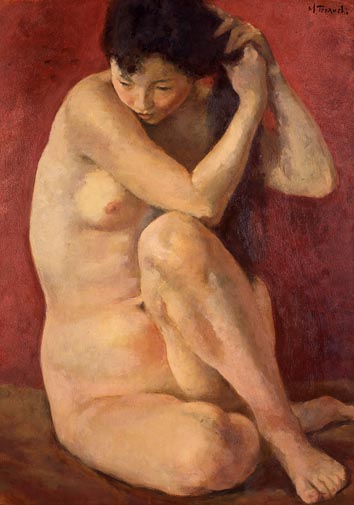
Featured in Collections
Curated cross-cuts that include this print.
Frequently Asked Questions
Nude (1947) (裸婦) was created by Manjirō Terauchi (寺内萬治郎) in 1947.