
Matsumura Keibun
松村景文
1779–1843
Japan
Biography
Matsumura Keibun (1779–1843) was a Kyoto painter of the Shijō school, the younger half-brother and pupil of the school's founder Matsumura Goshun (1752–1811), and one of the principal heirs of the early nineteenth-century Kyoto tradition of naturalistic bird-and-flower painting. Working at the intersection of the Maruyama-Shijō lineage descended from Maruyama Ōkyo (1733–1795) and the lyrical, Yosa Buson-derived sensibility that his brother had brought into the school, Keibun produced a body of work — hanging scrolls, screens, fan paintings, and woodblock-printed picture albums — that helped define the look of late Edo Kyoto kachō-e (bird-and-flower pictures) and that became, through his pupils, a foundational reference for the kachō-e specialists of the Meiji era.
Keibun was born in Kyoto in 1779, into the Matsumura family that would give its name to the Shijō school (so called because Goshun's studio stood on Shijō, Fourth Avenue, in central Kyoto). His father died when Keibun was still a small child, and he was raised and trained principally by his much older half-brother Goshun, who was his first and principal painting teacher. By his twenties he was working alongside Goshun and absorbing both the Maruyama habit of close observation from life (shasei) — Ōkyo's signal contribution to eighteenth-century Japanese painting — and the softer, more atmospheric brushwork that Goshun had developed from his earlier apprenticeship to Yosa Buson. When Goshun died in 1811, Keibun inherited his studio and became a central figure of Kyoto bird-and-flower painting for the next three decades.
Keibun's mature work, produced from the 1810s through the early 1840s, concentrated on kachō-e subjects — sparrows, nightingales, quails, herons, crickets, butterflies, and the seasonally specific flowering plants that the genre demanded (plum, willow, bush clover, peony, lotus, chrysanthemum) — handled with a quietness that distinguished him from his more ostentatious contemporaries. He typically built compositions around a single closely observed bird or insect set against a sparingly drawn plant, surrounded by generous negative space, in a way that united the Shijō school's naturalism with the spatial restraint of classical Japanese painting. He also painted occasional landscape, figure, and Buddhist subjects, but his reputation in his own lifetime and afterward rested principally on bird-and-flower pictures, in which he was widely considered one of the most skilled Kyoto practitioners of his generation.
A significant part of Keibun's influence came through woodblock-printed picture books and painting manuals. In 1830 he published the picture album Go Keibun gafu (呉景文画譜), and his bird-and-flower designs were reproduced in woodblock form in further albums, including posthumous compilations issued during the Meiji period from blocks based on his sketches. These albums circulated widely among Kyoto painters and amateur artists across the nineteenth century, transmitting Shijō compositional habits — the long diagonal across the page, the asymmetric placement of the principal motif, the careful gradation of ink wash on bird plumage — to later generations and to the readers of Meiji-period drawing manuals. Through them Keibun's pictorial vocabulary helped shape the later Kyoto kachō-e tradition carried on by painters such as Kōno Bairei and Imao Keinen.
Within Kyoto, Keibun taught a number of pupils, the most important of whom was Yokoyama Seiki (1792–1864); together with Shiokawa Bunrin (1808–1877), a pupil of Keibun's fellow Goshun student Okamoto Toyohiko, Seiki would be counted among the leading Kyoto painters who carried the Shijō manner into the second half of the nineteenth century. Keibun moved within the broader painting and literati circles of late Edo Kyoto, and his standing was recognized in the Heian jinbutsu shi (Who's Who of Capital People), the directories of Kyoto artistic and literary talent, in which he was listed among the city's notable residents from 1813 — confirming his position at the center of the Kyoto cultural establishment of the late Edo period. In 1829 he was commissioned to paint the birds on the ceiling of the Naginata-hoko, one of the great floats of the Gion Festival, which remains in use today.
Keibun died in Kyoto in 1843 at the age of sixty-four, leaving the continuation of the Shijō school to Yokoyama Seiki and the other painters of the next generation. His paintings entered Western collections during the Japonisme era of the later nineteenth century, and they survive today in significant numbers at the Metropolitan Museum of Art, the British Museum, the Seattle Art Museum, and many other American, European, and Japanese institutions. Among collectors and historians of Japanese painting today, Keibun is valued both for the intrinsic quality of his bird-and-flower pictures and for his role as the bridge across which the Shijō school passed from Goshun's founding generation to the nineteenth-century painters who would in turn shape Meiji nihonga and the kachō-e woodblock printing of the 1880s and 1890s.
Key Facts
- Active Period
- 1779–1843
- Nationality
- 🇯🇵Japan
- Subjects
- Birds & FlowersRainWinter
- Works Indexed
- 9
Frequently Asked Questions
Matsumura Keibun (1779–1843) was a Kyoto painter of the Shijō school, the younger half-brother and pupil of the school's founder Matsumura Goshun (1752–1811), and one of the principal heirs of the early nineteenth-century Kyoto tradition of naturalistic bird-and-flower painting. Working at the intersection of the Maruyama-Shijō lineage descended from Maruyama Ōkyo (1733–1795) and the lyrical, Yosa Buson-derived sensibility that his brother had brought into the school, Keibun produced a body of work — hanging scrolls, screens, fan paintings, and woodblock-printed picture albums — that helped define the look of late Edo Kyoto kachō-e (bird-and-flower pictures) and that became, through his pupils, a foundational reference for the kachō-e specialists of the Meiji era.
Matsumura Keibun was active from 1779 to 1843.
Matsumura Keibun's prints frequently feature birds & flowers, rain, winter.
Original prints by Matsumura Keibun can be found in collections including Metropolitan Museum of Art (via Wikimedia Commons), Art Institute of Chicago, Minneapolis Institute of Art (via Wikimedia Commons), Metropolitan Museum of Art.
Woodblock Prints by Matsumura Keibun (9)
Plum Blossoms
梅花図
ca. 1823
Hanging scroll; ink and color on silk

Bird on a Branch
枝に小鳥図
Early–mid-19th century
Hanging scroll; ink and color on paper

Bush Clover, Grass and Cricket
萩草に蟋蟀図
early 19th century
Hanging scroll; ink and color on silk

Nightingale on Willow Branch
柳に鶯図
early 19th century
Hanging scroll; ink and color on silk

Two Huts in Snow
雪中草庵図
about 1779–1843
Hanging scroll; ink and light color on paper

Sparrow and Spider
雀と蜘蛛図
early 19th century
Hanging scroll; ink and color on silk

Lotus in the Rain
雨中蓮図
1832
Hanging scroll; ink and color on silk

Tree Peonies and Chinese Poem on Peonies
牡丹図
ca. 1830s
Pair of hanging scrolls; ink and color on silk
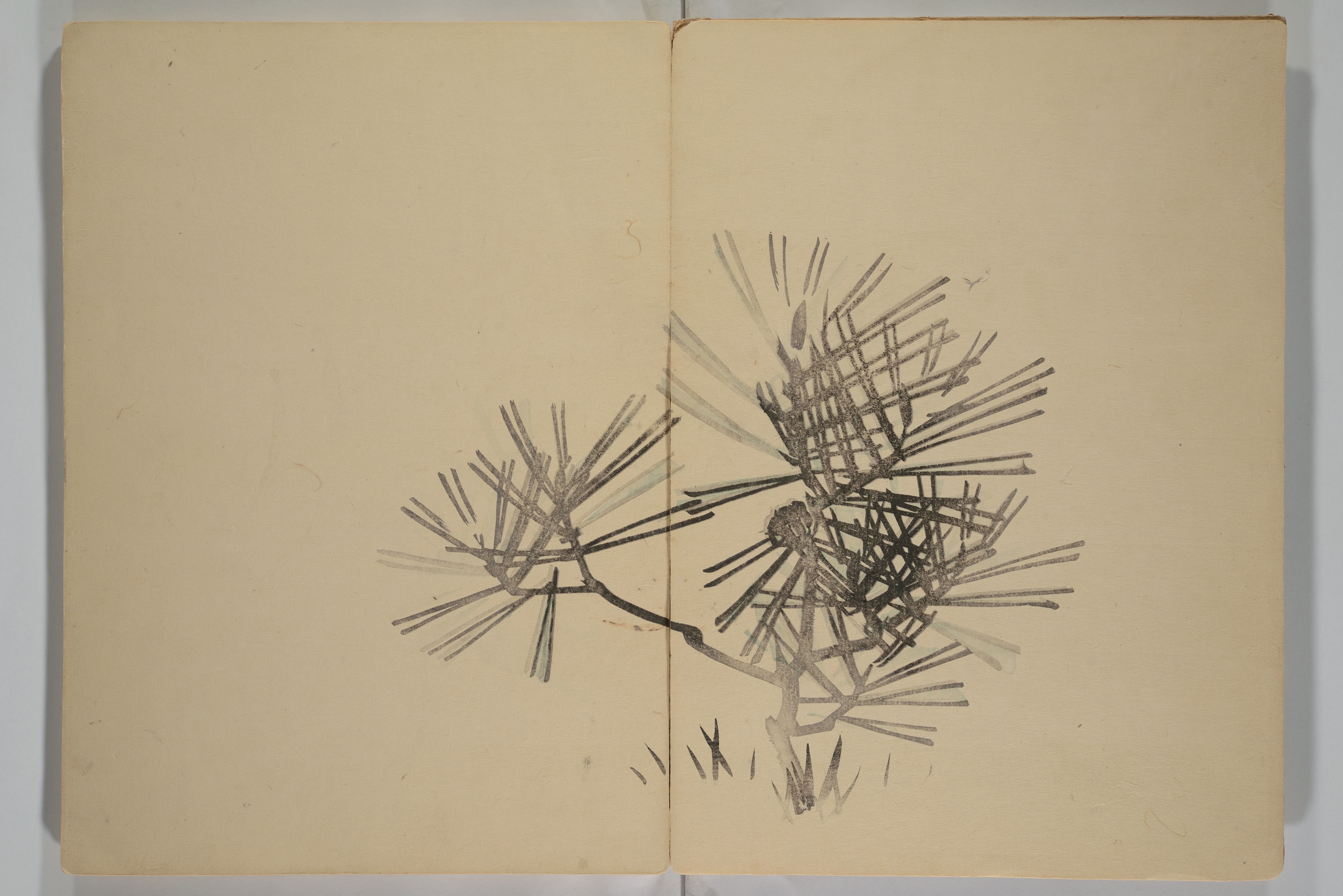
Kinkadō's Album of Drawings by Keibun (Keibun Kinka chō)
景文錦華帖
1898, seventh month (Meiji 31)
Woodblock-printed book (orihon, accordion-style); ink and color on paper