Biography
Mishima Shōsō (三島蕉窓, 1856-1928) was a Meiji-era Japanese nihonga painter, illustrator, and woodblock-print designer who occupies a distinctive position in the late nineteenth- and early twentieth-century print world as one of the most prolific and aesthetically refined practitioners of the kuchi-e (literary frontispiece) genre — the small, romantic color-woodblock illustrations that prefaced the monthly issues of Meiji-period literary magazines and historical novels. Born in Edo (present-day Tokyo) in the closing years of the Tokugawa shogunate, Shōsō trained in the eclectic Maruyama-Shijō manner and became a pupil of Kikuchi Yōsai (1781-1878), one of the most influential nihonga teachers of the late Edo and early Meiji eras; from this background he developed a precise, observational draftsmanship combined with a strong sense of historical costume and atmosphere that made him an unusually well-equipped illustrator for the demands of the Meiji literary press.
Shōsō's early biography is imperfectly documented, but the standard print-history sources agree on the principal outline of his life. He studied under Kikuchi Yōsai, the great historical painter whose Zenken Kojitsu (Examples of Ancient Worthies, 1836-1868) had codified the iconography of Japanese historical heroes for two generations of Meiji painters and illustrators; within Yōsai's circle Shōsō was a contemporary of the celebrated bird-and-flower painter Watanabe Seitei, who is credited with drawing him toward illustration and print design. From Yōsai he absorbed both a detailed knowledge of historical costume, armor, and court ceremonial and the disciplined linear draftsmanship — modeled on Chinese figure painting — that was the technical foundation of the historical-genre tradition. He took the art-name Shōsō (蕉窓, literally 'Banana-Tree Window'), a literary sobriquet of the kind favored by late-Edo and Meiji painters that situated the artist's studio in an imagined scholarly retreat. On the recommendation of Ernest Fenollosa he took part in the Kangakai (Painting Appreciation Society), though he characteristically kept his distance from the official art schools and salon exhibitions of the new Meiji art world.
From the late 1870s onward, Shōsō pursued a multi-track career characteristic of many Meiji-era artists. He produced illustrations for the booming Meiji press — among them the pictorial magazine Fūzoku Gahō, alongside newspaper work — where his ability to render historical and genre scenes with documentary accuracy made him a sought-after illustrator, and he was recognized as an accomplished designer of bijin-ga (pictures of beautiful women), fūzoku-ga (genre scenes), and musha-e (warrior subjects). His command of martial and historical imagery placed him among the well-regarded figure designers of the 1890s, the decade in which he also took up the kuchi-e work for which he is best remembered.
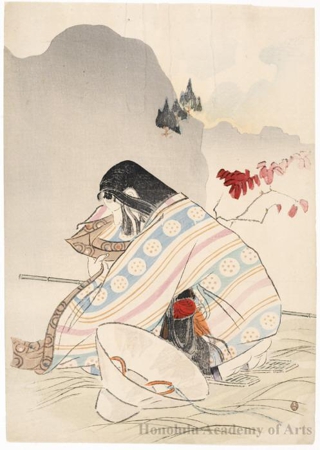
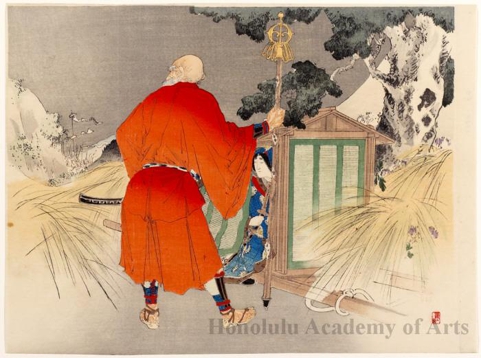
From the mid-1890s onward, Shōsō devoted an increasing share of his creative output to the kuchi-e genre, and it is on this body of work that his reputation among collectors most firmly rests. The kuchi-e — literally 'mouth picture,' the picture at the mouth or opening of a book — was a uniquely Meiji-period genre: a small color-woodblock print, typically printed on folded paper and tipped into the front of a monthly literary magazine or a hardcover novel, depicting in a single image the romantic or melodramatic essence of the issue or volume. Shōsō was among the most active kuchi-e artists for the publisher Shun'yōdō (春陽堂), a leading house of mass-market literary fiction in the late Meiji period, and his frontispieces appeared in fourteen issues of the monthly Bungei Kurabu (Literary Club) — the flagship literary magazine of the period and the principal vehicle for the kuchi-e genre, which carried well over two hundred such prints between 1895 and 1914. As a kuchi-e designer he was reckoned one of the pioneers of the form alongside Watanabe Seitei, and a leading figure among a following that included Terasaki Kōgyō, Kajita Hanko, and Tomioka Eisen. His kuchi-e from the late 1890s through the 1910s span the major subjects of the genre: bijin-ga of beautiful women in moments of contemplation or quiet emotional crisis; scenes of contemporary urban life rendered with close attention to costume and interior detail; and a smaller number of kachō-e (bird-and-flower) and shasei (sketch-from-life) compositions in which his Maruyama-Shijō training came forward most directly.
The Metropolitan Museum of Art holds several of Shōsō's Bungei Kurabu kuchi-e, including On My Own (Ware kara) and Hemeden, which show the range of his frontispiece work. His prints for Shun'yōdō novels and for Bungei Kurabu were widely circulated and collected in their day, and his floral and landscape kuchi-e — waterfall and seasonal-plant subjects among them — survive today in museum and private collections of Meiji kuchi-e, where his work has been a steady presence in the specialist market since the late twentieth-century revival of interest in the genre.
Shōsō's pictorial style as a kuchi-e designer combines the disciplined drawing of figure and historical costume he had learned in the Yōsai studio with a strong sense of contemporary Meiji-era setting — the modern hair arrangements, hybrid kimono fashions, and atmospheric urban interiors of the 1890s and 1900s — and with the botanical observation he had absorbed in his Maruyama-Shijō training. Where contemporaries such as Kaburaki Kiyokata and Takeuchi Keishū leaned toward atmospheric mood and a softer, watercolor-like print surface, Shōsō tended toward a sharper drawing of line, a more saturated palette in the secondary colors, and a more carefully observed sense of specific botanical detail in the floral backgrounds of his bijin-ga. His best kuchi-e — the late Bungei Kurabu compositions and the seasonal floral works — are characteristic late-Meiji nihonga in miniature: refined, decoratively disciplined, and rooted in a thorough knowledge of the East Asian painting tradition while adapted to the small-format demands of the literary frontispiece.
Shōsō continued to design kuchi-e and to paint in nihonga style into the Taishō period (1912-1926), although by the 1920s the genre was in decline as photolithographic reproduction displaced the woodblock-printed frontispiece in mass-market publishing, and the post-Meiji literary press turned to a new generation of Western-influenced illustrators. He died in 1928. His work has drawn renewed collector interest since the late twentieth-century revival of the Meiji kuchi-e market, and it appears in the major reference literature of the genre — including Helen Merritt and Nanako Yamada's Guide to Modern Japanese Woodblock Prints and Amy Reigle Newland's edited Hotei Encyclopedia of Japanese Woodblock Prints — as well as in the holdings and catalogues of specialist dealers such as Scholten Japanese Art. His career exemplifies the multi-track illustrator-painter pattern that defined the Meiji-era art world.
Key Facts
- Active Period
- 1856–1928
- Nationality
- 🇯🇵Japan
- Movement
- Meiji/Taishō Prints
- Works Indexed
- 4
Frequently Asked Questions
Mishima Shōsō (三島蕉窓, 1856-1928) was a Meiji-era Japanese nihonga painter, illustrator, and woodblock-print designer who occupies a distinctive position in the late nineteenth- and early twentieth-century print world as one of the most prolific and aesthetically refined practitioners of the kuchi-e (literary frontispiece) genre — the small, romantic color-woodblock illustrations that prefaced the monthly issues of Meiji-period literary magazines and historical novels. Born in Edo (present-day Tokyo) in the closing years of the Tokugawa shogunate, Shōsō trained in the eclectic Maruyama-Shijō manner and became a pupil of Kikuchi Yōsai (1781-1878), one of the most influential nihonga teachers of the late Edo and early Meiji eras; from this background he developed a precise, observational draftsmanship combined with a strong sense of historical costume and atmosphere that made him an unusually well-equipped illustrator for the demands of the Meiji literary press.
Mishima Shōsō was active from 1856 to 1928. They were associated with the Meiji/Taishō Prints movement.
Mishima Shōsō's work was shaped by the Meiji/Taishō Prints tradition in Japanese woodblock printmaking. Meiji/Taishō Prints: Meiji and Taishō era prints (1868–1926) bridge the transition from traditional ukiyo-e to the modern shin-hanga and sosaku-hanga movements.
Mishima Shōsō's prints frequently feature castles, waterfalls, moonlight, autumn foliage.
Original prints by Mishima Shōsō can be found in collections including Honolulu Museum of Art (via ukiyo-e.org), Private collection (via Wikimedia Commons), Bungei Kurabu literary magazine (via Wikimedia Commons).