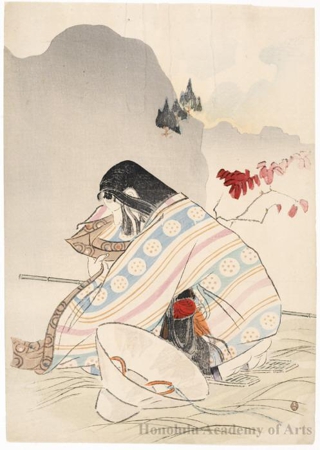
Coloration of Lacquer Tree Leaves
櫨紅葉
- Date:
- 1909
- Medium:
- Color woodblock print
Description
Coloration of Lacquer Tree Leaves (Haji Momiji, 櫨紅葉) is a color woodblock print by Mishima Shōsō dated to 1909 (Meiji 42) and now held by the Honolulu Museum of Art, one of his most distinctive late-Meiji compositions in the kachō-e (bird-and-flower) idiom that he had inherited from his Maruyama-Shijō training. The haji (Japanese lacquer tree, Toxicodendron sylvestre) is one of the most colorful of the autumn-foliage trees of the Japanese archipelago, turning a brilliant scarlet-orange in October and November and forming, alongside the Japanese maple (momiji), one of the principal subjects of the East Asian autumn-foliage (kōyō) tradition that runs from the Heian-period waka poetry of the Kokin Wakashū through the Edo-period autumn-foliage prints of the Tokaido road to the late-Meiji kachō-e revival of the 1900s. Shōsō's composition turns to the close drawing of the lacquer-tree leaves and the small fruit clusters, depicting the moment of peak autumn coloration when the tree's foliage is most intensely red against the cooling autumn sky. The work belongs to the floral kuchi-e tradition of the late 1900s in which the kuchi-e designers — including Shōsō, Kaburaki Kiyokata, Takeuchi Keishū, and Tomioka Eisen — turned from the bijin-ga and historical-genre subjects of the earlier kuchi-e to a renewed engagement with the seasonal-foliage tradition, producing for the literary magazines a body of small-format kachō-e that combined the precise observation of the Maruyama-Shijō tradition with the decorative discipline of the kuchi-e format. The print survives in the Honolulu Museum of Art as part of its substantial holding of Shōsō's seasonal kuchi-e, and is representative of his close engagement with the Japanese autumn-foliage tradition.
More Prints by Mishima Shōsō


Frequently Asked Questions
Coloration of Lacquer Tree Leaves (櫨紅葉) was created by Mishima Shōsō (三島蕉窓) in 1909.