Biography
Mizuno Toshikata (1866-1908) was one of the foremost Japanese woodblock print designers of the Meiji era, a virtuoso of historical narrative, sensō-e (war prints), and bijin-ga (pictures of beautiful women) whose brief but prolific career spanned the most turbulent decades of Japan's modernization. As the most accomplished pupil of Tsukioka Yoshitoshi - the last great master of ukiyo-e - Toshikata inherited and refined the tradition of dramatic figural printmaking at precisely the moment when Japan was reinventing itself as a modern industrial and military power. His prints document the Sino-Japanese War (1894-95) and the early phase of the Russo-Japanese War (1904-05) with an immediacy that made him one of the most widely seen image-makers of the late nineteenth century, while his bijin-ga and literary frontispieces preserved the elegance of an earlier woodblock tradition that was rapidly being displaced by photolithography and Western-style illustration.
Born in Edo (modern Tokyo) in 1866 - just two years before the Meiji Restoration would dismantle the Tokugawa shogunate - Toshikata grew up in a Japan transformed by its sudden opening to the West. His given name was Kumejiro. From a young age he showed exceptional artistic promise, entering the studio of Tsukioka Yoshitoshi around 1879, when he was approximately thirteen; alongside his training under Yoshitoshi he also studied traditional Japanese-style painting under Shibata Hōshū and Watanabe Seitei and worked as a ceramic painter. Yoshitoshi, the celebrated designer of "Thirty-Six Ghosts" and "One Hundred Aspects of the Moon," was at the height of his powers, and Toshikata quickly distinguished himself as his most gifted disciple. Yoshitoshi came to regard Toshikata as his artistic heir and would designate him his successor, and after the master's death in 1892 Toshikata was widely seen as the principal carrier of the Tsukioka lineage.
Toshikata's earliest prints, produced in the 1880s, drew heavily on historical and legendary subjects - the kind of dramatic figural compositions that had been Yoshitoshi's specialty. His early historical and warrior triptychs, often drawing on episodes such as those of the twelfth-century Genpei War, exemplify this early mode: bold, theatrical, and steeped in the conventions of musha-e (warrior prints) that stretched back through Kuniyoshi to the earliest Edo-period printmakers. He also illustrated novels and serialized fiction, contributing kuchi-e (frontispiece) prints to literary magazines such as Bungei Kurabu (Literary Club), where his refined, slightly melancholic style helped define the visual atmosphere of late-Meiji popular literature.
The outbreak of the First Sino-Japanese War in July 1894 transformed Toshikata's career almost overnight. The Meiji government's modernized military scored a series of rapid victories against Qing China, and the Japanese public hungered for images of the conflict. Toshikata, working at extraordinary speed alongside contemporaries such as Kobayashi Kiyochika, Migita Toshihide, and Ogata Gekkō, produced dozens of sensō-e triptychs documenting battles, naval engagements, and acts of individual heroism. Prints such as "Naval Officers Discussing Strategy to be Used in the War against China" and "Onoguchi Tokuji during the Siege of Jinzhou Fortress" - both now in the Metropolitan Museum of Art - combined contemporary military uniforms, modern artillery, and steam-powered warships with the traditional triptych format and the bold figural drama of the Yoshitoshi school. Toshikata's sensō-e were among the most widely distributed images of the war, and they helped establish the visual iconography of modern Japanese militarism even as they marked the swan song of ukiyo-e as a popular medium - within a decade photography and lithography would supplant woodblock prints for current-events imagery.
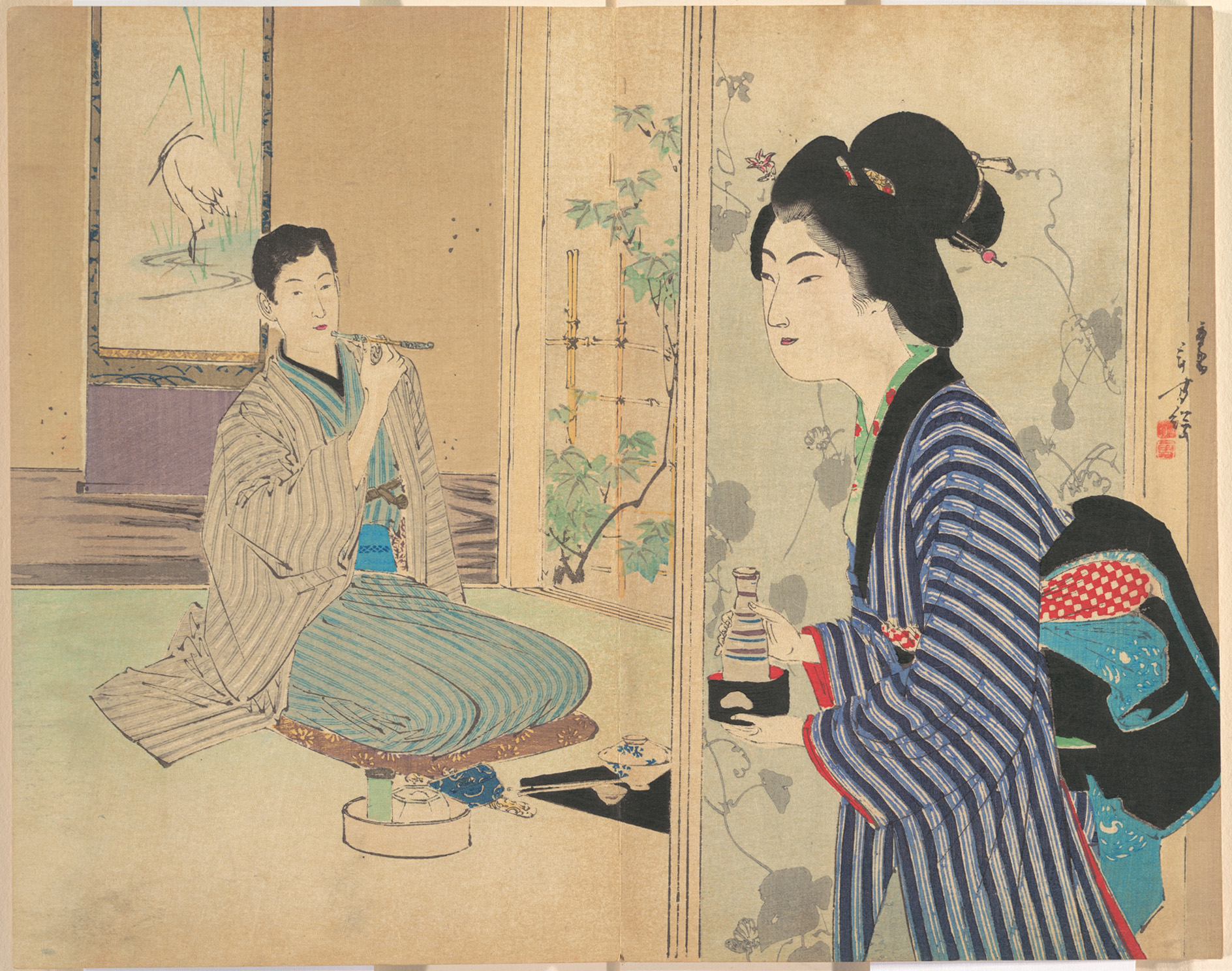
During the same years that he was producing battle prints, Toshikata turned with equal intensity to bijin-ga. His celebrated series "Sanjūroku Kasen" (variously translated "Thirty-six Elegant Selections" or "Thirty-six Beauties"), created in the early 1890s, depicts beautiful women drawn from a wide range of Japan's historical eras, each print pairing a meticulously researched costume study with a seasonal or domestic vignette; the series stands as one of the most ambitious bijin-ga projects of the Meiji period. Related prints entered the Metropolitan Museum of Art under the title "Noblewomen of the Tokugawa Period; Thirty-six Beauties" (Sanjūroku kasensōrō). Around 1896-97 Toshikata produced a celebrated series on the tea ceremony, "Chanoyu Hibigusa" (Daily Practice of the Tea Ceremony), which documents the rituals and aesthetics of chanoyu with quiet precision.
Toshikata's literary illustration work was equally prolific. He produced dozens of kuchi-e for Bungei Kurabu and other magazines throughout the 1890s and early 1900s, illustrating fiction by leading Meiji authors such as Izumi Kyōka and Kōda Rohan. His frontispieces - small, delicate, often emotionally charged - helped popularize a refined late-ukiyo-e aesthetic among readers who might never have purchased traditional broadsheet prints.
The Russo-Japanese War of 1904-05 brought a final flowering of sensō-e from Toshikata's brush, though by this point the genre was clearly waning in commercial significance. His Russo-Japanese War prints continued the visual conventions he had established a decade earlier, depicting officers, battles, and acts of heroism in the traditional triptych format. By this time his health was failing, and his output diminished.
Mizuno Toshikata died in 1908 at the age of forty-two, his career barely two decades long. Despite his short life, he produced an enormous body of work - estimates run into the hundreds of designs - and he taught the next generation of woodblock artists, including the celebrated bijin-ga master Kaburagi Kiyokata as well as Ikeda Shōen and Ikeda Terukata. Kiyokata would carry the Tsukioka lineage into the twentieth century and become a major figure of the Taishō-era nihonga movement, and through him Toshikata's stylistic legacy passed indirectly to shin-hanga designers such as Itō Shinsui.
Toshikata's prints are held by the Art Institute of Chicago, the Metropolitan Museum of Art, the Cleveland Museum of Art, the Victoria and Albert Museum, the British Museum, the Museum of Fine Arts Boston, and numerous other institutions worldwide. He remains essential to any serious study of Meiji prints, late ukiyo-e, sensō-e, and the transition from Edo-period printmaking to the shin-hanga revival of the twentieth century. As Yoshitoshi's foremost student and the bridge between traditional ukiyo-e and modern Japanese illustration, Mizuno Toshikata occupies a pivotal position in the history of Japanese woodblock prints - a master of dramatic narrative whose work captured both the spectacle of Japan's military modernization and the enduring beauty of its classical aesthetic traditions.
Key Facts
- Active Period
- 1866–1908
- Nationality
- 🇯🇵Japan
- Movements
- Meiji/Taishō PrintsUkiyo-e
- Subjects
- Mount FujiFishMoonlightSpring
- Works Indexed
- 31
Frequently Asked Questions
Mizuno Toshikata (1866-1908) was one of the foremost Japanese woodblock print designers of the Meiji era, a virtuoso of historical narrative, sensō-e (war prints), and bijin-ga (pictures of beautiful women) whose brief but prolific career spanned the most turbulent decades of Japan's modernization. As the most accomplished pupil of Tsukioka Yoshitoshi - the last great master of ukiyo-e - Toshikata inherited and refined the tradition of dramatic figural printmaking at precisely the moment when Japan was reinventing itself as a modern industrial and military power. His prints document the Sino-Japanese War (1894-95) and the early phase of the Russo-Japanese War (1904-05) with an immediacy that made him one of the most widely seen image-makers of the late nineteenth century, while his bijin-ga and literary frontispieces preserved the elegance of an earlier woodblock tradition that was rapidly being displaced by photolithography and Western-style illustration.
Mizuno Toshikata was active from 1866 to 1908. They were associated with the Meiji/Taishō Prints and Ukiyo-e movements.
Mizuno Toshikata's work was shaped by the Meiji/Taishō Prints and Ukiyo-e traditions in Japanese woodblock printmaking. Meiji/Taishō Prints: Meiji and Taishō era prints (1868–1926) bridge the transition from traditional ukiyo-e to the modern shin-hanga and sosaku-hanga movements. Ukiyo-e: ## What is ukiyo-e? Ukiyo-e ([浮世絵](/glossary/ukiyo-e)) — literally "pictures of the floating world" — is the Edo-period Japanese print and painting tradition that flourished from roughly 1660 to 1868, depicting the pleasures of urban life in Edo (modern Tokyo): courtesans, kabuki actors, sumo wrestlers, famous landscapes, and seasonal beauties.
Mizuno Toshikata's prints frequently feature mount fuji, fish, moonlight, spring.
Original prints by Mizuno Toshikata can be found in collections including Cleveland Museum of Art, ukiyo-e.org, Metropolitan Museum of Art, Victoria and Albert Museum.