
Biography
Nishimura Shigenobu (西村重信, active c. 1729-1740s, sometimes documented as c. 1723-1747) was an early-Edo ukiyo-e print designer who worked in the orbit of the Nishimura school led by Nishimura Shigenaga (1697-1756), one of the foundational masters of early-eighteenth-century Japanese woodblock printing. His career unfolded during a transitional decade and a half in which the urushi-e (lacquer pictures) format reached its highest refinement and the beni-e (rose-red pictures) tradition of hand-applied pink pigment from safflower flowered alongside it, in the years just before the benizuri-e two-block colour-printing revolution of the 1740s and the polychrome nishiki-e revolution that Suzuki Harunobu would launch in 1765. Surviving examples in the Art Institute of Chicago, the Metropolitan Museum of Art, and other major Western collections document a designer of considerable assurance in the hosoban (narrow-pillar) format, working across the principal subject genres of his era, kabuki actor portraits, bijinga of fashionable Edo beauties, and kacho-e (bird-and-flower pictures), with a refined linear vocabulary and a sensitive command of the hand-coloured urushi-e palette.
Shigenobu is distinct from the considerably later Yanagawa Shigenobu (1787-1832), the surimono and kacho-e specialist who was Katsushika Hokusai's son-in-law and pupil, and the two artists are sometimes confused in catalogues despite a working separation of nearly a century. The early Nishimura Shigenobu's pictorial vocabulary belongs to the early-eighteenth-century Nishimura-school inheritance rather than to the Katsushika lineage. He is documented as a pupil of the Nishimura school's senior figure, Nishimura Shigenaga, and the shared surname, the overlap of subject matter and format, and the shared signature conventions place him securely within that workshop. Many museum and dealer catalogues go a step further and identify Nishimura Shigenobu as an early art-name of Ishikawa Toyonobu (1711-1785)—the prominent mid-century master of hand-coloured actor prints and beauties, himself a pupil of Shigenaga, who is thought to have signed as Shigenobu before adopting the Toyonobu name—though this identification is not regarded as fully settled and firm documentation for the early Shigenobu remains sparse.
The hosoban format, the narrow vertical sheet roughly 33 by 16 centimetres developed for affordable actor prints and pillar pictures, was Shigenobu's primary working surface, and his surviving prints demonstrate the format's well-suitedness to single-figure compositions of beauties and standing actors. His actor portraits include hosoban depictions of Segawa Kikujiro I and Sanjo Kantaro II in the 1732 Ichimura Theater production of Shochikubai Kongen Soga, and a 1734 portrait of the Kyoto actor Anegawa Chiyosaburo; these document the kabuki repertoire of the early Kyoho era when the actor-print market was just beginning to acquire the scale and the iconographic conventions that the Torii school would consolidate later in the century. His bijinga, particularly the mid-1730s diptych of beauties carrying wedding decorations and the triptych A Set of Three Beauties featuring Ono no Komachi, demonstrate his command of the multi-sheet narrative format and his affinity for classical subject matter rendered in contemporary Edo dress. The 1737-38 print A Flower Vendor and the related triptych Peddler of Flowers of the Four Seasons capture the street-vendor subject that would become a perennial of mid-century ukiyo-e.
Shigenobu's kacho-e work is represented by the early-1730s Hollyhocks and Peacocks (Aoi ni kujaku), a hosoban urushi-e composition that documents his engagement with the bird-and-flower tradition then being adapted from Kano-school painting into the woodblock medium. His mature work extends into the late 1730s with a hand-coloured print in the Metropolitan Museum of Art depicting the itinerant flower vendor performed by the actor Ogino Isaburo around 1738, and his late or attributed work includes a rare hanging-scroll painting of the brine maiden Matsukaze, indicating that, like many ukiyo-e designers of his generation, his practice extended into the painted-screen and hanging-scroll formats alongside his woodblock output. Today Shigenobu occupies a modest but well-documented place in the early-eighteenth-century Nishimura-school transmission, an artist whose surviving prints help reconstruct the moment at which Edo woodblock printing was developing the refined hand-coloured idiom that would set the stage for the full-colour revolution to come.
Key Facts
- Nationality
- 🇯🇵Japan
- Movement
- Ukiyo-e
- Subjects
- Birds & Flowers
- Works Indexed
- 7
Frequently Asked Questions
Nishimura Shigenobu (西村重信, active c. 1729-1740s, sometimes documented as c. 1723-1747) was an early-Edo ukiyo-e print designer who worked in the orbit of the Nishimura school led by Nishimura Shigenaga (1697-1756), one of the foundational masters of early-eighteenth-century Japanese woodblock printing. His career unfolded during a transitional decade and a half in which the urushi-e (lacquer pictures) format reached its highest refinement and the beni-e (rose-red pictures) tradition of hand-applied pink pigment from safflower flowered alongside it, in the years just before the benizuri-e two-block colour-printing revolution of the 1740s and the polychrome nishiki-e revolution that Suzuki Harunobu would launch in 1765. Surviving examples in the Art Institute of Chicago, the Metropolitan Museum of Art, and other major Western collections document a designer of considerable assurance in the hosoban (narrow-pillar) format, working across the principal subject genres of his era, kabuki actor portraits, bijinga of fashionable Edo beauties, and kacho-e (bird-and-flower pictures), with a refined linear vocabulary and a sensitive command of the hand-coloured urushi-e palette.
Nishimura Shigenobu's work was shaped by the Ukiyo-e tradition in Japanese woodblock printmaking. Ukiyo-e: ## What is ukiyo-e? Ukiyo-e ([浮世絵](/glossary/ukiyo-e)) — literally "pictures of the floating world" — is the Edo-period Japanese print and painting tradition that flourished from roughly 1660 to 1868, depicting the pleasures of urban life in Edo (modern Tokyo): courtesans, kabuki actors, sumo wrestlers, famous landscapes, and seasonal beauties.
Nishimura Shigenobu's prints frequently feature birds & flowers.
Original prints by Nishimura Shigenobu can be found in collections including Art Institute of Chicago, Metropolitan Museum of Art.
Woodblock Prints by Nishimura Shigenobu (7)
Ono no Komachi, from A Set of Three Beauties (Bijin sanpukutsui)
c. 1720s
Hand-colored woodblock print; right sheet of hosoban triptych, urushi-e

Hollyhocks and Peacocks (Aoi ni kujaku)
early 1730s
Hand-colored woodblock print; hosoban, urushi-e

The Actors Segawa Kikujiro I as Oshichi and Sanjo Kantaro II as Kichisaburo in the play "Shochikubai Kongen Soga," performed at the Ichimura Theater in the third month, 1732
1732
Hand-colored woodblock print; hosoban, urushi-e

The Actor Anegawa Chiyosaburo from Kyoto
1734
Hand-colored woodblock print; hosoban, urushi-e

Beauty Carrying a Wedding Decoration (right sheet of hosoban diptych)
c. 1735
Hand-colored woodblock print; right sheet of hosoban diptych, urushi-e

A Flower Vendor
1737-38
Hand-colored woodblock print; hosoban
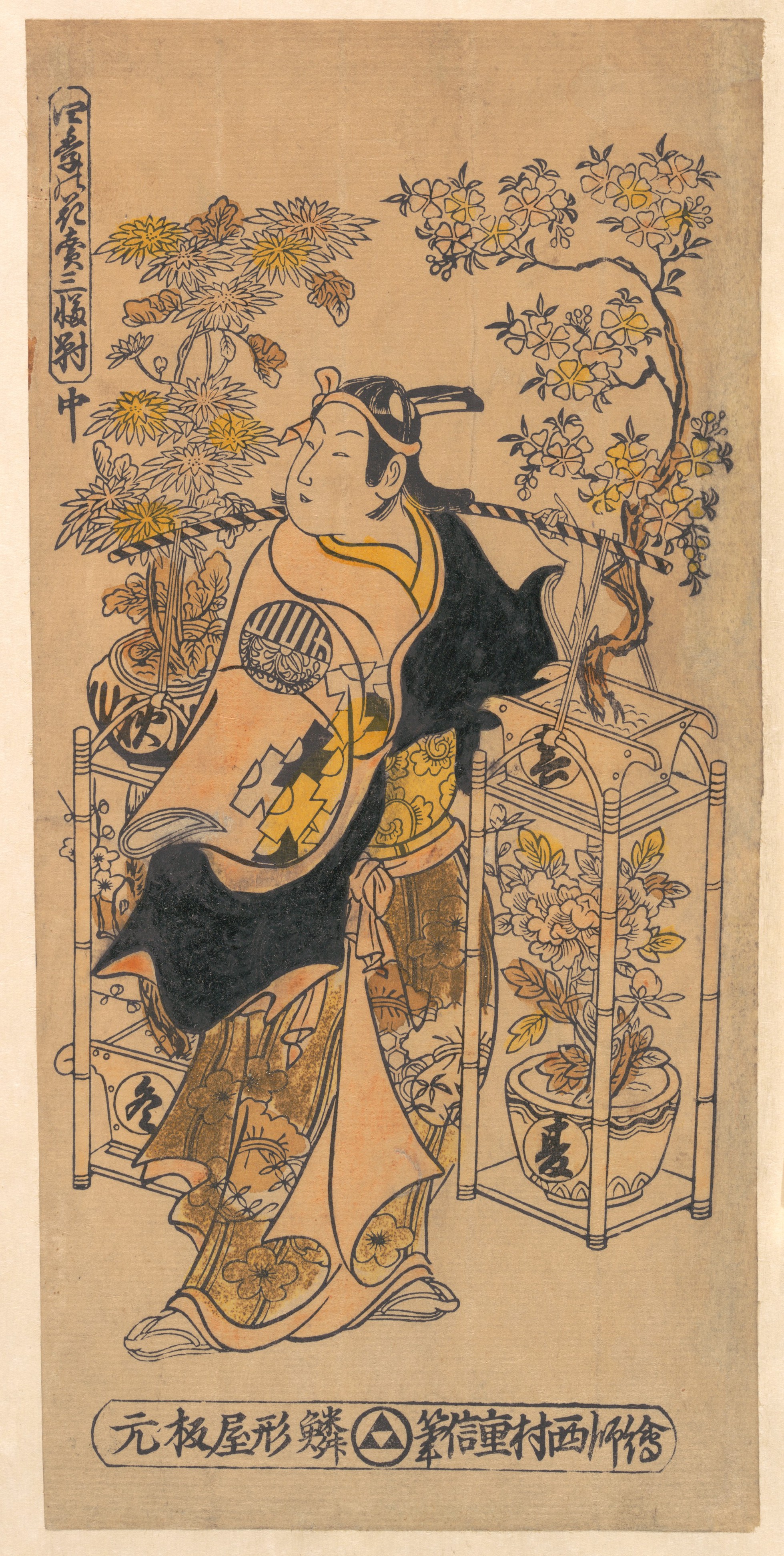
The Actor Ogino Isaburō as an Itinerant Flower Vendor
ca. 1738
Woodblock print; ink and color on paper