Biography
Nomura Yoshimitsu (野村義光, 1870–1958) was a Kyoto-based painter and occasional woodblock-print designer whose small body of prints belongs to the Kyoto branch of the shin-hanga movement. Born in Osaka into a family of Utagawa-school ukiyo-e painters — his father's line descended from Utagawa Yoshikuni, a pupil of Utagawa Kuniyoshi — he trained first in that tradition before moving to Kyoto as a young man and taking the name Yoshimitsu. In 1891 he broadened his studies to Western and panoramic painting under the French painter and etcher Georges Bigot, then working in Japan.
Yoshimitsu first made his reputation as a painter of large panoramas, among them celebrated scenes of the Satsuma Rebellion and, in 1895, the attack on Port Arthur; the latter was displayed at the Fourth Industrial Exhibition in Kyoto and afterward at the Panorama Hall in Ueno Park, Tokyo. From around 1915 until at least 1936 he also designed scenery for Kyoto's annual seasonal dances, work that drew on both his ukiyo-e background and his command of panoramic landscape.
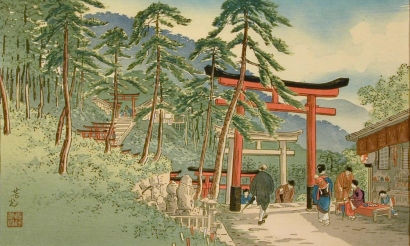
Primarily a painter, Nomura designed comparatively few prints. His best known are a 1931 set of six landscape woodblocks, Kyōraku Meishō (Famous Places of Kyoto), issued by the Kyoto publisher Satō Shōtarō, one of the principal promoters of Kyoto shin-hanga. These quiet views of the city's temples, pagodas, and riverbanks — among them the pagoda at Yasaka and a snow scene on the Kamo embankment — were realized through the collaborative carving and printing that defined shin-hanga production. Several were shown at the international exhibition held at the Toledo Museum of Art in Ohio in 1936, where the catalogue praised them for harmonizing the manner of ukiyo-e painting with the methods of European panoramic scenery.
Key Facts
- Nationality
- 🇯🇵Japan
- Movement
- Shin-hanga
- Works Indexed
- 39
Frequently Asked Questions
Nomura Yoshimitsu (野村義光, 1870–1958) was a Kyoto-based painter and occasional woodblock-print designer whose small body of prints belongs to the Kyoto branch of the shin-hanga movement. Born in Osaka into a family of Utagawa-school ukiyo-e painters — his father's line descended from Utagawa Yoshikuni, a pupil of Utagawa Kuniyoshi — he trained first in that tradition before moving to Kyoto as a young man and taking the name Yoshimitsu. In 1891 he broadened his studies to Western and panoramic painting under the French painter and etcher Georges Bigot, then working in Japan.
Nomura Yoshimitsu's work was shaped by the Shin-hanga tradition in Japanese woodblock printmaking. Shin-hanga: ## What is Shin-hanga? Shin-hanga (新版画), literally "new prints," is the early twentieth-century revival of the collaborative Japanese woodblock workshop, organized between roughly 1915 and 1960 by the Tokyo publisher Watanabe Shōzaburō (1885–1962) and a handful of competing houses.
Nomura Yoshimitsu's prints frequently feature temples & shrines, landscapes, abstract, snow scenes, rivers & lakes, autumn foliage.
Original prints by Nomura Yoshimitsu can be found in collections including ukiyo-e.org, Japanese Art Open Database, Ohmi Gallery, Museum of Fine Arts Boston.