
Biography
Ochiai Yoshiiku (落合芳幾, 1833-1904), who signed many of his works as Utagawa Yoshiiku (歌川芳幾), was one of the senior pupils of Utagawa Kuniyoshi and one of the most prolific designers active at the seam between late-Edo and early-Meiji ukiyo-e. His career spanned the Yokohama-e (pictures of foreigners) of the early 1860s, the late Edo actor print, the bloody musha-e and shini-e of the 1860s, the founding of the nishiki-e shimbun (color-print newspapers) of the 1870s, and a long final phase as an illustrator for major Meiji-period dailies and serialized novels. He is now studied as one of the central documentarians of the visual culture of bakumatsu and early Meiji Tokyo, and as one of the figures who, alongside his classmate Tsukioka Yoshitoshi, carried the Utagawa school's habits of design into the radically changed conditions of the post-Restoration print market.
Yoshiiku was born in Edo in Tenpō 4 (1833), the son, by most traditional accounts, of a teahouse proprietor in the Asakusa district — a neighborhood whose theaters, pleasure quarters, and seasonal markets supplied the central subjects of Edo popular print culture. He entered Utagawa Kuniyoshi's studio in the late 1840s or early 1850s, in the same cohort that produced Yoshitoshi (1839-1892), Yoshikazu, and Yoshitora, and absorbed Kuniyoshi's blend of musha-e dynamism, intense character work, and willingness to push the technical limits of the multi-block color print. Like other Kuniyoshi pupils, he received the art name Yoshi- (芳) from his master in token of the lineage, signing most of his prints simply as Yoshiiku (芳幾) or Ikkeisai Yoshiiku; he is indexed today under his family name Ochiai (as Ochiai Yoshiiku) as readily as under the Utagawa school name.
The first phase of Yoshiiku's career was dominated by the actor print and by the Yokohama-e boom that followed the opening of the treaty port at Yokohama in 1859. Working primarily for Edo publishers, he designed numerous oban triptychs depicting foreigners — Americans, Dutch, British, French, and Russians — in the Gankirō teahouse, in trading firms, in their houses and stables, and at leisure. His Picture of a Banquet of People of Five Nations at the Gankirō Teahouse (Gokakoku gankirō ni oite sakamori no zu, 1860, AIC) is among the most often-reproduced single sheets of the Yokohama-e genre; the related triptychs Picture of Men and Women from Many Countries and Foreign Words (Ikoku kotoba) belong to the same intensive production of 1860-1861. The Yokohama prints are now valued both for the visual exoticism of their costumes and ships and for what they reveal about how Edo townspeople imagined the foreigners they had begun to encounter directly in trade. In parallel, Yoshiiku produced actor prints in the late Edo manner for major Edo theaters, contributing to the bust and full-length okubi-e series of the 1860s and to the kabuki ghost-and-blood imagery in which his master Kuniyoshi had specialized. His Memorial Portrait of the Artist Utagawa Kuniyoshi (1861, AIC), printed shortly after Kuniyoshi's death, is one of a small group of shini-e (memorial prints) by the senior Kuniyoshi pupils that record the studio's loss.
A distinctive and historically important strand of Yoshiiku's bakumatsu work is his shadow-portrait actor prints (kage-e or silhouette images), of which the Metropolitan Museum's Silhouette Image of Kabuki Actor (JP2748.2) is an example. These designs, produced in the closing years of the Tokugawa regime when official sumptuary restrictions on actor portraiture were periodically tightened, reduced the actor's face to a black silhouette accompanied by an oblique reference to the role and to the famous likeness it conjured — a witty solution to the regulations that simultaneously demonstrated Yoshiiku's grasp of facial gesture as designed mass and outline. Alongside the silhouettes he produced more conventional actor sheets, scenes of public bathhouses (Interior of a Public Bath, MMA 2007.49.320a-c), and series of beauties (Beauties, MMA 2007.49.226; later Meiji series such as Naninani-hana of the House of Eikichi and Kodaiyū of the House of Matsumoto, both AIC) that show his command of the bijin tradition descended through his Utagawa master.
The second phase of Yoshiiku's career — the one for which he is now most widely remembered in print histories — coincided with the rapid commercial and political changes of the first Meiji decade. In 1874-1875 he co-founded, with the journalist Jōno Saigiku, the Tōkyō nichinichi shinbun nishiki-e and similar series of newspaper prints in which sensational current events — murders, fires, scandals, foreign incidents, supernatural curiosities — were illustrated as oban color prints with the accompanying news text printed alongside. Tsukioka Yoshitoshi was the principal designer for the parallel Yūbin hōchi shinbun series, and the two Kuniyoshi pupils thus dominated the brief but intense Meiji vogue for nishiki-e shimbun. Yoshiiku's designs for these series are now studied as the first sustained attempt to fuse Edo-period nishiki-e design with the conventions of nineteenth-century mass journalism, and they bridge the older ukiyo-e tradition with the photomechanical illustrated press that would displace woodblock printing by the end of the century. After the nishiki-e shimbun boom ended, he continued as a staff illustrator at the Tōkyō eiri shinbun and other Meiji dailies, designing wood-engraved frontispieces, novelistic illustrations, and serialized story art into the 1890s.
Yoshiiku died in Tokyo in 1904 at the age of seventy-one. His later years had been overshadowed by Yoshitoshi's more dramatic posthumous fame, but in the early twenty-first century his Yokohama-e, his shini-e for Kuniyoshi, his actor silhouettes, and his nishiki-e shimbun designs have all been brought back into focus by museum scholarship in Chicago, New York, Boston, and the Library of Congress. He is now read as a representative figure of the bakumatsu-Meiji transition: a Utagawa-trained designer who could draw a Yokohama merchant, a kabuki hero, a Meiji bijin, and a newspaper murder scene with equal fluency, and who left a body of prints uniquely documentary of the years in which Edo became Tokyo and the woodblock print began its long retreat before photography and lithography.
Key Facts
- Active Period
- 1833–1904
- Nationality
- 🇯🇵Japan
- Movements
- Meiji/Taishō PrintsUkiyo-e
- Works Indexed
- 5
Frequently Asked Questions
Ochiai Yoshiiku (落合芳幾, 1833-1904), who signed many of his works as Utagawa Yoshiiku (歌川芳幾), was one of the senior pupils of Utagawa Kuniyoshi and one of the most prolific designers active at the seam between late-Edo and early-Meiji ukiyo-e. His career spanned the Yokohama-e (pictures of foreigners) of the early 1860s, the late Edo actor print, the bloody musha-e and shini-e of the 1860s, the founding of the nishiki-e shimbun (color-print newspapers) of the 1870s, and a long final phase as an illustrator for major Meiji-period dailies and serialized novels. He is now studied as one of the central documentarians of the visual culture of bakumatsu and early Meiji Tokyo, and as one of the figures who, alongside his classmate Tsukioka Yoshitoshi, carried the Utagawa school's habits of design into the radically changed conditions of the post-Restoration print market.
Ochiai Yoshiiku was active from 1833 to 1904. They were associated with the Meiji/Taishō Prints and Ukiyo-e movements.
Ochiai Yoshiiku's work was shaped by the Meiji/Taishō Prints and Ukiyo-e traditions in Japanese woodblock printmaking. Meiji/Taishō Prints: Meiji and Taishō era prints (1868–1926) bridge the transition from traditional ukiyo-e to the modern shin-hanga and sosaku-hanga movements. Ukiyo-e: ## What is ukiyo-e? Ukiyo-e ([浮世絵](/glossary/ukiyo-e)) — literally "pictures of the floating world" — is the Edo-period Japanese print and painting tradition that flourished from roughly 1660 to 1868, depicting the pleasures of urban life in Edo (modern Tokyo): courtesans, kabuki actors, sumo wrestlers, famous landscapes, and seasonal beauties.
Original prints by Ochiai Yoshiiku can be found in collections including Art Institute of Chicago, Metropolitan Museum of Art.
Woodblock Prints by Ochiai Yoshiiku (5)

Picture of a Banquet of People of Five Nations at the Gankiro Teahouse (Gokakoku gankiro ni oite sakamori no zu)
五ヶ国 岩亀楼ニ於テ酒盛之図
1860
Color woodblock prints; oban triptych
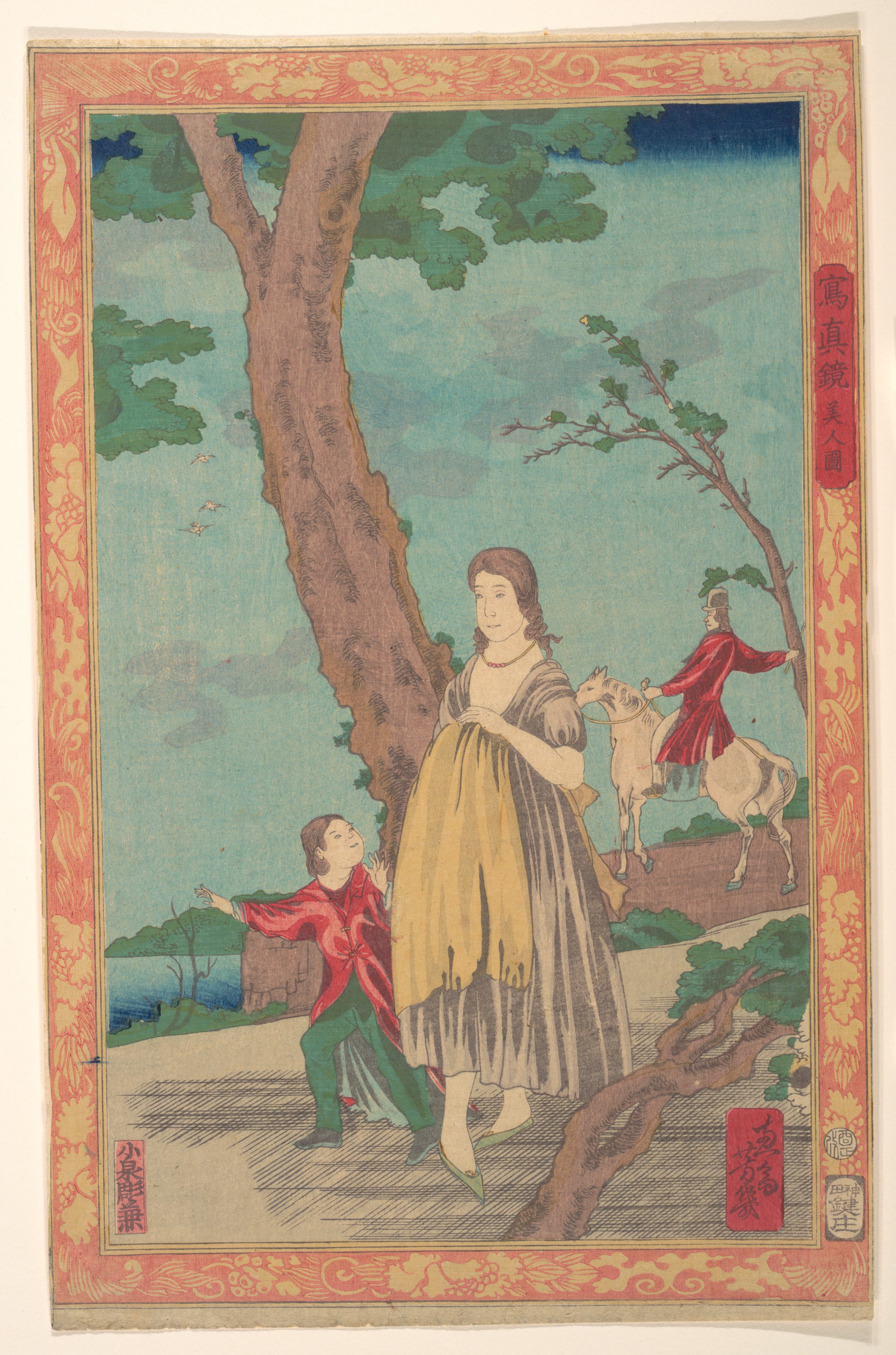
Beauties
美人
1st month, 1861
Woodblock print; ink and color on paper
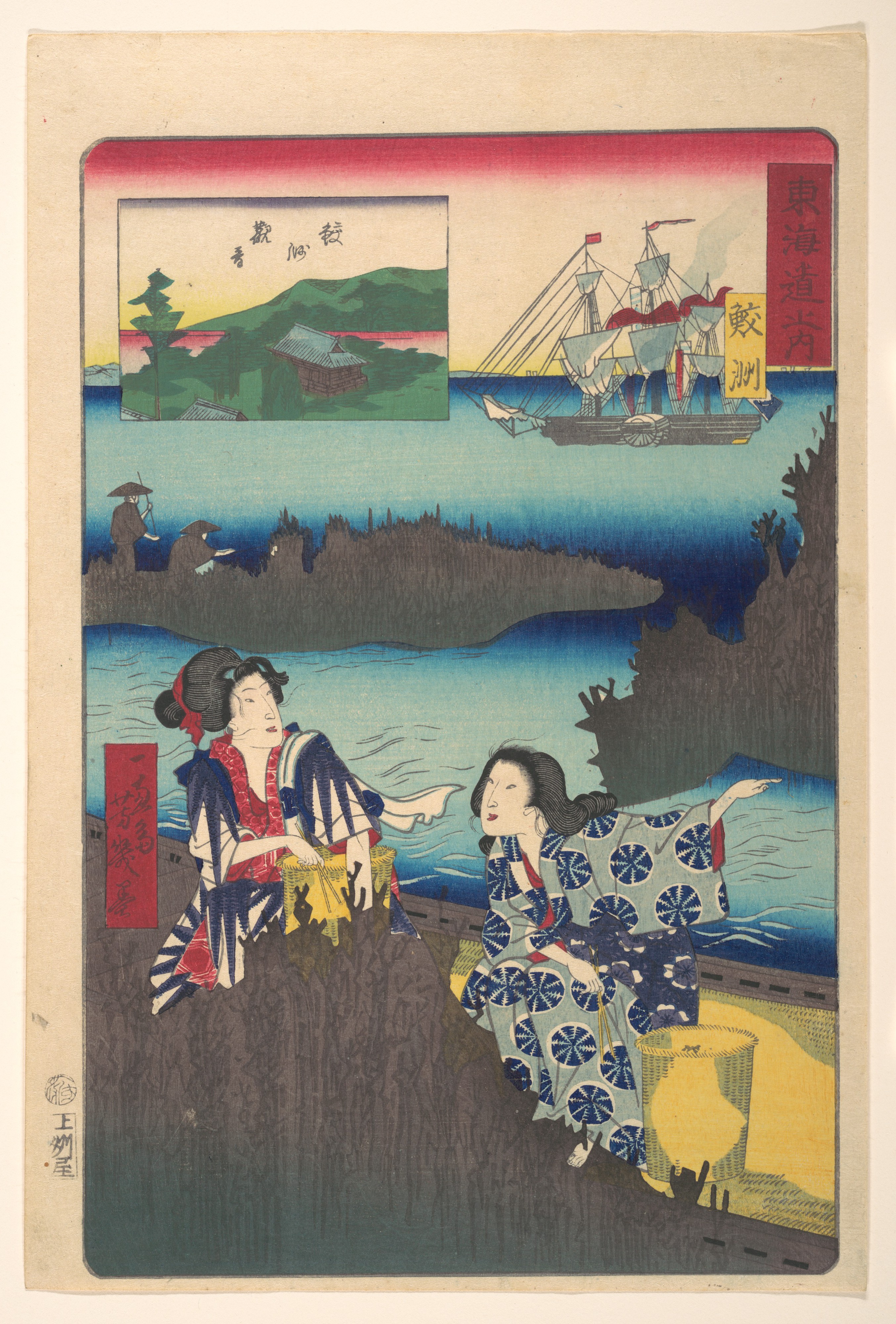
Gathering Seaweed
藻刈
7th month, 1863
Woodblock print; ink and color on paper
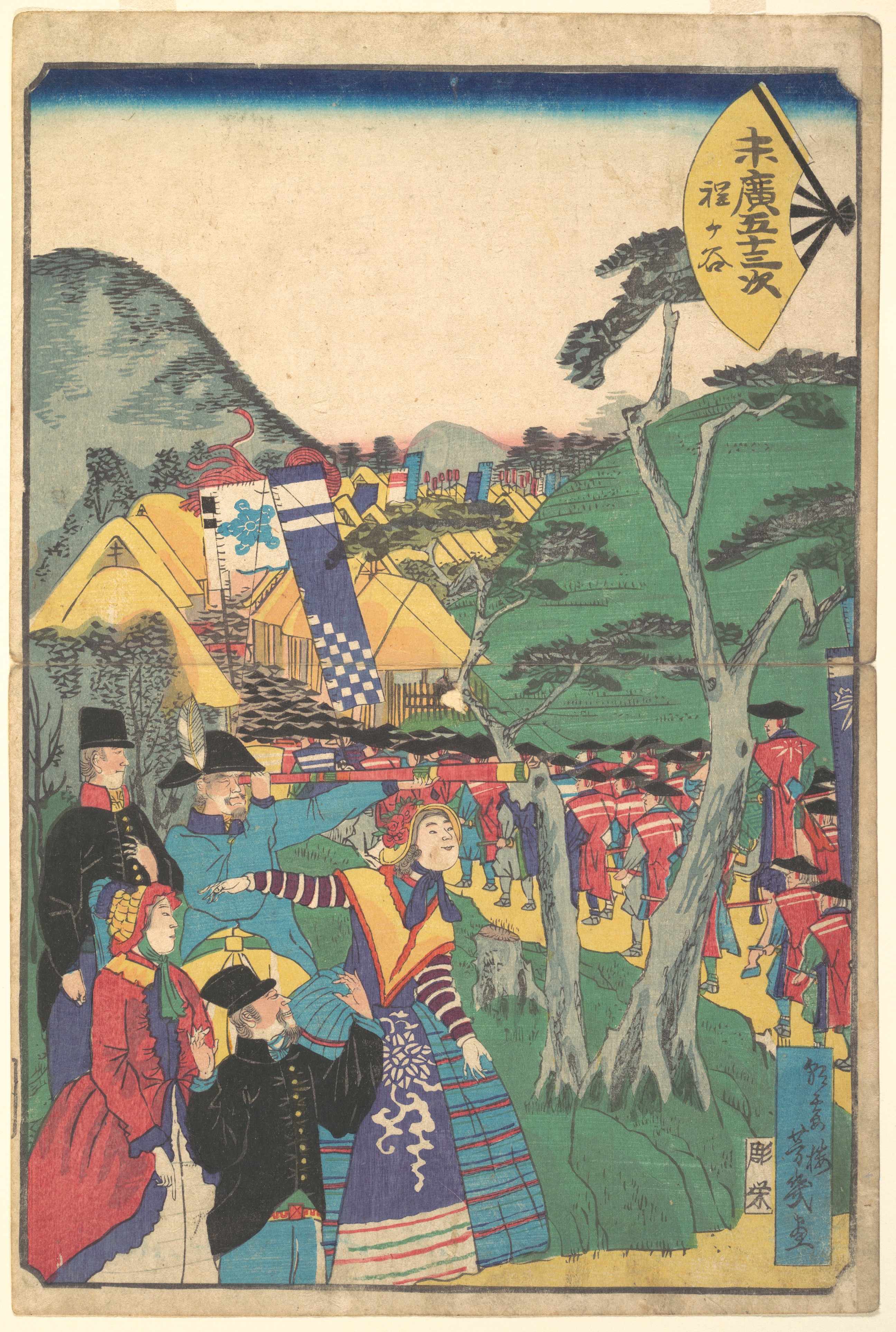
Hodogaya
保土ヶ谷
1865
Woodblock print; ink and color on paper
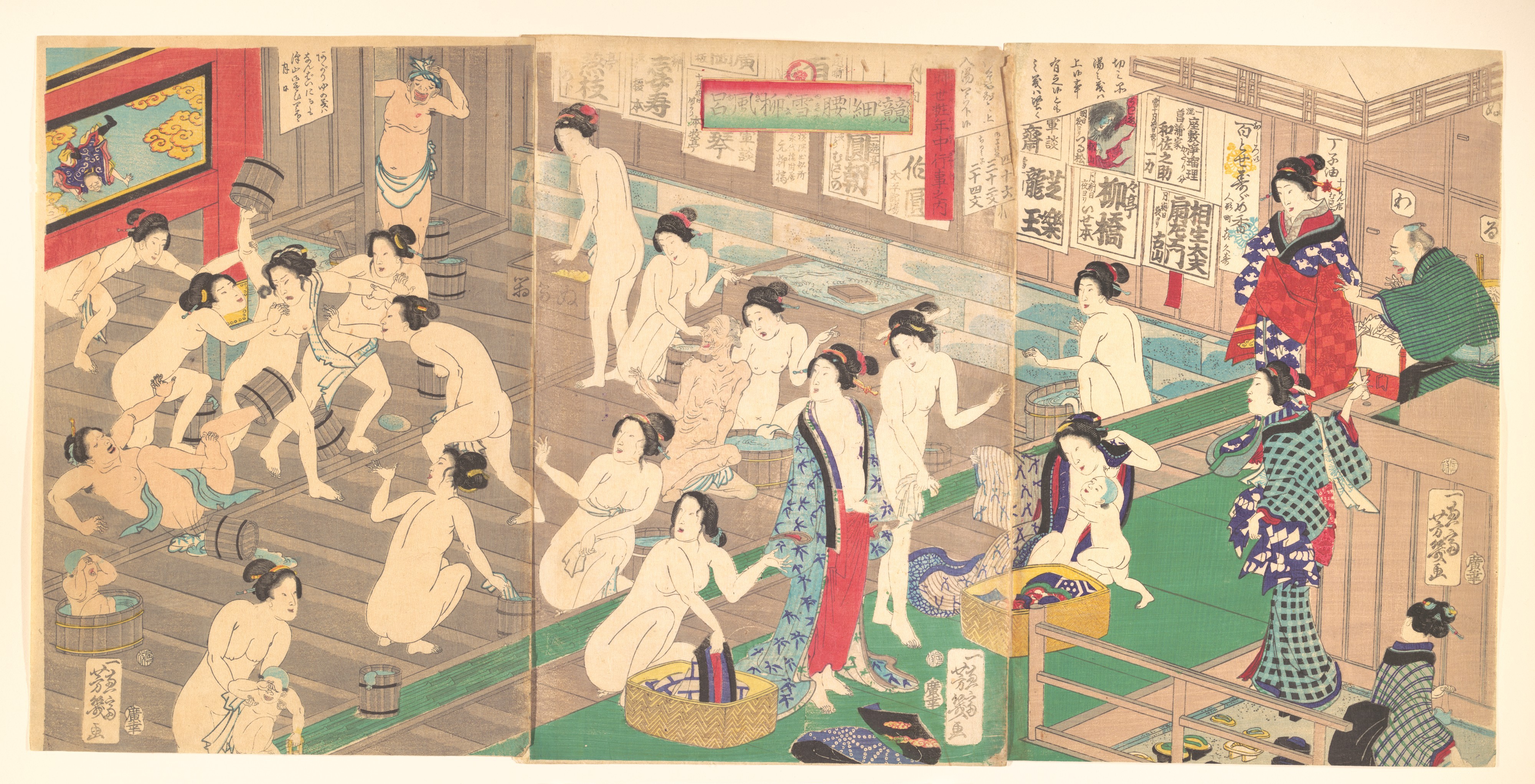
Interior of a Public Bath
銭湯之図
19th century
Triptych of woodblock prints; ink and color on paper