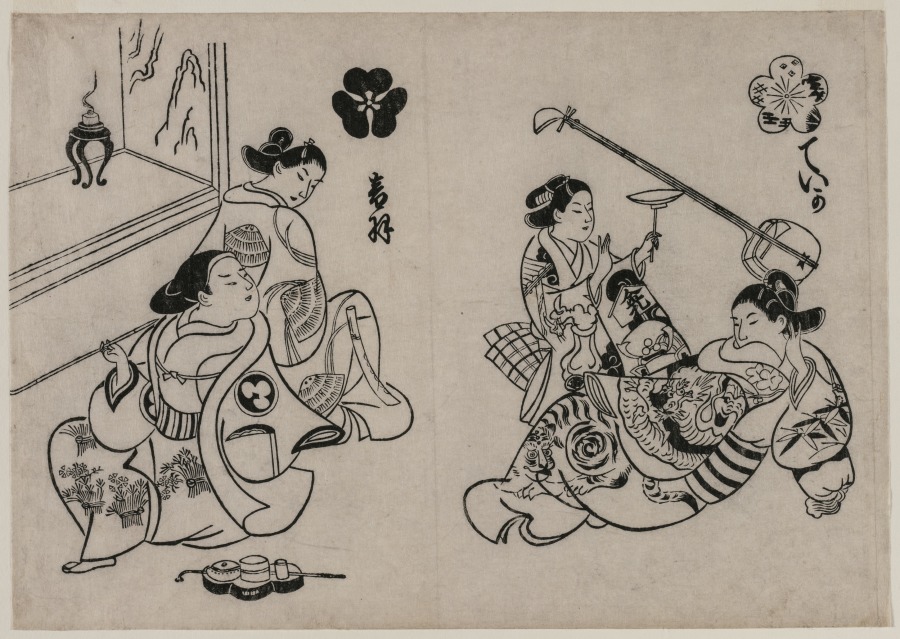
Biography
Okumura Masanobu (1686-1764) was one of the most inventive and commercially shrewd figures of early ukiyo-e, an artist who simultaneously redrew the design vocabulary of the Japanese woodblock print and rebuilt the publishing industry through which it circulated. Active in Edo for nearly six decades, he began in a world of black-ink sumizuri-e and lived long enough to see his own studio produce the two-color benizuri-e prints that led, in the hands of his younger contemporary Suzuki Harunobu, to the full-color nishiki-e revolution of 1765. Almost every important innovation of pre-Harunobu ukiyo-e bears Masanobu's fingerprints, as inventor, popularizer, or aggressive commercial promoter.
Born in Edo in 1686, very likely into a townsman household, Masanobu was largely self-taught and is not known to have belonged to any artistic school, though he absorbed deeply the figural manner of Torii Kiyonobu and Kiyomasu — whose bold, calligraphic line dominated early-eighteenth-century yakusha-e — as well as the example of the pioneering Hishikawa Moronobu. His earliest signed prints date to about 1700, when he was still a teenager. By the 1710s he was producing sumizuri-e of beauties, kabuki actors, and classical literary subjects with a confidence that placed him among the most ambitious designers of his generation, alongside contemporaries such as Nishikawa Sukenobu.
His most consequential move came about 1721, when he abandoned the publishers of his earlier work and opened his own wholesaling house, the Okumuraya, in Tori Shio-cho in Edo. The Okumuraya gave him what almost no other designer of his era possessed: complete editorial and commercial control, from drawing through block-cutting, printing, and marketing. He used that independence to launch format innovations that defined the visual culture of mid-eighteenth-century Edo. He was the central popularizer — and is traditionally credited as the originator — of the hashira-e or pillar print, the tall, narrow vertical format pasted on the wooden pillars of Edo townhouse interiors; his signatures sometimes proclaimed him its inventor. From the early 1740s he was a leading force in the uki-e or "floating picture," the perspective view that adapted Western linear perspective — transmitted through Chinese intermediaries and Dutch optical prints — to kabuki theatre interiors and Edo cityscapes, establishing a genre that Utagawa Toyoharu and later Hokusai would extend. He was among the first to produce benizuri-e, the two-color prints registered from multiple blocks using pink (beni) and green pigments, which between roughly 1745 and 1765 served as the technical bridge between hand-colored urushi-e and polychrome nishiki-e. His own urushi-e number among the earliest examples of that lacquered finish, made from about 1718, in which boiled animal glue thickens the ink to a glossy black surface enriched with brass filings for a metallic shimmer.
His subject matter spanned the ukiyo-e repertoire. He produced extensive yakusha-e of actors of the Ichikawa and Sanogawa lines in their signature roles. His bijin-ga of Yoshiwara courtesans, often in large hand-colored formats, helped define the early-eighteenth-century image of the courtesan as cultural icon. His mitate or parody prints reimagined classical Chinese, Buddhist, and Daoist figures — and the world of The Tale of Genji — in contemporary Yoshiwara dress. He also produced shunga, kacho-ga, and kabuki parodies in quantity.
Masanobu was among the first ukiyo-e figures to press for something like copyright protection. His trademark was a distinctive gourd-shaped seal, which from the 1720s he stamped on the works his house printed; his prints regularly carry inscriptions identifying the Okumuraya as the original publisher (hommoto) and warning customers that spurious copies were circulating and that they should look for the gourd mark — among the earliest sustained efforts at trademark protection in Japanese commercial history.
His influence on the development of nishiki-e was direct. The full-color revolution that Suzuki Harunobu launched in 1765 grew out of the benizuri-e workshop tradition that Masanobu and Ishikawa Toyonobu had helped build, and the compositional vocabulary of Harunobu's early bijin-ga owes much to the mitate prints Masanobu had produced for decades. Through Harunobu, his legacy passed into the work of Koryusai, Kiyonaga, Utamaro, and ultimately the great masters of the later eighteenth and nineteenth centuries. His only known pupil, Okumura Toshinobu, carried his manner into the next generation. Masanobu died in 1764, one year before Harunobu's revolution would inaugurate the classical period of ukiyo-e. His work survives today in major museum collections including the Art Institute of Chicago, the Cleveland Museum of Art, the Museum of Fine Arts Boston, the British Museum, and the Metropolitan Museum of Art.
Key Facts
- Active Period
- 1686–1764
- Nationality
- 🇯🇵Japan
- Movement
- Ukiyo-e
- Works Indexed
- 3
Frequently Asked Questions
Okumura Masanobu (1686-1764) was one of the most inventive and commercially shrewd figures of early ukiyo-e, an artist who simultaneously redrew the design vocabulary of the Japanese woodblock print and rebuilt the publishing industry through which it circulated. Active in Edo for nearly six decades, he began in a world of black-ink sumizuri-e and lived long enough to see his own studio produce the two-color benizuri-e prints that led, in the hands of his younger contemporary Suzuki Harunobu, to the full-color nishiki-e revolution of 1765. Almost every important innovation of pre-Harunobu ukiyo-e bears Masanobu's fingerprints, as inventor, popularizer, or aggressive commercial promoter.
Okumura Masanobu was active from 1686 to 1764. They were associated with the Ukiyo-e movement.
Okumura Masanobu's work was shaped by the Ukiyo-e tradition in Japanese woodblock printmaking. Ukiyo-e: ## What is ukiyo-e? Ukiyo-e ([浮世絵](/glossary/ukiyo-e)) — literally "pictures of the floating world" — is the Edo-period Japanese print and painting tradition that flourished from roughly 1660 to 1868, depicting the pleasures of urban life in Edo (modern Tokyo): courtesans, kabuki actors, sumo wrestlers, famous landscapes, and seasonal beauties.
Original prints by Okumura Masanobu can be found in collections including Art Institute of Chicago, Cleveland Museum of Art.

