Biography
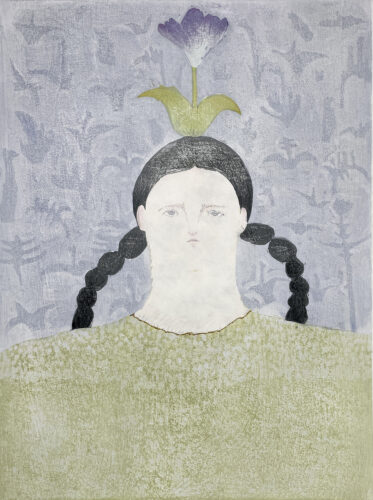
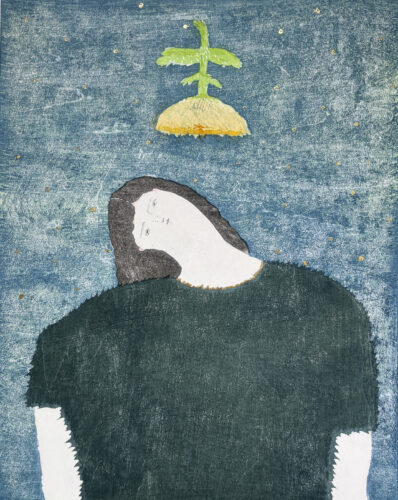
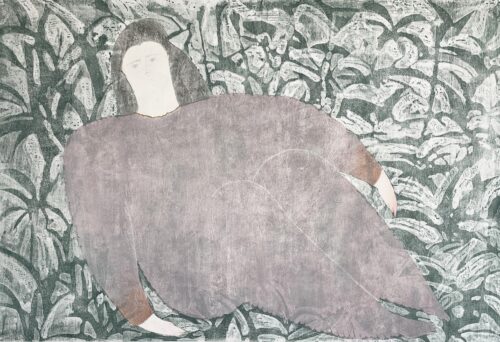
Sayaka Kawamura is a contemporary Japanese woodblock printmaker whose large-scale mokuhanga works interweave family memory, regional heritage, and the long traditions of Japanese printmaking into dreamlike compositions of remarkable luminosity. Born in 1989 in Sapporo, Hokkaido, Kawamura studied printmaking at Kyoto Seika University, graduating in 2013, before completing her graduate training at Tama Art University in 2015. She was appointed an Associate Member of the Japan Print Association in 2017.
Much of Kawamura's imagery is inspired by stories passed down through her family, particularly her father's upbringing in the port city of Otaru. Boats and maritime motifs recur throughout her prints, honoring her ancestors and the landscapes of northern Japan. Her work depicts an altered state where dreams and reality overlap, portraying scenes that feel impossible yet somehow deeply familiar — a quality that gives her prints their distinctive emotional resonance.
Kawamura's technical process is notable for its ambition and physicality. She prints on thickened kozo paper from Tosa, custom-made by papermakers specifically so she can work at large dimensions without damaging the delicate sheet. Because her compositions are expansive, she places the paper flat on her worktable and walks around the perimeter, using the baren to apply pressure evenly rather than leaning across the surface. She works with watercolor inks, building subtle textures and the soft, luminous palette characteristic of her prints through careful layering.
Kawamura has received numerous awards, including the Grand Prize at the 11th Kochi International Print Triennial in 2020 and the Constellation Studios Prize at the International Woodblock Print Conference in 2021. Her prints have been acquired by significant public collections, including the Los Angeles County Museum of Art (LACMA), the Harvard Art Museums, the Tama Art University Museum, and the Machida City Museum of Graphic Arts.
Represented by the Tolman Collection of Tokyo, Kawamura has exhibited widely in Japan and internationally, establishing herself as one of the most distinctive voices in a new generation of Japanese woodblock printmakers.
Key Facts
- Active Period
- 1989
- Nationality
- 🇯🇵Japan
- Movements
- Contemporary MokuhangaSōsaku-hanga
- Works Indexed
- 4
Frequently Asked Questions
Sayaka Kawamura is a contemporary Japanese woodblock printmaker whose large-scale mokuhanga works interweave family memory, regional heritage, and the long traditions of Japanese printmaking into dreamlike compositions of remarkable luminosity. Born in 1989 in Sapporo, Hokkaido, Kawamura studied printmaking at Kyoto Seika University, graduating in 2013, before completing her graduate training at Tama Art University in 2015. She was appointed an Associate Member of the Japan Print Association in 2017.
Sayaka Kawamura was active born in 1989. They were associated with the Contemporary Mokuhanga and Sōsaku-hanga movements.
Sayaka Kawamura's work was shaped by the Contemporary Mokuhanga and Sōsaku-hanga traditions in Japanese woodblock printmaking. Contemporary Mokuhanga: Contemporary mokuhanga (literally "wood-block print") encompasses artists working from approximately 1970 to the present who continue or reinvent traditional Japanese woodblock printing techniques. Sōsaku-hanga: ## What is sōsaku-hanga? Sōsaku-hanga (創作版画, "creative prints") was a twentieth-century Japanese print movement defined by a single commitment: the artist must design, carve, and print every work alone.
Sayaka Kawamura's prints frequently feature seascapes, interiors, birds & flowers, nature.