Biography
Shibata Zeshin (1807-1891) was one of the most inventive and technically virtuosic artists of nineteenth-century Japan, a master who bridged the Edo and Meiji periods with a body of work that defies easy categorization. Trained as both a lacquer artist and a painter, Zeshin pushed the boundaries of every medium he touched, producing exquisite urushi-e prints, intimate surimono, illustrated books, hanging scrolls, album leaves, and lacquered objects of almost impossible refinement. By the time of his death he was recognized as a giant of Japanese art, honored at home with an imperial court appointment and celebrated abroad at international expositions in Vienna, Philadelphia, and Paris.
Born in Edo (modern Tokyo) in 1807, Zeshin was the son of a shrine carpenter and wood sculptor. Apprenticed at age eleven to the lacquer master Koma Kansai II, he absorbed the painstaking discipline of urushi work, a craft that demanded years to master and offered virtually no margin for error. Lacquer became his lifelong technical foundation, but his ambitions extended far beyond decorative arts. In his late teens he began studying painting with Suzuki Nanrei, a leading Edo painter of the Maruyama-Shijo lineage, the school that combined the close naturalistic observation of Maruyama Okyo with the lyrical, brushwork-driven sensibility of the Shijo painters of Kyoto. To deepen his classical foundation, Zeshin also steeped himself in Chinese poetry and classical studies and made an extended sojourn to Kyoto in his twenties, where he immersed himself in literati culture and refined his calligraphy.
This hybrid training - half craftsman, half literatus - produced an artist who was equally at home rendering a single dragonfly on a fan and devising new technical formulas for lacquer pigments. Zeshin is best remembered today for his remarkable urushi-e: paintings in real lacquer on paper or silk. While lacquer is normally applied to wood or metal, Zeshin developed a method of working it onto paper supports, producing surfaces that glint with the same deep luster as a lacquered tray but with the spontaneity of a brush drawing. The technical difficulty was enormous, and Zeshin remained essentially alone in his mastery of it.
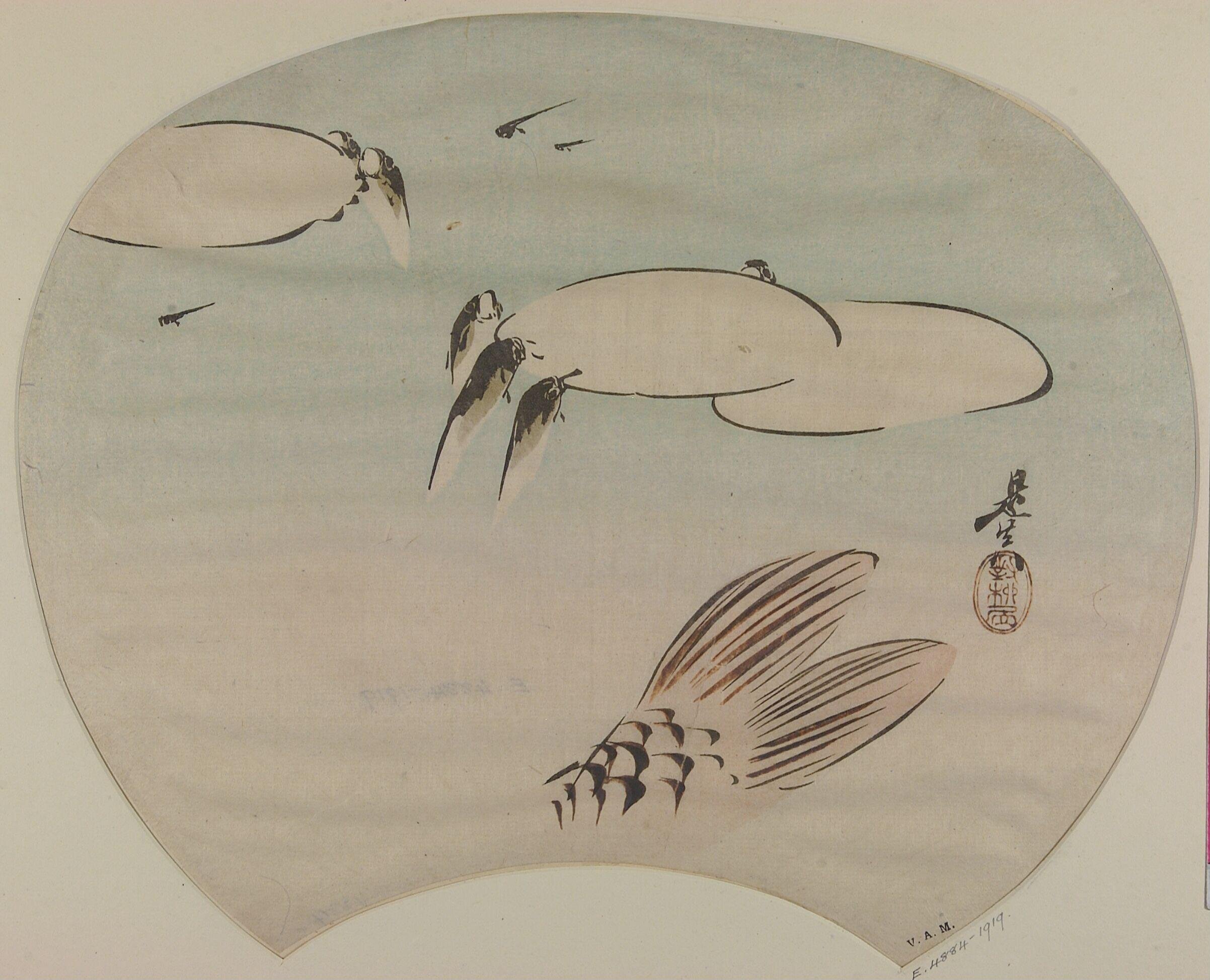
He was also one of the most important figures in the late history of surimono, the privately commissioned woodblock prints that pair poetry with image. Working with poets across the great kyoka clubs of Edo, Zeshin produced surimono into the 1880s, long after the genre had passed its mid-century peak. His surimono of the 1860s, 1870s, and 1880s are immediately recognizable: spare compositions, exquisite blind-printing and metallic pigments, and a sly intelligence in the relationship between text and motif. Animals and small natural subjects recur throughout - frogs, monkeys, sparrows, rats, plum branches, dragonflies - rendered with the close observation of a naturalist and the wit of a poet. Where many of his contemporaries crowded the surimono surface with figural scenes, Zeshin tended toward a calligraphic economy that lets a single rat, fish, or bough of bamboo carry the entire image.
The political revolutions of 1868 transformed Japan but did not derail Zeshin's career. He was already a senior figure by the time of the Meiji Restoration, and he adapted with remarkable agility. He exhibited internationally at the 1873 Vienna World's Fair and the 1876 Philadelphia Centennial and showed again at the 1889 Paris Exposition Universelle, and in 1890 he was named an Artist to the Imperial Household (Teishitsu Gigei-in), one of the earliest such designations. Foreign collectors, especially in Britain and the United States, prized his lacquer panels and album paintings, and important groups of his work passed into the British Museum, the Khalili Collection, the Metropolitan Museum of Art, and the Art Institute of Chicago.
His Meiji-era surimono - including a long series of bird, animal, and seasonal subjects from the 1880s - show an artist still inventing in his seventies and eighties. These late surimono, many keyed to a particular season or month, map Zeshin's continuing engagement with the poetry circles of his youth even as Edo became Tokyo and the woodblock-print industry contracted around him; a rich group of them survives at the Art Institute of Chicago. His illustrated books demonstrate the same gifts in serial form: subtle washes, restrained palettes, and a draughtsman's eye for the eccentric profile of a fish, frog, or branch.
Zeshin used several art names across his career, including Reisai, but "Zeshin" - the name he adopted in maturity - became inseparable from his identity as a self-consciously hybrid artist working across painting, lacquer, and print. He died in Tokyo in 1891. His son Shibata Reisai and his pupil Ikeda Taishin carried his lacquer tradition into the twentieth century, but his idiosyncratic blend of urushi-e, Maruyama-Shijo naturalism, and surimono wit had no real successor.
For today's collectors of Japanese prints, Shibata Zeshin occupies an unusual position. He is not primarily a ukiyo-e artist in the conventional sense - he made no actor or courtesan portraits, ran no large publishing concern, and most of his prints reached only the small circle of poets who commissioned them. Yet his surimono and his urushi-e prints are among the most refined sheets ever produced in Japan, and his late-career work documents the precise moment when the Edo print tradition negotiated its survival into the Meiji era. Collecting Zeshin means collecting an artist who treated every square inch of paper as a problem of pigment, surface, and wit, and who answered it with thirty years of consistently inventive solutions.
Key Facts
- Active Period
- 1807–1891
- Nationality
- 🇯🇵Japan
- Movements
- Meiji/Taishō PrintsUkiyo-e
- Subjects
- Fish
- Works Indexed
- 26
Frequently Asked Questions
Shibata Zeshin (1807-1891) was one of the most inventive and technically virtuosic artists of nineteenth-century Japan, a master who bridged the Edo and Meiji periods with a body of work that defies easy categorization. Trained as both a lacquer artist and a painter, Zeshin pushed the boundaries of every medium he touched, producing exquisite urushi-e prints, intimate surimono, illustrated books, hanging scrolls, album leaves, and lacquered objects of almost impossible refinement. By the time of his death he was recognized as a giant of Japanese art, honored at home with an imperial court appointment and celebrated abroad at international expositions in Vienna, Philadelphia, and Paris.
Shibata Zeshin was active from 1807 to 1891. They were associated with the Meiji/Taishō Prints and Ukiyo-e movements.
Shibata Zeshin's work was shaped by the Meiji/Taishō Prints and Ukiyo-e traditions in Japanese woodblock printmaking. Meiji/Taishō Prints: Meiji and Taishō era prints (1868–1926) bridge the transition from traditional ukiyo-e to the modern shin-hanga and sosaku-hanga movements. Ukiyo-e: ## What is ukiyo-e? Ukiyo-e ([浮世絵](/glossary/ukiyo-e)) — literally "pictures of the floating world" — is the Edo-period Japanese print and painting tradition that flourished from roughly 1660 to 1868, depicting the pleasures of urban life in Edo (modern Tokyo): courtesans, kabuki actors, sumo wrestlers, famous landscapes, and seasonal beauties.
Shibata Zeshin's prints frequently feature fish.
Original prints by Shibata Zeshin can be found in collections including Art Institute of Chicago, Victoria and Albert Museum, Cleveland Museum of Art.