
Violin
ヴァイオリン
- Date:
- 1933
- Medium:
- Oil on canvas
- Source:
- Nakano Museum of Art, Nara
Description
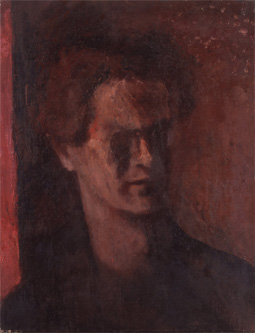
Held in the Nakano Museum of Art in Nara, Violin (1933) belongs to the small group of still-life canvases that Suda Kunitarō painted alongside his major architectural pictures of the early 1930s, and stands among the most concentrated demonstrations of the European pictorial language that he had brought back from Madrid a decade earlier. The composition is austere — a single violin laid on a plain table-top against a dark, undefined ground — and the entire painting is held within a narrow range of brown-black, umber and oxide red, with the highlights restricted to the curve of the instrument's body and the strings. The frontal placement, the rich tonal density and the unembellished ground all draw openly on the Spanish bodegón tradition of the seventeenth century, in particular the still-life painting of Sánchez Cotán and Zurbarán that Suda had studied in Madrid. The choice of subject is no accident: Suda was a serious amateur musician and a lifelong student of Noh, and the picture stands as a quiet meditation on the affinity between the European painted object and the Japanese sense of the contemplative artefact.
More Prints by Suda Kunitarō


Frequently Asked Questions
Violin (ヴァイオリン) was created by Suda Kunitarō (須田國太郎) in 1933.