Biography
Takeji Asano (1900–1999) was a Japanese woodblock print artist known for his vivid and atmospheric depictions of temples, shrines, gardens, and famous scenic views, primarily in the Kyoto-Osaka region. Working principally in the sosaku-hanga tradition, in which the artist designs, carves, and prints their own blocks, Asano produced over two hundred woodblock prints during a remarkably long career that spanned more than seven decades.
Born on October 24, 1900, in Kyoto, Asano grew up surrounded by the ancient capital's rich cultural heritage—its temples, shrines, and gardens would become the central subjects of his art. He received his early artistic education at the Kyoto City School of Fine Arts and Crafts, graduating in 1919. He continued his studies at the Kyoto City Specialist School of Painting, completing the program in 1923. Initially trained in Western-style oil painting, he transitioned to Japanese-style painting (nihonga) under the guidance of Tsuchida Bakusen, one of the most prominent nihonga painters active in Kyoto at the time.
The decisive turning point in Asano's career came in 1928, when he enrolled in a woodblock printing course at the Gasendo studio in Kyoto, taught by Hiratsuka Un'ichi, one of the founding figures of the sosaku-hanga movement. Hiratsuka's philosophy that the artist should control every stage of the printmaking process—design, carving, and printing—resonated deeply with Asano and shaped his artistic approach for the rest of his life.
In 1929, Asano was among the co-founders of the Kyoto Sosaku-Hangakai (Kyoto Creative Print Society), alongside Tokuriki Tomikichiro, Asada Benji, and Kawai Unosuke. This society became an important center for sosaku-hanga activity in western Japan. The following year, Asano collaborated with Asada and Tokuriki on Creative Prints of Twelve Months in New Kyoto, published by Uchida, one of his first significant print publications. During the early 1930s, he contributed to the magazine Taishu Hanga (Popular Prints), published by the Kyoto Sosaku-Hangakai, and also produced some designs in the shin-hanga collaborative model while continuing to develop his own carving and printing skills.
Asano's artistic maturity is best represented by the Kinki Meisho Fukei (Noted Views in the Kyoto-Osaka Area) series, which he launched in 1947 as fully self-carved and self-printed works. This series established the pattern that would characterize the remainder of his career: carefully observed architectural and landscape views of Japan's cultural heartland, rendered with a sensitivity to atmosphere, season, and time of day.
From the 1950s onward, Asano's most prominent commercial relationship was with the Kyoto publisher Unsodo, for whom he designed numerous landscape prints. His Unsodo prints include the Eight Noted Places of Kyoto and the three-volume Kyoto Famous Prints postcard sets, featuring such subjects as Higashihonganji Temple in Rain, Heian Shrine in Spring, Snow in Sanjo-ohashi Bridge, Imperial Palace in Moonlight, Ginkakuji Temple in Autumn, Daimonji Bonfires, Snow in Kinkakuji Temple, Nijo Castle in Moonlight, Kiyomizu Temple in Autumn, and Sanjusangendo Temple in Rain. He was an associate member of the Nihon Hanga Kyokai (Japan Print Association) from 1955 to 1960.
While deeply rooted in Kyoto, Asano was not provincial in his outlook. In 1964, he befriended the American artist Ben Shahn, a connection that reflected his engagement with international artistic currents. In 1965, he undertook an extensive international tour, visiting Mexico, the United States, Spain, Italy, Greece, and Turkey. He held a one-artist exhibition in Mexico City during this trip, bringing his vision of Japanese landscapes and architecture to an international audience.
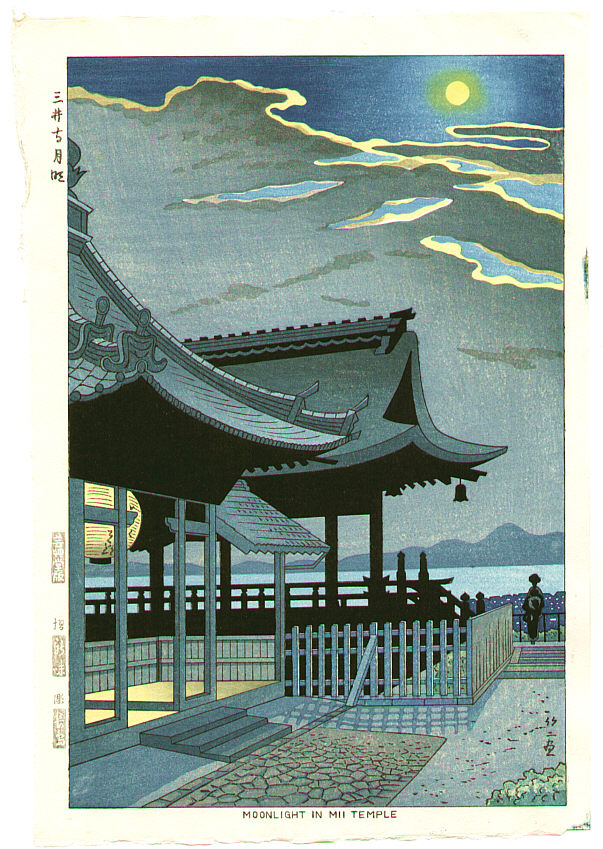
Asano's prints are characterized by their intimate observation of architectural detail and their atmospheric rendering of weather and seasonal effects. His preferred subjects were the temples, shrines, pagodas, and garden landscapes of Kyoto and the surrounding Kansai region, though he also depicted other famous Japanese sites including Nachi Waterfall. His compositions frequently feature rain, snow, and moonlight, using these atmospheric conditions to imbue familiar architectural subjects with emotional depth and temporal specificity. His color palette tends toward rich, harmonious tones that evoke both the natural beauty and the spiritual character of sacred sites.
Working within the sosaku-hanga ethos, Asano maintained direct control over every stage of his printmaking process. This approach gave his works a distinctive quality of personal expression that distinguishes them from the more commercially polished shin-hanga prints produced through the publisher-directed collaborative system. At the same time, his technical skill in carving and printing was refined enough to achieve effects of considerable subtlety and sophistication.
Asano's longevity was extraordinary. He continued making prints and teaching woodblock carving and printing well into his nineties, finally retiring from teaching at the age of ninety-seven because of difficulty walking. Even then, he continued painting gouache works, producing five to six pieces daily until his death. He died on February 10, 1999, at the age of ninety-eight.
Asano's archive, consisting of most of his woodblock prints, some original blocks, tools, and sketchbooks, is held by Kyoto Seika University. His career was documented by the print scholar Helen Merritt. Though less internationally famous than some of his contemporaries, Asano's body of work stands as a testament to the enduring vitality of the sosaku-hanga movement and to the inexhaustible artistic inspiration provided by Kyoto's cultural landscape.
Key Facts
- Active Period
- 1900–1999
- Nationality
- 🇯🇵Japan
- Movement
- Sōsaku-hanga
- Works Indexed
- 80
Frequently Asked Questions
What is Takeji Asano known for?
Takeji Asano (1900–1999) was a Japanese woodblock print artist known for his vivid and atmospheric depictions of temples, shrines, gardens, and famous scenic views, primarily in the Kyoto-Osaka region. Working principally in the sosaku-hanga tradition, in which the artist designs, carves, and prints their own blocks, Asano produced over two hundred woodblock prints during a remarkably long career that spanned more than seven decades.
When was Takeji Asano active?
Takeji Asano was active from 1900 to 1999. They were associated with the Sōsaku-hanga movement.
What artistic movements influenced Takeji Asano?
Takeji Asano's work was shaped by the Sōsaku-hanga tradition in Japanese woodblock printmaking. Sōsaku-hanga: The "creative prints" movement (c.
What subjects did Takeji Asano depict?
Takeji Asano's prints frequently feature landscapes, temples & shrines, snow scenes, mountains, rivers & lakes, urban scenes.
Where can I see Takeji Asano's original prints?
Original prints by Takeji Asano can be found in collections including Ukiyo-e.org (via Artelino), ukiyo-e.org.
How much do Takeji Asano prints cost?
Takeji Asano prints are among the most undervalued in the Japanese woodblock print market, offering collectors high-quality work at remarkably accessible prices. Known for his vivid depictions of Kyoto temples, gardens, and seasonal landscapes, Asano's prints are visually striking and consistently well-printed. Most sell for $150–$1,500. Asano's edition landscape is more complex than most shin-hanga artists because he worked with multiple publishers and also self-published. His prints published by Unsodo in Kyoto are the most common and affordable: $150–$600 for standard editions. Works published by Uchida Art Co. are somewhat scarcer: $300–$1,000. His self-published sosaku-hanga style works, which he designed, carved, and printed himself, are the rarest and most sought-after: $500–$1,500. For publisher-produced prints, look for the Unsodo or Uchida publisher seals; self-published works bear only Asano's own seal and signature. Asano's most popular subjects are his autumn foliage scenes at Kyoto temples, cherry blossom compositions, and snow scenes. His bold use of color — particularly vibrant reds, oranges, and greens — gives his prints immediate visual impact. Publisher editions (Unsodo): $150–$600. Publisher editions (Uchida): $300–$1,000. Self-published works: $500–$1,500. Asano represents one of the best value opportunities for new collectors: the visual quality of his prints is comparable to artists selling at three to five times his price level. His market has been rising as more collectors discover his work through online platforms.