
Biography
Teisai Hokuba (蹄斎北馬, 1771–1844) was a Japanese ukiyo-e printmaker, book illustrator, and painter active in Edo through the first half of the nineteenth century. Among the senior pupils of Katsushika Hokusai, Hokuba is remembered today above all as one of the most prolific and refined designers of surimono — the privately commissioned, deluxe-edition prints used by kyōka poetry circles, theatre clubs, and well-to-do merchant patrons to mark seasonal occasions and exchange verses. He worked across the full span of the Bunka and Bunsei eras (1804–1830), the period scholars treat as the golden age of the surimono format, and his output across that quarter-century forms one of the central bodies of work by which the genre is now understood.
Hokuba's personal name was Arisaka Gorohachi (有坂五郎八); the art name Hokuba — literally 'Northern Horse' — paired the 'Hoku' (北) of his master Hokusai with 'ba' (馬, horse), and the studio name Teisai (蹄斎, 'hoof studio') carried through the same equine theme. Born in Edo to a family with samurai connections — he is recorded as having served as a minor retainer — he entered Hokusai's studio as one of the master's earliest pupils, a group that also included Hokkei, Shinsai, and Hokuju, and distinguished himself for his elegant figure work. By the early nineteenth century he had established the relationship with the kyōka networks whose patronage would shape the rest of his career.
Kyōka (狂歌), the 'mad verse' of comic and satirical poetry that flourished in Edo from the late eighteenth century, was the engine behind the surimono market. Poets organized themselves into clubs (ren) under master judges such as Ōta Nanpo (Shokusanjin); the clubs commissioned surimono — typically square shikishiban prints, roughly twenty centimeters per side — to circulate verses at New Year's, at hanami parties, and at the changing of seasons. Privately commissioned rather than published for the open market, surimono were produced in small editions on the finest paper, lavished with expensive pigments, embellished with metallic dust, blind-printing (karazuri), and burnishing, and untroubled by the censors who policed commercial nishiki-e. They afforded designers a freedom unavailable elsewhere in the print trade — and Hokuba seized it with a virtuosity few peers matched.
Hokuba's surimono cover an unusually broad range: New Year's egoyomi (picture calendars), kachō-e (bird-and-flower) series, allegorical themes such as the Eight Immortals of the Wine Cup, long-format landscapes of travelers and Mount Fuji, and many single-figure bijin in interiors, with mirrors, with musical instruments, with books. His bijin style is unmistakable. Where his master Hokusai's beauties carry a wiry, slightly angular energy, Hokuba's are calm and rounded, with full oval faces, gentle downward-curving eyes, and small composed mouths. Figures lean toward sitting and kneeling poses, their kimono falling in deep folds patterned with intricate textile design that surimono printing — uniquely capable of blind embossing — was able to render. His bijin are not the celebrity courtesans of Yoshiwara okubi-e but a quieter cast: musicians, attendants, mothers with children, women in the interior moments of domestic life. This register suited the private, occasional nature of the surimono commission.
Alongside the surimono, Hokuba was a prolific book illustrator, producing designs for kyōka anthologies, ehon (picture books), gōkan (illustrated fiction), and the multi-volume Harusame shū (Spring Rain Collection), an album-style compilation of surimono that the Metropolitan Museum of Art preserves in fine impression. He continued contributing book designs through the 1830s. His painted output in ink and color on silk and paper is correspondingly substantial; the Met, the Art Institute of Chicago, and the Cleveland Museum of Art all preserve hanging scrolls under his name.
Hokuba worked through the long peak of Bunka-Bunsei surimono and into the constrained 1830s, when the Tenpō Reforms of 1841–43 sharply curtailed luxury production and effectively ended the surimono golden age. He died in 1844 at the age of seventy-three. Major collections of his prints are held by the Art Institute of Chicago (an exceptional run of surimono), the Metropolitan Museum of Art (the Harusame shū album), the Museum of Fine Arts in Boston, the Cleveland Museum of Art, and the British Museum. For students of Japanese woodblock prints, Teisai Hokuba is one of the indispensable names of the surimono tradition — a designer whose career maps almost exactly onto the format's classical period and whose distinctive bijin style and precise printing make his work a benchmark for the genre at its height.
Key Facts
- Active Period
- 1771–1844
- Nationality
- 🇯🇵Japan
- Movement
- Ukiyo-e
- Subjects
- RainSpringBirds & Flowers
- Works Indexed
- 5
Frequently Asked Questions
Teisai Hokuba (蹄斎北馬, 1771–1844) was a Japanese ukiyo-e printmaker, book illustrator, and painter active in Edo through the first half of the nineteenth century. Among the senior pupils of Katsushika Hokusai, Hokuba is remembered today above all as one of the most prolific and refined designers of surimono — the privately commissioned, deluxe-edition prints used by kyōka poetry circles, theatre clubs, and well-to-do merchant patrons to mark seasonal occasions and exchange verses. He worked across the full span of the Bunka and Bunsei eras (1804–1830), the period scholars treat as the golden age of the surimono format, and his output across that quarter-century forms one of the central bodies of work by which the genre is now understood.
Teisai Hokuba was active from 1771 to 1844. They were associated with the Ukiyo-e movement.
Teisai Hokuba's work was shaped by the Ukiyo-e tradition in Japanese woodblock printmaking. Ukiyo-e: ## What is ukiyo-e? Ukiyo-e ([浮世絵](/glossary/ukiyo-e)) — literally "pictures of the floating world" — is the Edo-period Japanese print and painting tradition that flourished from roughly 1660 to 1868, depicting the pleasures of urban life in Edo (modern Tokyo): courtesans, kabuki actors, sumo wrestlers, famous landscapes, and seasonal beauties.
Teisai Hokuba's prints frequently feature rain, spring, birds & flowers.
Original prints by Teisai Hokuba can be found in collections including Metropolitan Museum of Art, Art Institute of Chicago.
Woodblock Prints by Teisai Hokuba (5)

Ferry boat on the Yodo River
c. 1815/25
Color woodblock print; shikishiban, surimono
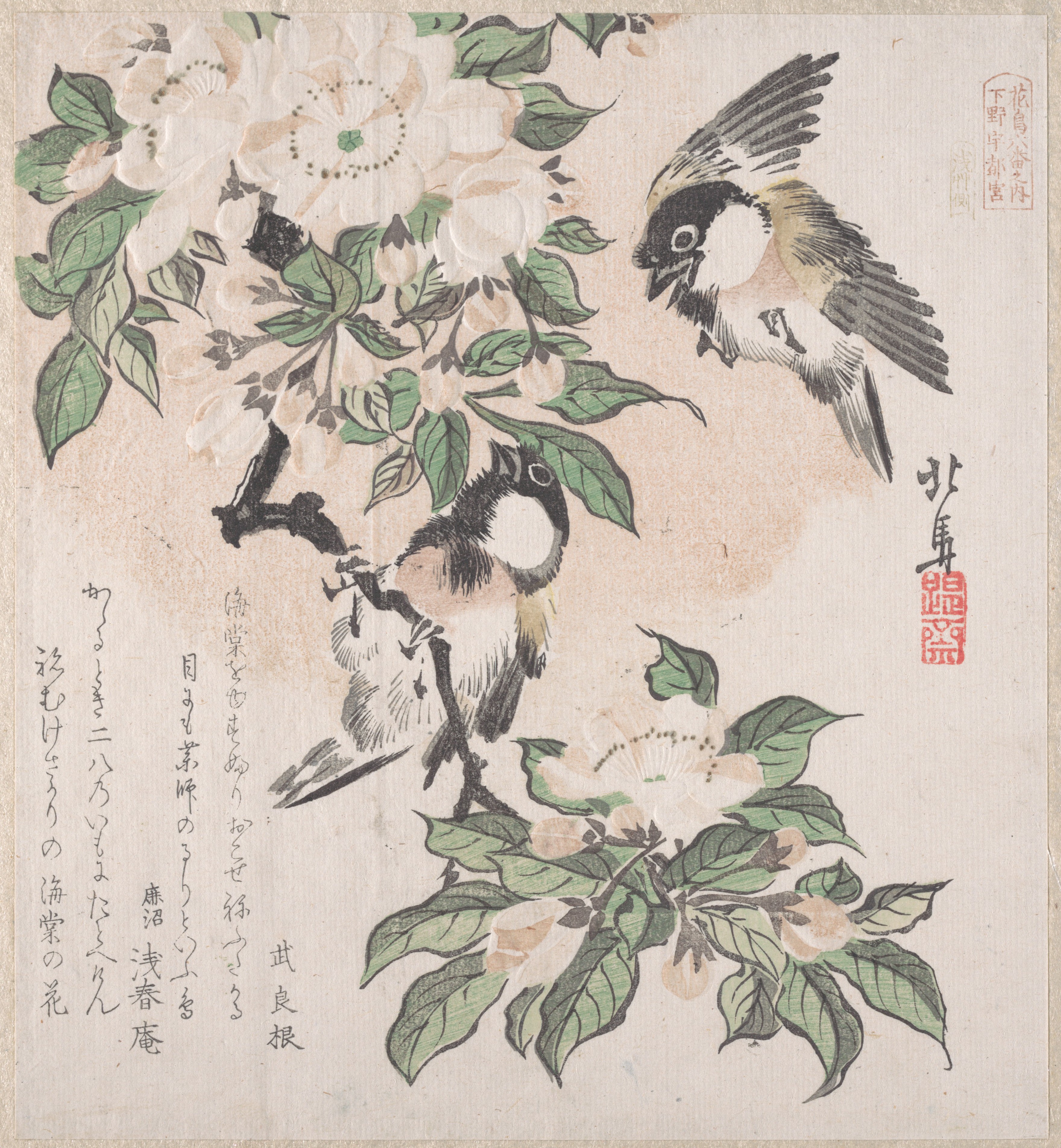
Spring Rain Collection (Harusame shū), vol. 3: Marsh-tits and Crab Apple Flowers
ca. 1820
Privately published woodblock prints (surimono) mounted in an album; ink and color on paper
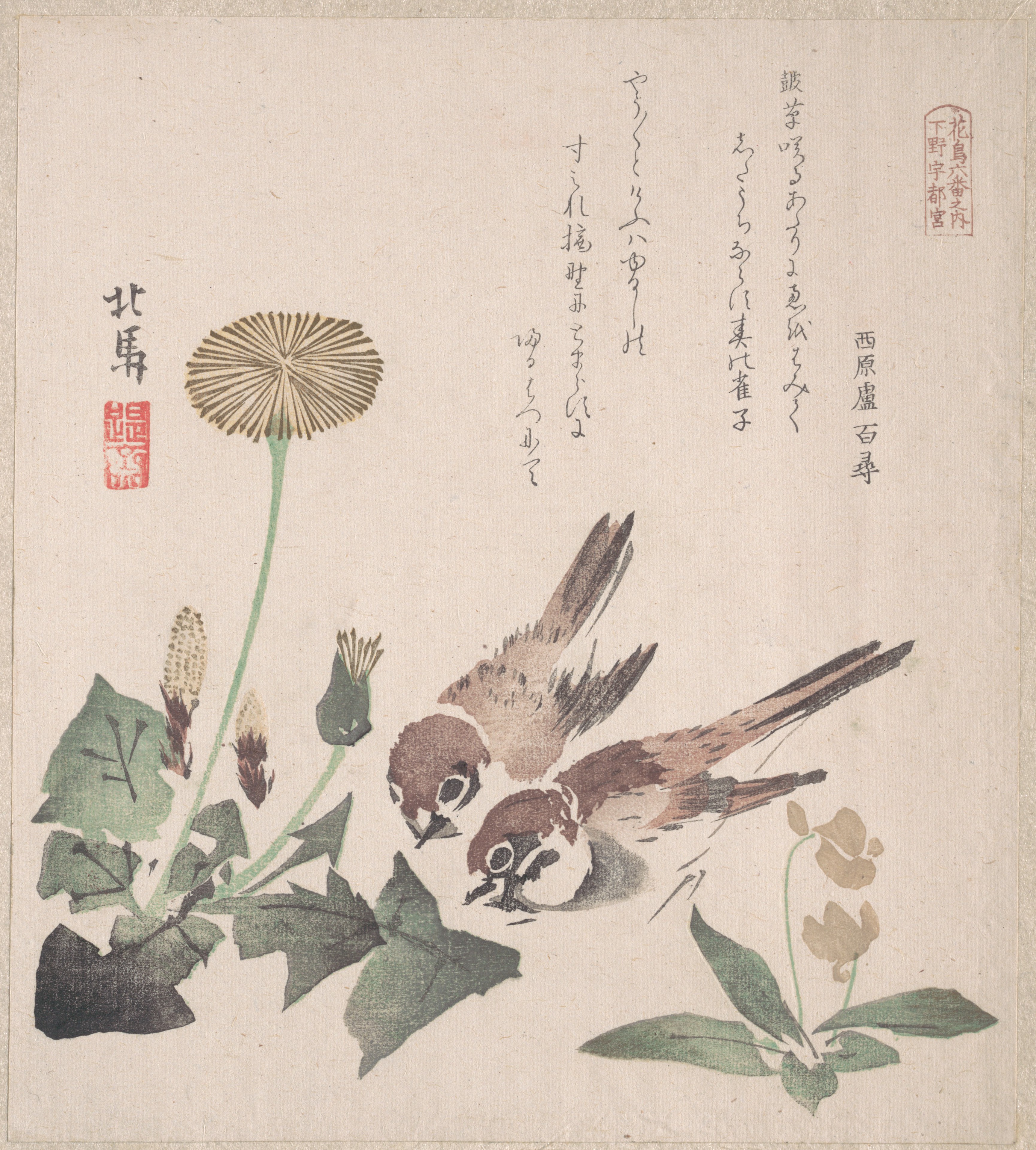
Spring Rain Collection (Harusame shū), vol. 3: Sparrows and Dandelions
ca. 1820
Privately published woodblock prints (surimono) mounted in an album; ink and color on paper
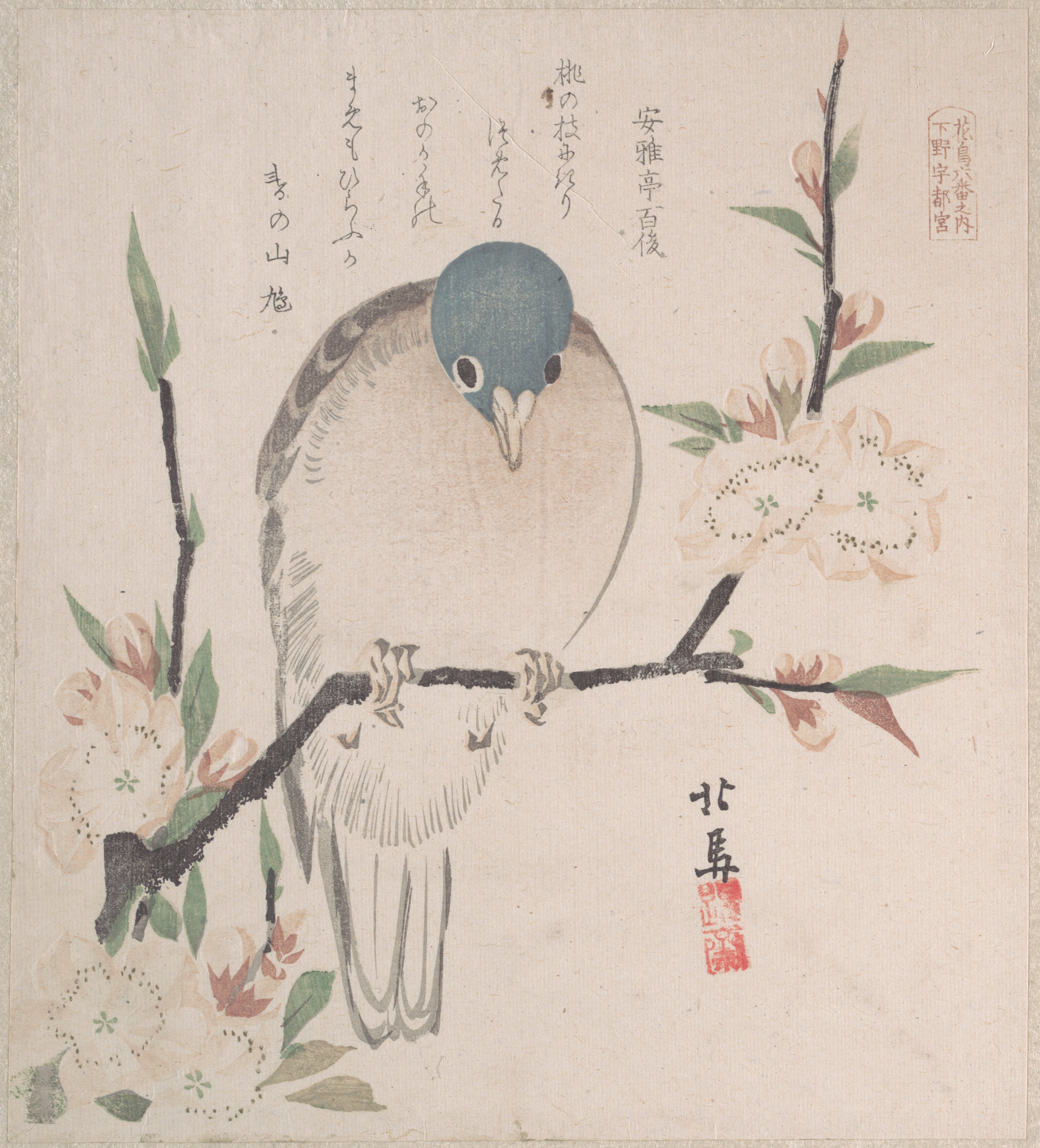
Spring Rain Collection (Harusame shū), vol. 3: Mountain Dove and Peach Flowers
ca. 1820
Privately published woodblock prints (surimono) mounted in an album; ink and color on paper

Spring Rain Collection (Harusame shū), vol. 3: Swallows and Peonies
ca. 1820
Privately published woodblock prints (surimono) mounted in an album; ink and color on paper