Biography
Tomioka Eisen (1864-1905) was a Meiji-era ukiyo-e artist who stood at the crossroads of two worlds: the dying tradition of woodblock printmaking and the burgeoning culture of illustrated literary magazines that defined late-nineteenth-century Japan. In a career cut short by his death at forty-one, Tomioka Eisen produced a remarkable body of Meiji prints, frontispieces, and book illustrations that blended the late Edo aesthetic of bijin-ga with the new visual idioms emerging from Tokyo's modernizing publishing industry. His most enduring contribution was to the genre of kuchi-e — the multi-color woodblock frontispieces bound into popular novels — where his elegant, melancholy portraits of women helped define the look of Meiji literary culture and built a bridge between the Hokusai school tradition and the dawn of twentieth-century shin-hanga.
Born in 1864 in Nakano village in what is now Saku city, Nagano Prefecture, Tomioka Eisen came of age during the upheavals of the Meiji Restoration. His birth in the final years of the Tokugawa shogunate placed him in a generation that inherited the techniques of Edo ukiyo-e but was forced to reinvent them for a country racing toward industrial modernity. As a young artist, Eisen moved to Tokyo and entered the studio of Kobayashi Eitaku, an eclectic painter whose own training reached back through the Kano school and into the broader currents of late Edo painting. Through Eitaku, Eisen absorbed a lineage that connected him to the Hokusai school tradition — the technical fluency, the appetite for narrative drama, and the willingness to move freely between high painting and popular illustration that had defined Hokusai and his many disciples a generation earlier. That dual orientation, toward both refined brushwork and commercial printmaking, would shape Eisen's entire career.
By the 1890s Tomioka Eisen had established himself as one of the most prolific illustrators in Tokyo. The publishing industry was undergoing a transformation: cheap movable-type printing had replaced the woodblock for text, but the illustrated frontispiece — printed from carved woodblocks on fine paper and bound into the front of a novel as a luxurious enticement to the reader — became one of the defining visual experiences of Meiji print culture. Eisen produced kuchi-e in extraordinary numbers, working in particular for Bungei Kurabu (Literary Club), the influential monthly fiction magazine published by Hakubunkan beginning in 1895. His frontispieces accompanied serialized novels and short stories by leading Meiji authors, and his images of women — often shown in moments of private reflection, framed by domestic interiors, gardens, or the corners of teahouses — became inseparable in readers' minds from the literature itself.
Tomioka Eisen's bijin-ga occupy a distinctive position in the long history of beautiful-women pictures. He worked at the moment when the classical ukiyo-e bijin — codified by Utamaro and refined by Kunisada and Kuniyoshi — was giving way to a more psychologically interior, sometimes overtly melancholy depiction of women. His figures often look downward or away, caught in a private thought. They wear the elaborate kimonos of the late Edo and Meiji periods, but the compositions feel quieter than their Edo predecessors: less concerned with displaying fashion than with capturing a mood. In this Eisen anticipated the introspective bijin-ga of later artists such as Kaburagi Kiyokata and the early shin-hanga generation, and his work is now seen as an important transitional link between Edo ukiyo-e and the bijin-ga of the twentieth century.
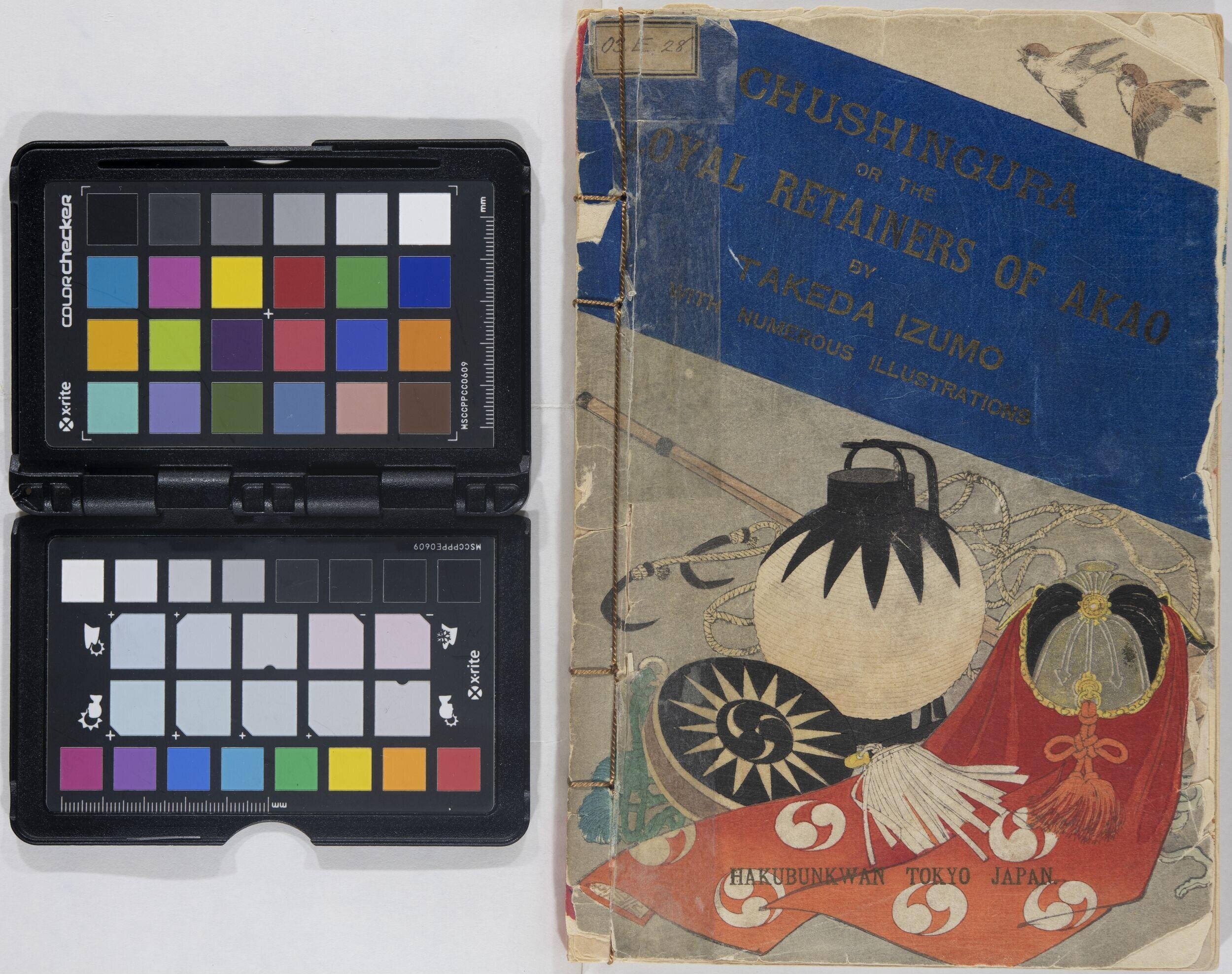
Alongside his bijin-ga, Tomioka Eisen produced a significant body of historical and narrative prints. He illustrated scenes from the Chushingura — the perennially popular tale of the forty-seven ronin who avenged their lord's death — and a wide range of subjects drawn from Japanese history, legend, and the supernatural. His 1894 Chushingura print held by the Victoria and Albert Museum reflects this engagement with the warrior-narrative tradition that the Hokusai school had cultivated through musha-e (warrior pictures). Other works pair beauties with samurai, ghosts with skulls, or place lone figures against atmospheric landscapes, drawing on the broader narrative vocabulary that ukiyo-e had developed over two centuries. He was also active as a painter, exhibiting at the Japan Painting Association and contributing to the Meiji-era effort to reposition the traditional arts within a modernizing national culture.
Tomioka Eisen's late ukiyo-e position is what gives his work much of its historical interest. By the time he was producing his mature prints in the 1890s and early 1900s, the great Edo publishing houses were gone, the popular print market had contracted dramatically, and many observers — including foreign collectors — believed ukiyo-e was finished as a living tradition. Eisen's career demonstrates the opposite: that the woodblock medium had migrated into new contexts. The book frontispiece, the literary magazine, and the illustrated newspaper became the new vehicles for woodblock art. Carvers and printers continued to produce work of extraordinary technical quality. And artists like Eisen continued to draw on the centuries-old vocabulary of ukiyo-e while engaging the subjects and sensibilities of a new century.
Tomioka Eisen died in 1905, at the age of forty-one. His death came just as Watanabe Shozaburo and a younger generation were beginning to assemble what would become the shin-hanga movement, and just before the broader Taisho cultural flowering that would revive Japanese woodblock printmaking on new terms. Had he lived longer, Eisen might well have participated in that revival; as it stands, his prints are now collected by museums including the Victoria and Albert Museum and circulate widely through the ukiyo-e.org digital archive of Meiji and Taisho prints. For students of the period, Tomioka Eisen offers an essential view of what late ukiyo-e actually looked like — not a fading echo of Edo glamour, but a working artistic tradition adapting to a literary, magazine-driven, modern Japan.
Key Facts
- Active Period
- 1864–1905
- Nationality
- 🇯🇵Japan
- Movements
- Meiji/Taishō PrintsUkiyo-e
- Works Indexed
- 28
Frequently Asked Questions
Tomioka Eisen (1864-1905) was a Meiji-era ukiyo-e artist who stood at the crossroads of two worlds: the dying tradition of woodblock printmaking and the burgeoning culture of illustrated literary magazines that defined late-nineteenth-century Japan. In a career cut short by his death at forty-one, Tomioka Eisen produced a remarkable body of Meiji prints, frontispieces, and book illustrations that blended the late Edo aesthetic of bijin-ga with the new visual idioms emerging from Tokyo's modernizing publishing industry. His most enduring contribution was to the genre of kuchi-e — the multi-color woodblock frontispieces bound into popular novels — where his elegant, melancholy portraits of women helped define the look of Meiji literary culture and built a bridge between the Hokusai school tradition and the dawn of twentieth-century shin-hanga.
Tomioka Eisen was active from 1864 to 1905. They were associated with the Meiji/Taishō Prints and Ukiyo-e movements.
Tomioka Eisen's work was shaped by the Meiji/Taishō Prints and Ukiyo-e traditions in Japanese woodblock printmaking. Meiji/Taishō Prints: Meiji and Taishō era prints (1868–1926) bridge the transition from traditional ukiyo-e to the modern shin-hanga and sosaku-hanga movements. Ukiyo-e: ## What is ukiyo-e? Ukiyo-e ([浮世絵](/glossary/ukiyo-e)) — literally "pictures of the floating world" — is the Edo-period Japanese print and painting tradition that flourished from roughly 1660 to 1868, depicting the pleasures of urban life in Edo (modern Tokyo): courtesans, kabuki actors, sumo wrestlers, famous landscapes, and seasonal beauties.
Tomioka Eisen's prints frequently feature moonlight, mythology, children, winter.
Original prints by Tomioka Eisen can be found in collections including ukiyo-e.org, Victoria and Albert Museum, Metropolitan Museum of Art.