Biography
Kiyoharu (清春, active circa 1704-1720s) is an early-eighteenth-century Edo ukiyo-e designer whose surviving prints are catalogued in Western collections under the name Kondō Kiyoharu (近藤清春). His art-name places him within the orbit of the Torii school - it shares the 'Kiyo' element with masters such as Torii Kiyonobu I (1664-1729) and Torii Kiyomasu, and much of his actor-print work follows the Torii workshop manner of the urushi-e era. Major collections including the Museum of Fine Arts in Boston, the Harvard Art Museums, the British Museum, and the Metropolitan Museum of Art preserve his sheets under the Kondō Kiyoharu name, reflecting his standing as a distinct if minor designer of the period.
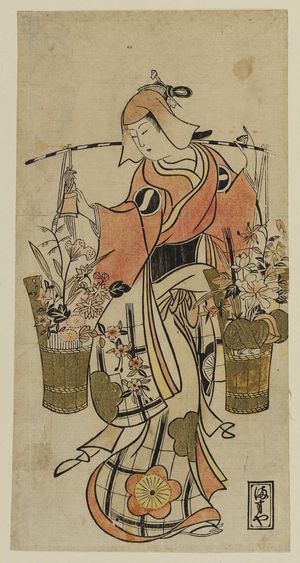
Kiyoharu belongs to the generation of Edo ukiyo-e designers who came of age in the decade after Hishikawa Moronobu's death in 1694 and who worked through the Shōtoku (1711-1716) and early Kyōhō (1716-1736) eras, when the urushi-e print consolidated as a dominant Edo format. The urushi-e, or lacquer print, was built from a black-line woodblock impression hand-coloured with safflower-derived beni pink, ochres, and yellows, with selectively applied glossy black accents - bone-glue mixed into the ink to imitate the sheen of lacquer - on obi sashes, hair, and headdresses. Kiyoharu was an accomplished practitioner of the mode, and his surviving sheets are catalogued almost without exception as hand-coloured woodblock prints in the urushi-e manner.
The surviving corpus divides between actor portraits typical of Torii-school workshop production and a smaller body of historical, didactic, and devotional subjects that distinguishes him from his more strictly theatrical contemporaries. The Museum of Fine Arts in Boston preserves several signed actor prints depicting performers of the Edo kabuki stage - among them portraits of Ichikawa Monnosuke I and of Sanjō Kantarō with Yamashita Kamematsu, and a group composition of actors arrayed in a pleasure barge on the river. Such sheets belong to the Torii-manner actor-portrait tradition of the period, when Torii Kiyonobu I and his successors held the contract to design the publicity billboards and illustrated programs for the three licensed Edo theaters - the Nakamura-za, Ichimura-za, and Morita-za. Beyond the world of yakusha-e, the Harvard Art Museums hold urushi-e sheets from his series of the Twenty-Four Paragons of Filial Piety (Nijūshikō), the canonical Confucian anthology of moral exemplars that had been a staple of East Asian didactic literature since the Yuan dynasty. Kiyoharu's adaptation of the Paragons to the early Edo single-sheet print represents one of the period's distinctive experiments in extending the new popular medium beyond kabuki and Yoshiwara subjects into moral and devotional iconography.
The breadth of subject matter is what most clearly differentiates Kiyoharu's corpus from the work of the Torii school's other designers. Where Torii Kiyomasu I and Torii Kiyomasu II concentrated almost entirely on yakusha-e and the related signage business, Kiyoharu's sheets venture into historical narrative - the British Museum holds prints from his Eight Views of Kamakura (Kamakura Hakkei), which adapts the medieval Eight Views convention to a domestic Japanese subject - and into the Confucian moral exemplars of the Paragons of Filial Piety. That expanded iconographic reach is characteristic of the experimental temper of early Edo ukiyo-e in the urushi-e decades before the benizuri-e colour-printing developments of the 1740s.
Kiyoharu's place in the history of the Edo print is that of a minor but distinctive figure, working at the moment when the Torii school's contract for kabuki publicity was being consolidated under Kiyonobu I and his successors, yet extending the ukiyo-e single sheet into subject matter that his stricter Torii-school contemporaries largely avoided. His surviving prints and books are now held in major Western collections under the name Kondō Kiyoharu, among the documents of the experimental, hand-coloured, urushi-e moment that bridged Hishikawa Moronobu's founding generation and the full-colour nishiki-e revolution of the mid-1760s.
Key Facts
- Nationality
- 🇯🇵Japan
- Movement
- Ukiyo-e
- Subjects
- Birds & Flowers
- Works Indexed
- 2
Frequently Asked Questions
Kiyoharu (清春, active circa 1704-1720s) is an early-eighteenth-century Edo ukiyo-e designer whose surviving prints are catalogued in Western collections under the name Kondō Kiyoharu (近藤清春). His art-name places him within the orbit of the Torii school - it shares the 'Kiyo' element with masters such as Torii Kiyonobu I (1664-1729) and Torii Kiyomasu, and much of his actor-print work follows the Torii workshop manner of the urushi-e era. Major collections including the Museum of Fine Arts in Boston, the Harvard Art Museums, the British Museum, and the Metropolitan Museum of Art preserve his sheets under the Kondō Kiyoharu name, reflecting his standing as a distinct if minor designer of the period.
Torii Kiyoharu's work was shaped by the Ukiyo-e tradition in Japanese woodblock printmaking. Ukiyo-e: ## What is ukiyo-e? Ukiyo-e ([浮世絵](/glossary/ukiyo-e)) — literally "pictures of the floating world" — is the Edo-period Japanese print and painting tradition that flourished from roughly 1660 to 1868, depicting the pleasures of urban life in Edo (modern Tokyo): courtesans, kabuki actors, sumo wrestlers, famous landscapes, and seasonal beauties.
Torii Kiyoharu's prints frequently feature birds & flowers.
Original prints by Torii Kiyoharu can be found in collections including Museum of Fine Arts, Boston, Harvard Art Museums.
