
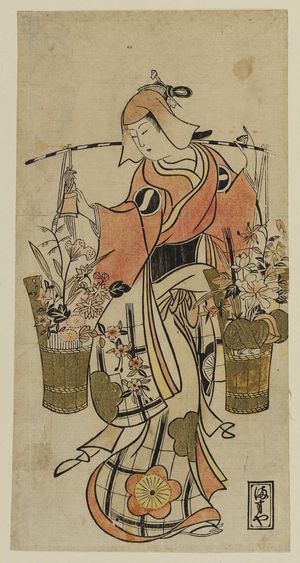
Second Twelve Paragons, from the Twenty-Four Paragons of Filial Piety (Nijūshikō)
二十四孝
- Date:
- Mid Edo period, 1704-1720
- Medium:
- Hand-colored ukiyo-e woodblock print; ink and color on paper
- Source:
- Harvard Art Museums
Description
Second Twelve Paragons, from the Twenty-Four Paragons of Filial Piety (Nijushiko), dated to circa 1715, completes Torii Kiyoharu's two-sheet contribution to the canonical Confucian narrative cycle that had circulated in Japanese painting, printed books, and decorative arts since the medieval period. The Nijushiko, compiled in the Yuan dynasty by Guo Jujing, gathered twenty-four exemplary tales of filial conduct drawn from Chinese history and legend, and the set became one of the foundational moral texts of Tokugawa Japan. Kiyoharu's second sheet presents paragons thirteen through twenty-four, paired with the First Twelve Paragons sheet to complete the visual cycle and allowing viewers to identify each story through its characteristic attributes distributed across the composition. The drawing employs the disciplined bold contour that the Torii circle established for its early-eighteenth-century production, the line carrying the principal expressive weight of the design against the lightly inked ground. The hand-applied tan-e coloring, characteristic of Torii-school output during the Kyoho era, brings selective orange-red emphasis to costume and ground details, with the lead-based tan pigment a hallmark of the workshop's commercial production before the later transition toward fuller polychromy. Although the Torii school had been founded around its monopoly on kabuki advertising and single-sheet actor portraits, its members regularly extended into adjacent subject categories, and Kiyoharu's engagement with the Confucian paragons tradition places him within this broader Torii practice of subject range. The serialized two-sheet format of First Twelve and Second Twelve Paragons allowed the workshop to compress the entire twenty-four-paragon cycle into a digestible visual format, making the full Confucian narrative available to viewers as a pair. Harvard Art Museums preserves this impression (source_url https://harvardartmuseums.org/art/208009) as a representative document of the Torii school's early-eighteenth-century engagement with the Confucian paragons tradition, the print paired with the corresponding First Twelve Paragons sheet to constitute the complete two-sheet set.
More Prints by Torii Kiyoharu
Frequently Asked Questions
Second Twelve Paragons, from the Twenty-Four Paragons of Filial Piety (Nijūshikō) (二十四孝) was created by Torii Kiyoharu (鳥居清春) in Mid Edo period, 1704-1720.