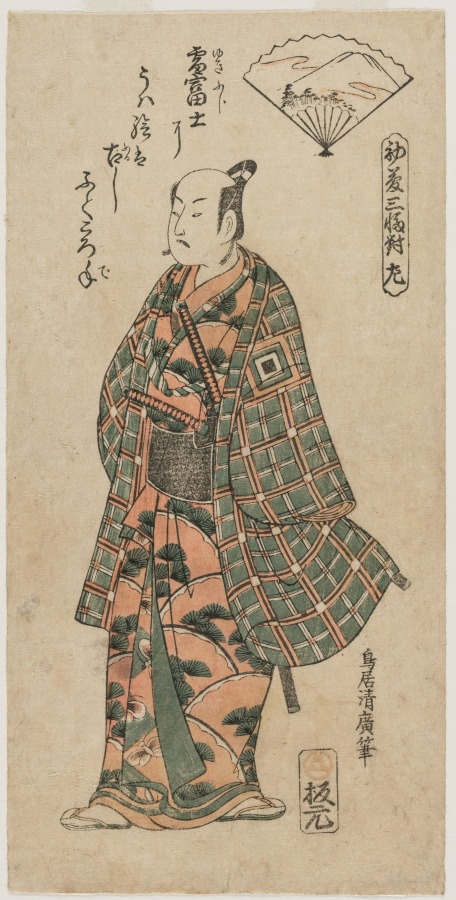
Biography
Torii Kiyohiro (鳥居清広) was a designer of the Torii school of Edo ukiyo-e, working through the middle decades of the eighteenth century. His first known works date from about 1751 and his last from around 1764, and he is generally believed to have died about 1776. He was active at the moment when Japanese woodblock printing was moving from hand-coloured urushi-e (lacquer prints) to the two- and three-block benizuri-e (rose prints), and finally toward the full-colour nishiki-e (brocade prints) introduced by Suzuki Harunobu around 1765. His surviving works document the changing palette of mid-century Japanese printmaking in the benizuri-e years immediately preceding that revolution.
Kiyohiro's date of birth is unknown, and the basic facts of his life are sparser than for the school heads whose name he carried. His personal name is recorded as Shichinosuke. He was registered as a student of Torii Kiyomasu I and is thought to have studied under Torii Kiyonobu II or Torii Kiyomasu II, placing him as a pupil of the Torii workshop rather than a head of the school. He was a contemporary of Torii Kiyomitsu (1735-1785); the early scholar Ernest Fenollosa rated the two designers of nearly equal ability and even speculated that they may have been brothers. Kiyohiro's prints carry Torii signature conventions and frequently address the same yakusha-e (actor prints) that were the workshop's core commercial business.
The Torii school had been founded in the late seventeenth century by Torii Kiyonobu I and Torii Kiyomasu I, who together codified the visual conventions of Edo theatrical publicity — bold contour line, exaggerated stance work, and the standardised hosoban (narrow vertical) format for single-actor portraits. The Torii line became the principal designers of the kanban signboards, banzuke programmes, and illustrated theatre books produced for the licensed Edo kabuki theatres — the Nakamura-za, Ichimura-za, and Morita-za. Kiyohiro worked inside this established system, producing yakusha-e of the leading kabuki actors of his day while also designing bijin-ga (beautiful-women prints), parody compositions, and multi-figure genre scenes for the broader Edo print market.
Kiyohiro worked principally in benizuri-e, the registered-colour technique in which a small number of colour blocks — most characteristically a soft rose-red (beni) and green — were printed over a black key block to yield consistent multi-coloured impressions across a print run without the hand-colouring of the earlier urushi-e. The Art Institute of Chicago's Clarence Buckingham Collection, one of the finest holdings of Japanese prints outside Japan, preserves a number of his benizuri-e sheets.
A distinctive feature of his output is a fondness for the multi-figure composition — paired actors on hosoban sheets, or groups of figures arranged across an uncut triptych printed on a single piece of paper, which let him develop figural rhythms across the full width of the sheet without the expense of a separate-sheet triptych. His Girls of Fukagawa (Fukagawa musume sanpukutsui), a benizuri-e triptych in the Art Institute of Chicago, is a characteristic example. The format suited mid-century Edo bijin-ga, which favoured comparative groupings — courtesans of the three cities, sisters of a single house — as compositional armatures.
In the school's chronology Kiyohiro belongs to the generation working between the founders and Torii Kiyonaga (1752-1815), who would carry the workshop into the full nishiki-e era. He was a contemporary of Kiyomitsu, remembered above all as the teacher of Kiyonaga; Kiyohiro's own reputation rests on a smaller but distinctive body of work notable for its compositional inventiveness and for its position in the years just before the nishiki-e revolution. His signed prints survive in major public collections, including the Art Institute of Chicago (Clarence Buckingham Collection), the Metropolitan Museum of Art, and the Honolulu Museum of Art.
Key Facts
Frequently Asked Questions
Torii Kiyohiro (鳥居清広) was a designer of the Torii school of Edo ukiyo-e, working through the middle decades of the eighteenth century. His first known works date from about 1751 and his last from around 1764, and he is generally believed to have died about 1776. He was active at the moment when Japanese woodblock printing was moving from hand-coloured urushi-e (lacquer prints) to the two- and three-block benizuri-e (rose prints), and finally toward the full-colour nishiki-e (brocade prints) introduced by Suzuki Harunobu around 1765. His surviving works document the changing palette of mid-century Japanese printmaking in the benizuri-e years immediately preceding that revolution.
Torii Kiyohiro's work was shaped by the Ukiyo-e tradition in Japanese woodblock printmaking. Ukiyo-e: ## What is ukiyo-e? Ukiyo-e ([浮世絵](/glossary/ukiyo-e)) — literally "pictures of the floating world" — is the Edo-period Japanese print and painting tradition that flourished from roughly 1660 to 1868, depicting the pleasures of urban life in Edo (modern Tokyo): courtesans, kabuki actors, sumo wrestlers, famous landscapes, and seasonal beauties.
Torii Kiyohiro's prints frequently feature children.
Original prints by Torii Kiyohiro can be found in collections including Art Institute of Chicago.
Woodblock Prints by Torii Kiyohiro (9)

The Elopement
c. 1750
Color woodblock print; oban, benizuri-e

Sugoroku Players
c. 1750
Color woodblock print; oban, benizuri-e

Young Woman Holding an Umbrella
c. 1750
Color woodblock print; hosoban, benizuri-e

The Actors Sanogawa Ichimatsu (right), Ichikawa Ebizo I (center) and Onoe Kikugoro I (left)
c. 1753
Color woodblock print; uncut hosoban triptych, benizuri-e

The Actor Nakamura Tomijuro I as Omi no Okane
1754
Color woodblock print; hosoban, benizuri-e

The Actors Ichikawa Ebizo I as Miura Osuke and Onoe Kikugoro I as a Yujo
1754
Color woodblock print; oban, benizuri-e

Girls of Fukagawa - A Triptych (Fukagawa musume sanpukutsui)
c. 1755
Color woodblock print; uncut hosoban triptych, benizuri-e

The Actors Yamashita Kinsaku II and Segawa Kikunojo II
c. 1757
Color woodblock print; hosoban, benizuri-e

Beauty of Ibarakiya Pulling at a Man's Umbrella - a Parody of the Legend of Watanabe no Tsuna and the Ibaraki Demon
c. 1759
Color woodblock print; oban, benizuri-e