Biography
Torii Kiyotada I (鳥居清忠, active c. 1720-1750) was a designer of the Torii school of ukiyo-e who specialised in kabuki actor prints in the urushi-e and benizuri-e techniques that dominated Edo polychrome printing in the second quarter of the eighteenth century. He belongs to the generation of Torii pupils who bridged the founders of the school - Torii Kiyonobu I (1664-1729) and Torii Kiyomasu I (active c. 1696-1716) - with the mid-century revival under Torii Kiyonobu II and the school's third head Torii Kiyomitsu (1735-1785). The Torii school had been founded in Edo at the turn of the eighteenth century by Kiyonobu I and Kiyomasu I, whose contracts to design the kanban billboards and printed publicity for the three licensed Edo theatres - the Nakamura-za, Ichimura-za, and Morita-za - established the family's hereditary monopoly on theatrical advertising that would persist for more than a century.
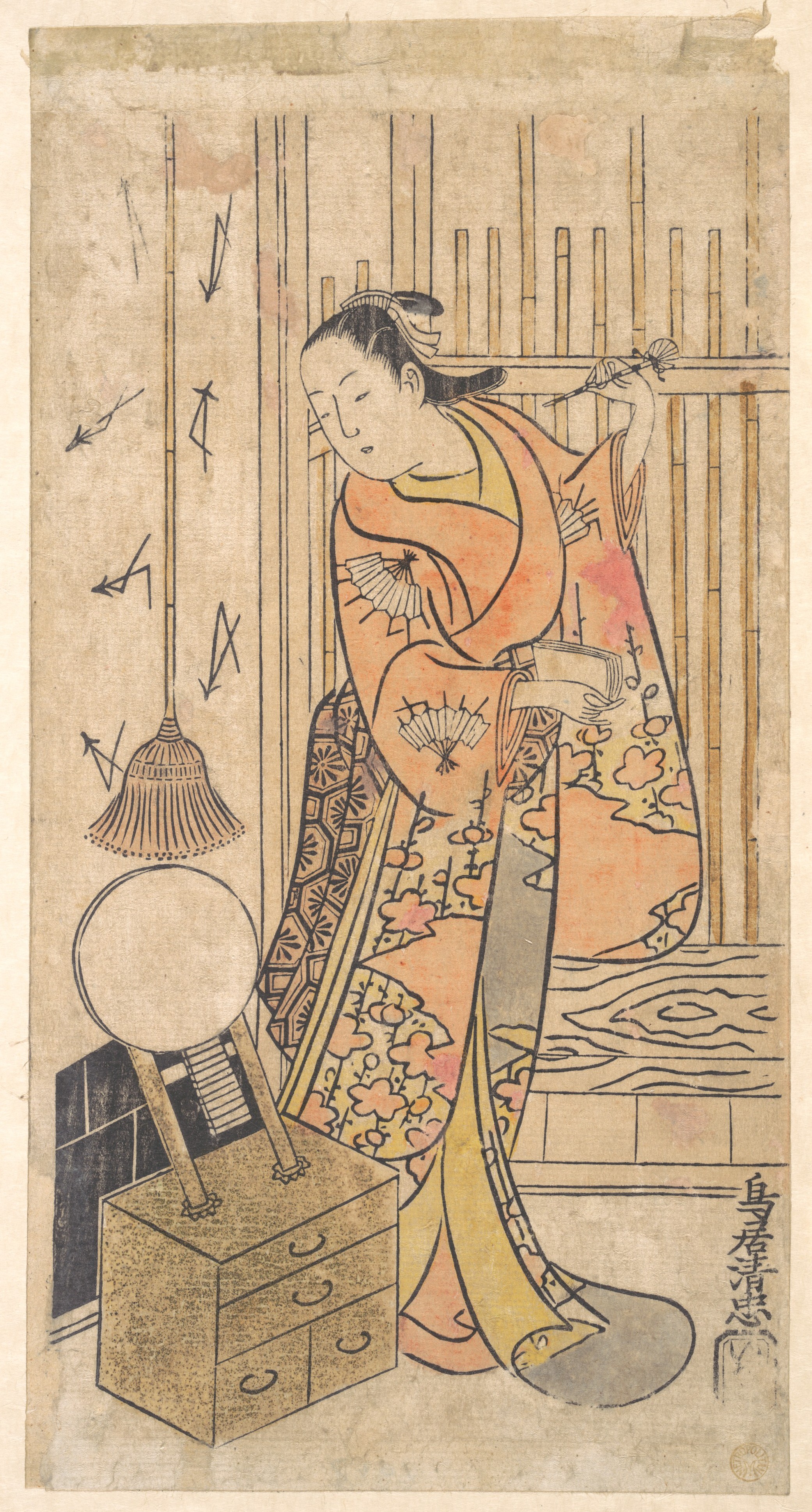
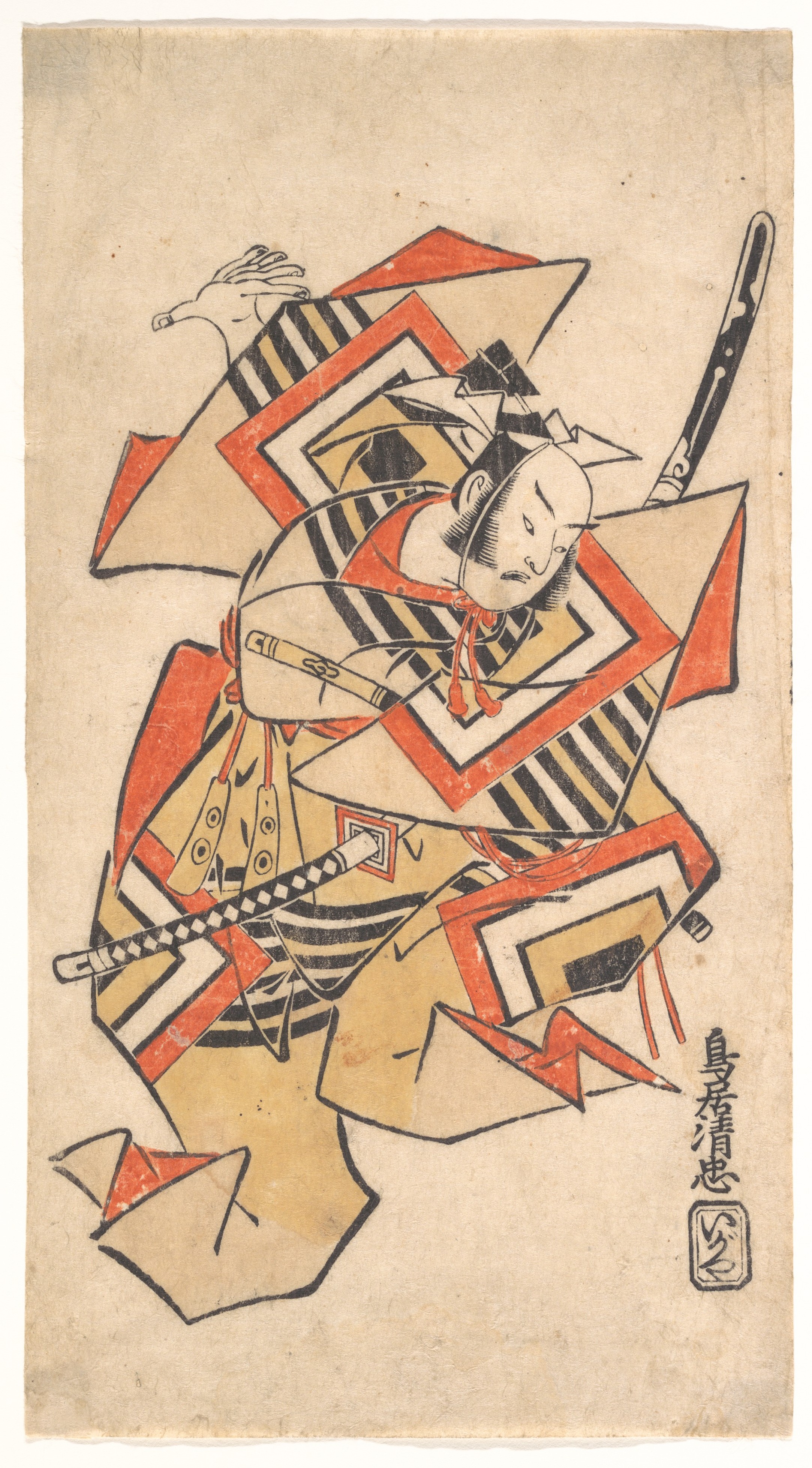
Kiyotada's surviving signed prints are predominantly yakusha-e: single-figure portraits of kabuki actors performed in specific roles on the narrow vertical hosoban sheet that the Torii workshop had codified as its house format. The Metropolitan Museum of Art holds work attributed to him, including a portrait of Ichikawa Danjuro II - the celebrated aragoto specialist - in his signature role of Shibaraku ('Wait a Moment'), one of the most famous bravura pieces in the entire kabuki repertoire. Kiyotada worked in the techniques that defined Edo printing before the introduction of full multi-block colour. His urushi-e ('lacquer prints') used a thick black ink mixed with animal-skin glue or fish-glue to imitate the gleaming surface of black lacquer, often combined with the brushed-on application of metallic dust (brass powder for gold, tin for silver). His tan-e ('orange-red prints') employed the hand-applied red lead pigment tan, the most characteristic colour of early ukiyo-e. The transition from these hand-coloured techniques to the registered two- and three-block benizuri-e of the 1740s and 1750s defines the period of his working life.
The identification of which prints belong to Kiyotada I versus the later Torii artists who took the same name remains one of the more contested questions in ukiyo-e attribution. In the standard reference literature - such as Richard Lane's Images from the Floating World (1978) and the catalogues of Roger Keyes - the early Kiyotada is generally treated as a discrete designer active from around 1720 to about 1750, distinct from later Torii artists who worked under the Kiyotada name through the eighteenth and nineteenth centuries. Later compilers have noted that the boundary between the works of Kiyotada I and his successors is occasionally indistinct, particularly for prints lacking precise theatrical documentation, and some attributions migrate between Kiyotada I, II, and III in successive scholarly publications. Museums vary in their cataloguing practice: the Metropolitan Museum lists the early prints simply as 'Torii Kiyotada, fl. ca. 1720-50' - effectively Kiyotada I without the numeral - while the Art Institute of Chicago catalogues him as 'Torii Kiyotada I,' active in the same period. Both refer to the same designer, the first to bear the name.
Among Kiyotada's most ambitious surviving works are not single-actor portraits but wide-angle architectural and theatrical scenes that show him as one of the early experimenters with perspective in Japanese woodblock printing. His The Main Gate, New Yoshiwara (c. 1745), preserved at the Art Institute of Chicago in the Clarence Buckingham Collection, deploys the European-derived single-point perspective (uki-e) on a wide horizontal toku-oban sheet, depicting the entrance gate of the licensed Yoshiwara pleasure quarter at Asakusa with the receding street and ranks of buildings drawn toward a vanishing point at the centre of the composition. This perspective technique, learned indirectly from Dutch engravings imported through Nagasaki, was a novelty in mid-eighteenth-century Edo print culture, and Kiyotada and a small number of contemporaries (notably Okumura Masanobu) were among its earliest exponents. He applied the same technique to interior scenes, including a celebrated view of the interior of a kabuki theatre (c. 1739-40), among the first large-scale perspective prints produced in Japan.
Kiyotada's signed prints survive today in major holdings of early Torii-school ukiyo-e, including the Art Institute of Chicago (Clarence Buckingham Collection) and the Metropolitan Museum of Art. His prints constitute one of the principal visual records of Edo kabuki during the decades following Ichikawa Danjuro I's establishment of the aragoto style, and the documentary value of his actor portraits - with their identifications of performer and role - makes them useful evidence for the reconstruction of mid-eighteenth-century Edo theatrical practice.
Key Facts
- Nationality
- 🇯🇵Japan
- Movement
- Ukiyo-e
- Works Indexed
- 2
Frequently Asked Questions
Torii Kiyotada I (鳥居清忠, active c. 1720-1750) was a designer of the Torii school of ukiyo-e who specialised in kabuki actor prints in the urushi-e and benizuri-e techniques that dominated Edo polychrome printing in the second quarter of the eighteenth century. He belongs to the generation of Torii pupils who bridged the founders of the school - Torii Kiyonobu I (1664-1729) and Torii Kiyomasu I (active c. 1696-1716) - with the mid-century revival under Torii Kiyonobu II and the school's third head Torii Kiyomitsu (1735-1785). The Torii school had been founded in Edo at the turn of the eighteenth century by Kiyonobu I and Kiyomasu I, whose contracts to design the kanban billboards and printed publicity for the three licensed Edo theatres - the Nakamura-za, Ichimura-za, and Morita-za - established the family's hereditary monopoly on theatrical advertising that would persist for more than a century.
Torii Kiyotada I's work was shaped by the Ukiyo-e tradition in Japanese woodblock printmaking. Ukiyo-e: ## What is ukiyo-e? Ukiyo-e ([浮世絵](/glossary/ukiyo-e)) — literally "pictures of the floating world" — is the Edo-period Japanese print and painting tradition that flourished from roughly 1660 to 1868, depicting the pleasures of urban life in Edo (modern Tokyo): courtesans, kabuki actors, sumo wrestlers, famous landscapes, and seasonal beauties.
Original prints by Torii Kiyotada I can be found in collections including Metropolitan Museum of Art.